Have you ever paused over loath or loathe and wondered which spelling is correct? You are not alone. These two words look almost identical, but they have different meanings and grammatical uses. That small final e can change the word completely.
If you want to spell loath correctly, the key is understanding what the word means and how it works in a sentence. Loath is an adjective meaning unwilling or reluctant, while loathe is a verb meaning to strongly dislike something. This guide explains the loath meaning, the loath or loathe difference, and the most common mistakes in simple language. You will also learn how to spell loathe, understand loath vs loathe, and see why the phrase I would be loathe to is usually written differently. By the end, the loath loathe difference will be easy to remember.
Quick Answer
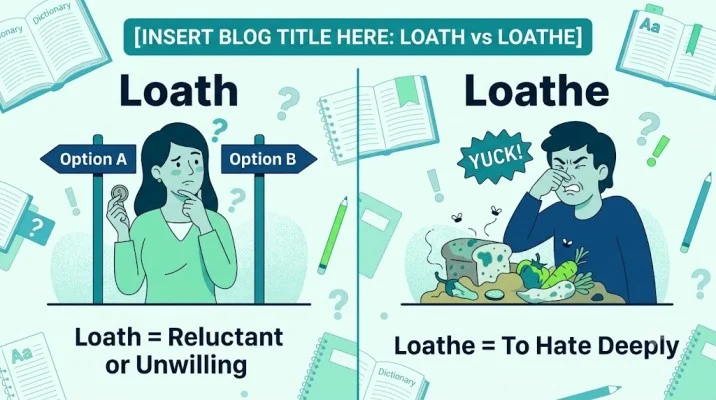
The difference between loath and loathe is simple.
- Loath is an adjective that means reluctant or unwilling.
- Loathe is a verb that means to hate something deeply.
Examples
- I am loath to cancel the meeting.
- I loathe waking up early on weekends.
Remember this trick:
- Loath = unwilling
- Loathe = hate
The Origin of Loath or Loathe
Although loath and loathe look nearly the same, they have different histories.
Origin of Loath
The word loath comes from Old English lāth, meaning unwilling, reluctant, or opposed. It has been used for centuries to describe someone who does not want to do something.
Example:
- She was loath to leave her hometown.
Origin of Loathe
The word loathe developed from the same ancient language but became a verb meaning to hate or feel extreme dislike.
Example:
- They loathe dishonesty.
Why the Confusion Exists
The confusion happens because:
- Both words share almost the same spelling.
- Their pronunciation is very similar.
- Many writers forget that one is an adjective while the other is a verb.
- Spell check usually accepts both words.
British English vs American English Spelling
Unlike many English words, loath and loathe do not have British and American spelling differences.
Both countries use exactly the same spellings and meanings.
| Feature | British English | American English |
|---|---|---|
| Loath | ✅ Correct | ✅ Correct |
| Loathe | ✅ Correct | ✅ Correct |
| Meaning of Loath | Reluctant | Reluctant |
| Meaning of Loathe | Hate deeply | Hate deeply |
| Preferred Spelling | Same | Same |
Examples
British English:
- She was loath to complain.
- I loathe rude behavior.
American English:
- He is loath to admit his mistake.
- We loathe heavy traffic.
Why Is There Confusion Between “Loath or Loathe”?
The confusion is surprisingly common.
Similar Appearance
Only one letter separates the two words.
- loath
- loathe
That extra e changes the word from an adjective into a verb.
Similar Pronunciation
Many speakers pronounce them almost the same, especially during fast conversation.
Grammar Confusion
People often do not realize that:
- Loath describes a person.
- Loathe describes an action.
Typing Errors
Writers often forget the final e while typing quickly.
Autocorrect Problems
Since both spellings are valid, grammar tools may not notice the mistake.
Search Behavior
Many users search loath or loathe because they remember the sound but not the exact meaning.
Which Spelling Should You Use?
The correct choice depends on what you want to say.
Use “Loath” When You Mean Reluctant
Examples:
- I am loath to interrupt.
- She was loath to accept help.
- They were loath to sell the house.
Use “Loathe” When You Mean Hate
Examples:
- I loathe dishonesty.
- He loathes cold weather.
- We loathe wasting time.
For American Writers
Use both words exactly as above.
For British Writers
The same rules apply.
For International English
There is no regional difference.
The meaning—not your location—determines which word you should use.
Common Mistakes with Loath or Loathe
Here are mistakes people make most often.
Mistake 1
❌ I loath homework.
✅ I loathe homework.
Reason:
You are expressing hate, so you need the verb.
Mistake 2
❌ She was loathe to attend.
✅ She was loath to attend.
Reason:
You are describing reluctance.
Mistake 3
❌ They were loathe the new policy.
✅ They loathed the new policy.
Reason:
After a subject, use the correct verb form.
Mistake 4
❌ I am loathe Mondays.
✅ I loathe Mondays.
Reason:
“Hate” requires the verb.
Mistake 5
❌ We were loathe to speak.
✅ We were loath to speak.
Reason:
The sentence describes unwillingness.
Loath or Loathe in Everyday Examples
Understanding real-life examples makes the difference easier.
Emails
Correct:
I am loath to delay the project, but we need more information.
Correct:
I loathe receiving spam emails.
News Writing
Correct:
The minister was loath to comment before the investigation ended.
Correct:
Residents loathe the constant noise.
Social Media
Correct:
I absolutely loathe fake spoilers.
Correct:
I’m loath to leave this vacation.
School Writing
Correct:
The student was loath to answer the question.
Correct:
Many people loathe bullying.
Business Writing
Correct:
Management is loath to increase prices.
Correct:
Customers loathe poor service.
Google Trends & Usage Behavior
People usually search loath or loathe because they know one spelling is correct but cannot remember which meaning belongs to each word.
Common searches include:
- loath meaning
- loathe meaning
- loath vs loathe
- is it loath or loathe
- how to use loath
- how to use loathe
- loath examples
- loathe examples
Many users arrive after receiving grammar corrections while writing emails, essays, reports, or social media posts. Others hear the words in conversation and search online to confirm the correct spelling.
Both words continue to appear in books, journalism, business writing, and academic English, making this confusion relevant for learners and native speakers alike.
Comparison Table – Keyword Variations
| Word | Meaning | Correct Usage | Context |
|---|---|---|---|
| Loath | Reluctant, unwilling | ✅ Correct | Describing feelings |
| Loathe | Hate deeply | ✅ Correct | Expressing strong dislike |
| Loathing | Extreme hatred | ✅ Correct | Noun/Adjective form |
| Loathed | Hated | ✅ Correct | Past tense |
| Loathsome | Causing disgust | ✅ Correct | Adjective |
| Loathly | Reluctantly (rare) | ✅ Correct | Literary English |
Frequently Asked Questions
What is the difference between loath and loathe?
Loath means unwilling or reluctant and works as an adjective. Loathe means to hate something deeply and works as a verb. Although the spellings are similar, they serve different grammatical purposes and cannot replace one another.
Is loath a real English word?
Yes. Loath is a genuine English adjective that has existed for centuries. It describes someone who is reluctant, hesitant, or unwilling to do something. It is less common than loathe, which is one reason people often confuse the two.
Is loathe a real English word?
Yes. Loathe is a common English verb that means to hate someone or something intensely. It is stronger than simply saying “dislike” and is widely used in everyday English, journalism, and literature.
Why do people confuse loath and loathe?
People confuse them because they look almost identical and sound very similar. The only spelling difference is the final e, but that single letter changes the word from an adjective into a verb with a completely different meaning.
Which spelling is correct in English?
Both spellings are correct. Use loath when talking about being reluctant. Use loathe when talking about hatred or strong dislike. The correct choice depends entirely on your intended meaning.
Is there a British or American difference?
No. British English and American English use loath and loathe in exactly the same way. There are no regional spelling differences between the two words.
Can loath and loathe be used interchangeably?
No. They have different meanings and different grammatical roles. Replacing one with the other creates incorrect or confusing sentences, even though both spellings are valid English words.
How can I remember the difference?
Think of the extra E in loathe as standing for Extreme hate. If you mean “hate,” use loathe. If you mean “reluctant,” use loath. This simple memory trick helps many writers avoid mistakes.
Conclusion
Although loath and loathe differ by only one letter, their meanings are completely different. Loath describes someone who is unwilling or reluctant, while loathe means to hate something intensely. Knowing this distinction makes your writing clearer and more professional. Since both words are correct English words, spelling tools may not warn you when you choose the wrong one.
The easiest way to remember the difference is to connect loath with reluctance and loathe with hatred. Once you understand their roles as an adjective and a verb, using the correct word becomes natural and helps you communicate with confidence.
Read More Related Articles:
Fazed or Phased | The Correct Word, Meaning, Examples, and …
Parent or Guardian | Everything You Need to Know Before Filling …
Crain or Crane | Which Spelling Is Correct? Meaning, Usage …