Have you ever typed cacoon or cocoon into a search engine and wondered which spelling is correct? You are not alone. Thousands of people search for this question because the two words sound similar when spoken. A small spelling mistake can make it difficult to find accurate information, especially when writing school assignments, articles, emails, or social media posts.
The confusion usually happens because many people hear the word before they see it written. As a result, they may write cacoon instead of cocoon. The good news is that the answer is simple. In standard English, cocoon is the correct spelling. The word cacoon is generally considered a misspelling.
This guide explains the difference between cacoon or cocoon, their meaning, origin, usage, common mistakes, and practical examples. By the end, you will know exactly which spelling to use and how to avoid confusion in the future.
Quick Answer
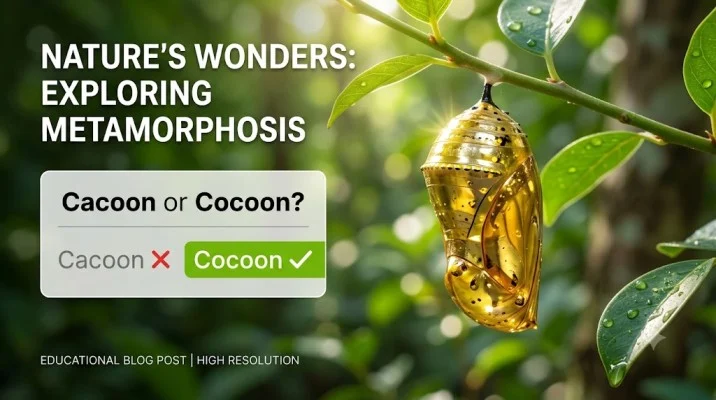
The correct spelling is cocoon.
A cocoon is a protective covering made by certain insects, such as moths and butterflies, during their transformation stage. It can also describe a safe or comfortable environment.
Examples:
- The caterpillar built a cocoon before becoming a moth.
- She felt protected inside her cozy cocoon of blankets.
Cacoon is not the standard English spelling and is usually a typing or spelling error.
The Origin of Cacoon or Cocoon
Understanding where the word comes from helps explain why cocoon is the accepted spelling.
The word cocoon entered English through French. The French word cocon referred to the silky case spun by a caterpillar before it transforms into an adult insect.
Over time, English speakers adopted the word and changed it slightly to cocoon. The spelling became standardized in dictionaries, educational materials, and scientific writing.
Why Does the Confusion Exist?
Several factors contribute to the confusion:
- Similar pronunciation
- Fast typing mistakes
- Limited familiarity with insect-related terms
- Memory-based spelling guesses
- Autocorrect misunderstandings
Since the word contains repeated “o” letters, some people accidentally replace one with an “a” and write cacoon.
Historical Development
The spelling cocoon has remained consistent for centuries. Unlike some English words that have multiple accepted spellings, cocoon has only one standard form in modern English.
Therefore, dictionaries, schools, publishers, and language experts all recognize cocoon as the correct spelling.
British English vs American English Spelling
Many spelling questions exist because British and American English often use different forms.
For example:
| American English | British English |
|---|---|
| Color | Colour |
| Honor | Honour |
| Center | Centre |
| Theater | Theatre |
However, cocoon is different.
Both British English and American English use exactly the same spelling.
Comparison Table
| Language Version | Correct Spelling | Accepted? |
|---|---|---|
| American English | Cocoon | Yes |
| British English | Cocoon | Yes |
| Canadian English | Cocoon | Yes |
| Australian English | Cocoon | Yes |
| New Zealand English | Cocoon | Yes |
Example in American English
- The caterpillar formed a cocoon before emerging as a moth.
Example in British English
- Scientists observed the cocoon throughout the insect’s development.
No major English-speaking country uses cacoon as the correct spelling.
Why Is There Confusion Between “Cacoon” and “Cocoon”?
Many spelling mistakes happen because words sound different from how they look.
1. Pronunciation Similarity
When people hear the word spoken, the vowel sounds may seem unclear. Some listeners assume the first vowel is “a” rather than “o”.
This can lead to:
- Cocoon → correct
- Cacoon → incorrect
2. Typing Errors
Quick typing often causes letter substitutions.
Examples:
- cocoon → cacoon
- cocoon → cocon
- cocoon → coconn
Small keyboard mistakes can create nonstandard spellings.
3. Search Behavior
Many users search using the spelling they believe is correct.
Common searches include:
- cacoon meaning
- cacoon definition
- cacoon spelling
- cacoon or cocoon
Search engines usually understand that users are looking for cocoon.
4. Limited Exposure
Not everyone encounters the word regularly.
People interested in:
- insects
- biology
- nature
- education
are more likely to recognize the correct spelling immediately.
5. Autocorrect Problems
Autocorrect tools sometimes fail to catch unusual misspellings, especially if the word resembles a name or uncommon term.
As a result, the error may remain unnoticed.
Which Spelling Should You Use?
The answer is straightforward.
Use cocoon in every standard writing situation.
For American Audiences
Use cocoon.
Example:
- The insect remained inside the cocoon for several weeks.
For British Audiences
Use cocoon.
Example:
- The cocoon protected the developing moth.
For International Readers
Use cocoon.
Example:
- A cocoon serves as a protective covering during metamorphosis.
In Academic Writing
Always use cocoon.
Example:
- Researchers examined the structure of the cocoon.
In Casual Writing
Use cocoon.
Example:
- I stayed inside my cocoon of blankets all weekend.
No matter where your audience lives, cocoon is the correct choice.
Common Mistakes with Cacoon or Cocoon
Many writers make similar errors. Understanding them can help you avoid future mistakes.
Mistake #1: Replacing the First “O” with “A”
❌ The butterfly emerged from a cacoon.
✅ The butterfly emerged from a cocoon.
Explanation:
The correct spelling starts with “co,” not “ca.”
Mistake #2: Dropping a Letter
❌ The insect stayed in a cocon.
✅ The insect stayed in a cocoon.
Explanation:
The word requires two “o” letters in the middle.
Mistake #3: Adding Extra Letters
❌ The cocooon hung from the branch.
✅ The cocoon hung from the branch.
Explanation:
Adding extra letters creates a spelling error.
Mistake #4: Assuming Both Spellings Are Accepted
❌ Cacoon and cocoon are both correct.
✅ Cocoon is the accepted English spelling.
Explanation:
Only cocoon appears in standard dictionaries.
Mistake #5: Using It Incorrectly as a Verb
❌ He cocooned himself in a cacoon.
✅ He cocooned himself in a cocoon.
Explanation:
Even when used figuratively, the noun remains cocoon.
Cocoon in Science and Nature
A cocoon plays an important role in the life cycle of many insects.
What Is a Cocoon?
A cocoon is a protective case made from silk or other materials.
Its purpose is to:
- Protect the insect
- Support development
- Reduce environmental risks
- Provide safety during transformation
Insects That Create Cocoons
Examples include:
- Moths
- Silkworms
- Certain beetles
- Some parasitic wasps
Cocoon vs Chrysalis
Many people confuse these terms.
| Term | Meaning |
|---|---|
| Cocoon | Protective silk covering made by some insects |
| Chrysalis | Hard pupal stage of butterflies |
A butterfly typically forms a chrysalis.
Many moths create cocoons.
This distinction often surprises people learning about insect development.
Cocoon in Everyday Examples
The word cocoon is not only used in biology. It also appears in everyday conversations, news reports, social media posts, literature, and professional writing. Understanding these examples makes it easier to use the word correctly.
In Emails
Professional and personal emails often use the word figuratively.
Examples:
- The new workspace creates a cocoon of comfort for employees.
- During the storm, we stayed inside our warm cocoon at home.
- The retreat provides a peaceful cocoon away from city life.
In News Articles
Journalists use both the literal and figurative meanings.
Examples:
- Scientists discovered a rare insect cocoon in the forest.
- The child remained in a protective cocoon of family support.
- Researchers studied the cocoon before the moth emerged.
On Social Media
The word appears frequently in lifestyle and nature-related posts.
Examples:
- Weekend plan: stay inside a cocoon of blankets and watch movies.
- Look at this amazing cocoon hanging from a tree branch!
- Nature is incredible. This cocoon will soon become a beautiful moth.
In Formal Writing
Writers often use cocoon as a symbol of growth, protection, and transformation.
Examples:
- The organization created a cocoon of support for new employees.
- The cocoon stage is critical to insect development.
- Education can provide a cocoon where young minds grow safely.
In Books and Literature
Authors often use cocoon as a metaphor.
Examples:
- She wrapped herself in a cocoon of silence.
- The town became a cocoon protecting its traditions.
- His confidence emerged like a butterfly from a cocoon.
In Everyday Conversations
Examples:
- I spent the whole day in a cocoon of blankets.
- The baby slept peacefully in a cocoon-like bed.
- Winter makes me want to stay in my cozy cocoon.
These examples show why cocoon remains a versatile and widely used English word.
Search Trends and Usage Behavior
People search for cacoon or cocoon because they want a quick spelling correction. The majority of searches come from users who have heard the word but are unsure how to write it.
Common Search Intent
Most users searching this phrase want to know:
- Which spelling is correct
- Whether cacoon is a real word
- The meaning of cocoon
- Proper usage in writing
- Differences between the two spellings
Why Typo-Based Searches Happen
Many English words contain double letters, making them difficult to spell correctly.
Examples include:
- Committee
- Accommodation
- Occasion
- Cocoon
Because of this, people often guess the spelling and search for confirmation.
Regional Usage Patterns
English speakers worldwide use cocoon.
The term is common in:
- United States
- United Kingdom
- Canada
- Australia
- New Zealand
- Ireland
- South Africa
The misspelling cacoon appears mainly in search queries rather than published writing.
Educational Searches
Students often search for:
- Cocoon meaning
- Cocoon life cycle
- Cocoon definition
- Cocoon spelling
These searches usually relate to biology lessons and insect development.
Figurative Usage Searches
Many users also search for:
- Cocoon meaning in literature
- Cocoon metaphor
- Cocoon symbolism
In these cases, the word represents protection, growth, comfort, or transformation.
Comparison Table – Keyword Variations
Cacoon vs Cocoon
| Word | Meaning | Correct or Incorrect | Context of Use |
|---|---|---|---|
| Cacoon | No standard English meaning | Incorrect | Usually a spelling mistake |
| Cocoon | Protective covering made by insects | Correct | Biology, nature, education |
| Cocoon | Safe or comfortable environment | Correct | Everyday speech and writing |
Additional Comparison
| Feature | Cacoon | Cocoon |
|---|---|---|
| Found in standard dictionaries | No | Yes |
| Used in scientific writing | No | Yes |
| Used in schools | No | Yes |
| Accepted worldwide | No | Yes |
| Recommended spelling | No | Yes |
Quick Memory Trick
Think of the word:
COCOON = CO + COON
Notice the double “o” pattern.
Remembering the repeated “o” letters makes the correct spelling easier to recall.
Related Words and Terms
Learning related vocabulary can strengthen understanding.
Metamorphosis
The biological process where an insect changes form.
Example:
- The moth underwent metamorphosis inside the cocoon.
Pupa
The developmental stage between larva and adult insect.
Example:
- The pupa remained protected within the cocoon.
Chrysalis
A butterfly’s pupal stage.
Example:
- The butterfly emerged from its chrysalis.
Silk
The material used by many insects to build cocoons.
Example:
- The cocoon was woven from silk fibers.
Transformation
A major change in appearance or condition.
Example:
- The cocoon represents transformation and growth.
Symbolism of the Cocoon
The word cocoon carries powerful symbolic meaning.
Protection
A cocoon protects a developing insect from danger.
Growth
Important development happens inside the cocoon.
Change
The cocoon symbolizes personal transformation.
Renewal
Many cultures associate cocoons with fresh beginnings.
Comfort
People often describe safe environments as cocoons.
Because of these meanings, the word appears frequently in motivational writing, literature, and personal development discussions.
Frequently Asked Questions
1. What is the correct spelling: cacoon or cocoon?
The correct spelling is cocoon. It refers to the protective covering created by certain insects during development. The spelling cacoon is generally considered a mistake and is not recognized as the standard English form. For academic, professional, and everyday writing, always use cocoon.
2. Is cacoon a real word?
In standard English, cacoon is not recognized as a proper dictionary word. Most examples of its use are spelling errors made when people intend to write cocoon. Some uncommon names or local terms may resemble it, but the accepted English word remains cocoon.
3. Why do people confuse cacoon and cocoon?
The confusion usually happens because the words sound similar when spoken. Many people hear the word before seeing it written. Typing mistakes, memory-based spelling guesses, and occasional autocorrect issues also contribute to the confusion between cacoon and cocoon.
4. Which spelling is correct in English?
Across all major forms of English, including American, British, Canadian, and Australian English, the correct spelling is cocoon. There is no accepted regional variation that uses cacoon instead.
5. Is cacoon a typo or a name?
Most of the time, cacoon is simply a typo. People accidentally replace the first “o” with an “a” while typing. While similar spellings may occasionally appear as names or brand names, they are unrelated to the standard English word cocoon.
6. What does cocoon mean?
A cocoon is a protective covering made by certain insects, especially moths, during transformation. The word can also describe a place or situation that feels safe, comfortable, and protected. Both meanings are common in modern English.
7. Is cocoon used outside biology?
Yes. Beyond biology, cocoon is often used figuratively. People describe warm blankets, supportive environments, peaceful homes, or protective situations as a cocoon. The word symbolizes comfort, safety, growth, and transformation.
8. How can I remember the correct spelling of cocoon?
A simple trick is to remember the two “o” letters in the middle of the word. Think about the round shape of a cocoon and associate it with the double “o.” This memory aid helps many people avoid writing cacoon by mistake
Conclusion
The answer to cacoon or cocoon is simple and clear. Cocoon is the correct spelling in standard English and is used worldwide in education, science, professional writing, and everyday communication. The spelling cacoon is usually a typo caused by pronunciation confusion, typing mistakes, or memory-based guessing. Understanding the origin, meaning, and proper usage of cocoon helps writers communicate accurately and confidently. Whether you are discussing insect development, writing a school assignment, posting on social media, or using the word as a metaphor for comfort and protection, cocoon is always the correct choice. Remember the double “o” spelling, and you will avoid this common mistake every time.
Read More Related Articles:
Parent or Guardian | Meaning, Differences, Legal Roles …
Osaka or Kyoto | Which Japanese City Is Better for Your …