Quick Answer:
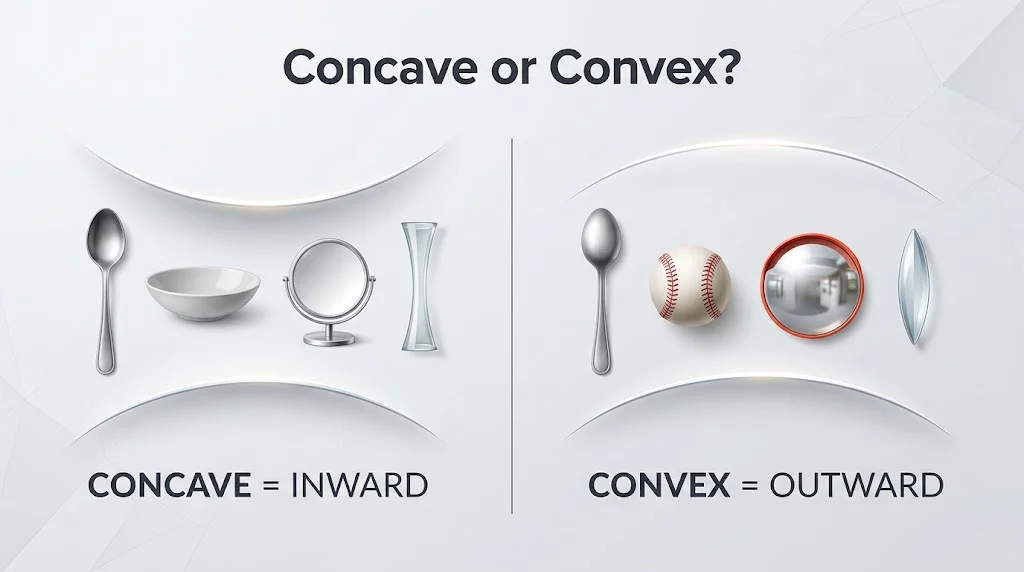
Concave curves or bends inward, like the inside of a bowl. Convex curves or bulges outward, like the outside of a ball. Both are correct words, but they describe opposite shapes.
When you see a curved surface, mirror, lens, or mathematical graph, choosing between concave or convex can feel confusing at first. The two words are often taught together because they describe opposite types of curves, yet their unusual spellings and similar sounds can make them easy to mix up.
This guide makes the difference simple by showing what each word means, where the terms came from, and how to recognize them in real life. Whether you are writing about mirrors, lenses, geometry, or everyday objects, knowing which word describes an inward or outward curve can help you avoid mistakes. By the end, you will have a quick visual rule that makes concave or convex much easier to remember.
The Origin of Concave or Convex
The words concave and convex come from Latin and have been used in English for centuries to describe curved surfaces.
Concave comes from the Latin word concavus, meaning hollowed out or curved inward. Think about the inside of a spoon or bowl. Its surface goes inward, creating a hollow shape.
Convex comes from the Latin convexus, which relates to something rounded or vaulted outward. A simple example is the outside of a ball, where the surface bulges toward you.
The two words became useful in mathematics, science, optics, architecture, and everyday descriptions because they provide precise ways to explain the direction of a curve.
A useful connection is:
Concave = curves inward
Convex = curves outward
The words are not alternative spellings of the same term. They describe opposite shapes.
Concave vs Convex: What Is the Difference?
The easiest way to understand the difference is to focus on the direction of the curve.
A concave surface bends inward. It has a shape similar to the inside of a bowl.
A convex surface bends outward. It has a shape similar to the outside of a ball.
Imagine holding a spoon.
The inside of the spoon is concave because it curves inward.
The back of the spoon is convex because it curves outward.
This simple example can help you remember the difference without memorizing a complicated definition.
| Word | Basic Meaning | Shape | Simple Example |
|---|---|---|---|
| Concave | Curved inward | Hollow or inward | Inside of a bowl |
| Convex | Curved outward | Bulging outward | Outside of a ball |
| Concave lens | Thinner in the middle | Curves inward | Diverging lens |
| Convex lens | Thicker in the middle | Curves outward | Magnifying lens |
| Concave mirror | Reflecting surface curves inward | Hollow side | Makeup or shaving mirror |
| Convex mirror | Reflecting surface curves outward | Bulging side | Vehicle side mirror |
How to Remember Concave and Convex
A simple memory trick can make these words much easier.
Think of a cave.
The word concave contains the sound and letters of cave. A cave goes inward into the ground or rock.
So:
Concave = cave = inward
For convex, imagine something that expands outward or bulges toward you.
Another useful trick is to remember that a convex object resembles the outside of a ball, while a concave object resembles its inside.
You can also use your hand.
Cup your hand like a small bowl. The inside is concave.
Turn your hand over. The rounded outside is convex.
These visual examples are often easier to remember than dictionary definitions.
Concave and Convex in Mirrors
Mirrors are one of the most common places where these terms appear.
A concave mirror has a reflecting surface that curves inward. It can collect and focus light toward a point. Because of this property, concave mirrors are used in several situations where magnification or focused light is useful.
A convex mirror curves outward. It spreads reflected light and gives a wider field of view.
This is why convex mirrors are useful when you need to see a larger area.
For example, mirrors used to help drivers see areas beside or behind a vehicle often use a convex shape. The wider viewing angle can help reveal more of the surrounding area.
The important distinction is:
Concave mirror = curves inward
Convex mirror = curves outward
Concave and Convex Lenses
The same basic idea applies to lenses.
A concave lens curves inward and is generally thinner in the center than at the edges. It causes light rays to spread apart, so it is also called a diverging lens.
A convex lens curves outward and is generally thicker in the center than at the edges. It brings light rays together and is known as a converging lens.
Convex lenses are used in many optical devices, including magnifying glasses and certain types of cameras and microscopes.
Concave lenses are also important in optical systems and are commonly used to help correct particular types of vision problems.
So when you encounter these words in science, remember the shape first. The direction of the curve helps you understand what the lens does.
Concave or Convex in Geometry
In mathematics, concave and convex can describe shapes, curves, sets, and polygons.
A shape is generally described as concave when part of it curves or points inward, creating an indentation.
A convex shape has no inward indentation. Its boundary consistently bulges outward.
Imagine drawing a simple star. The spaces between its points create inward sections, so a typical star shape is concave.
Now imagine drawing a smooth oval. Its boundary does not contain an inward dent, so it is convex.
This distinction becomes more precise in advanced geometry, but the basic visual idea remains useful:
Inward dent = concave
Outward bulge = convex
Common Mistakes with Concave or Convex
One common mistake is treating concave and convex as interchangeable words. They are not.
Incorrect: A bowl has a convex inside surface.
Correct: A bowl has a concave inside surface.
Another mistake is forgetting that an object can have both types of curves.
A spoon is a good example. Its inner surface is concave, while its outer surface is convex.
People also sometimes assume that concave always means smaller and convex always means larger. That is not the best rule. The important feature is the direction of the curve, not simply the size of the object.
Another common mistake is confusing the terms when discussing lenses or mirrors.
Instead of memorizing every application separately, identify the shape first. Once you know whether the surface curves inward or outward, the correct term becomes much easier to choose.
Concave or Convex in Everyday Examples
These words are not limited to classrooms and science books. You can find examples around you.
Concave examples:
- Inside of a bowl
- Inside of a spoon
- Hollow side of a satellite dish
- Concave mirror
- Concave lens
- An inward curve in a shape
Convex examples:
- Outside of a ball
- Back of a spoon
- Rounded surface of a bubble
- Convex mirror
- Convex lens
- An outward curve in a shape
Here are some sentence examples:
The inside of the bowl is concave.
The outside of the ball is convex.
The dentist used a concave mirror to view the area clearly.
A convex mirror can provide a wider field of view.
The lens has a convex surface that bends light toward a focus.
Seeing the words in complete sentences makes their meanings easier to remember.
Concave or Convex in British and American English
There is no spelling difference between British and American English for these words.
Both varieties use:
Concave
Convex
You do not need to change the spelling based on your audience.
| English Variety | Concave | Convex |
|---|---|---|
| British English | Concave | Convex |
| American English | Concave | Convex |
| Canadian English | Concave | Convex |
| Australian English | Concave | Convex |
The difference is therefore not regional. If you are writing a science assignment in the United States or a mathematics textbook in the United Kingdom, the same spellings apply.
Why Do People Confuse Concave and Convex?
The main reason is that the words are usually taught as a pair. Since they describe opposite ideas, learners often remember one definition but attach it to the wrong word.
Their similar structure can also make them difficult to recall quickly.
Another issue is that the words appear frequently in technical subjects. Someone may understand the visual concept but forget which label belongs to which shape.
Pronunciation can add to the problem, especially when someone has mostly encountered the terms in speech rather than writing.
The solution is not to memorize two long dictionary definitions. Instead, connect concave with a cave and an inward curve.
Then treat convex as the outward counterpart.
This gives you a simple mental picture rather than two abstract definitions.
Which One Should You Use?
Both concave and convex are correct English words. The right choice depends entirely on the shape you are describing.
Use concave when something curves inward or has a hollowed surface.
Use convex when something curves outward or bulges toward the outside.
For formal writing, academic work, scientific reports, and technical explanations, use the exact term that matches the shape.
If you are unsure, ask yourself one question:
Does the surface go inward or outward?
If it goes inward, choose concave.
If it goes outward, choose convex.
This approach works in geometry, optics, science, architecture, and everyday descriptions.
Comparison Table: Concave vs Convex
| Feature | Concave | Convex |
|---|---|---|
| Direction | Inward | Outward |
| Appearance | Hollowed | Bulging |
| Simple visual | Inside of a bowl | Outside of a ball |
| Mirror | Curves inward | Curves outward |
| Lens | Usually thinner at center | Usually thicker at center |
| Light behavior | Can spread light in a concave lens | Can bring light together in a convex lens |
| Geometry | Has inward indentation | No inward indentation |
| Memory trick | Cave = inward | Bulge = outward |
FAQs
What is the simple difference between concave and convex?
Concave means curved inward, like the inside of a bowl. Convex means curved outward, like the outside of a ball. The two words describe opposite curve directions and are commonly used in geometry, optics, science, and everyday descriptions.
Is a bowl concave or convex?
The inside of a bowl is concave because its surface curves inward and creates a hollow space. However, the outside of the bowl can be convex if it has a rounded surface. The answer depends on which part of the bowl you describe.
Is a ball concave or convex?
The outside surface of a typical ball is convex because it bulges outward in every direction. A solid ball does not normally have an inward indentation. Therefore, when describing its outer surface, convex is the appropriate term.
Is a spoon concave or convex?
A spoon can be both. The inside of the spoon is concave because it curves inward, while the back of the spoon is convex because it curves outward. This makes a spoon one of the easiest objects for remembering both terms.
How can I remember concave easily?
Connect concave with the word cave. A cave goes inward, so concave means inward-curving. For example, the inside of a bowl is concave. This simple word association is often easier to remember than a technical definition.
What is a convex shape?
A convex shape curves outward and does not contain an inward indentation. A circle, oval, or the outside of a ball can provide simple examples. In geometry, the meaning becomes more precise, but the basic idea remains an outward curve.
What is a concave shape?
A concave shape has an inward section or indentation. A crescent shape and many star shapes provide familiar examples. In simple terms, if part of a shape appears to bend inward rather than smoothly bulge outward, it can be described as concave.
Are concave and convex opposites?
Yes. In basic descriptions of curves, concave and convex represent opposite directions. Concave describes an inward curve, while convex describes an outward curve. Remembering this contrast makes it easier to select the correct word when describing mirrors, lenses, objects, or shapes.
Conclusion
Understanding concave or convex becomes much easier when you stop focusing on the unusual words and look at the direction of the curve. Concave means inward, like the inside of a bowl or spoon. Convex means outward, like the outside of a ball. The same distinction appears in mirrors, lenses, geometry, science, and everyday objects. There is also no British-American spelling difference, so both words keep the same spelling across major varieties of English. When you are unsure, remember the simple connection: concave has a cave inside, while convex bulges outward. Once that visual rule becomes familiar, choosing between these two commonly confused terms becomes quick and natural.
Read More Related Articles:
- Empathetic or Empathic | What’s the Difference and Which …
- Intel or Ryzen| Which CPU Is Better in 2026? Complete …
- Narita or Haneda| Which Tokyo Airport Should You …