Quick Answer:
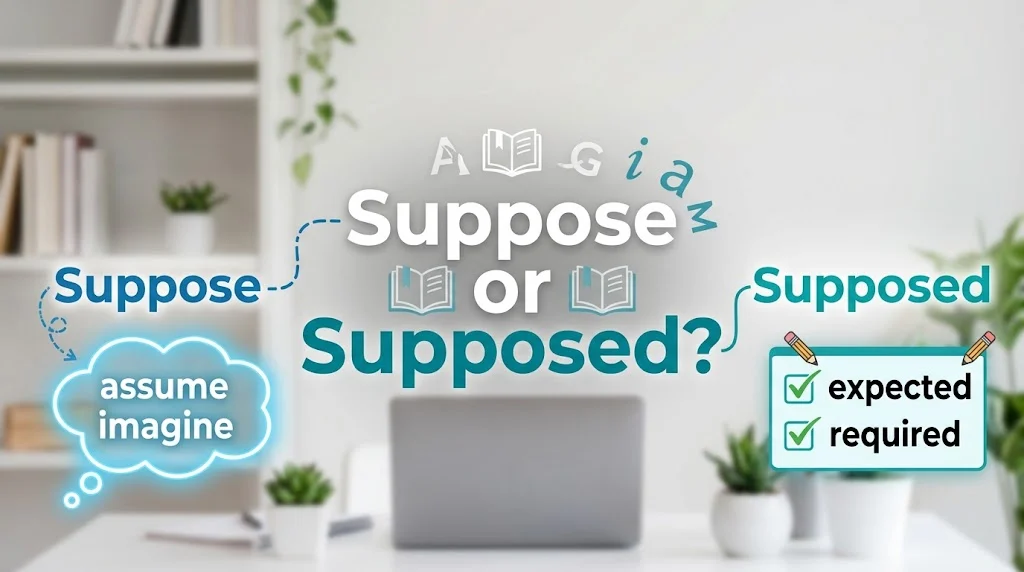
Suppose and supposed are both correct words, but they have different uses. Use suppose as a verb for imagining, assuming, or suggesting; use supposed when describing something expected, intended, or required.
Have you ever stopped while writing and wondered whether to use suppose or supposed? You are not alone. These two words look almost identical, but adding -d changes how the word works in a sentence. The confusion often appears in everyday phrases such as “I suppose,” “supposed to,” and “I supposed.” Because people hear these expressions so often in conversation, it is easy to mix them up when writing.
This guide makes the difference simple. You will learn what suppose means, when supposed is correct, how their grammar works, and how native speakers use both words naturally. Whether you are writing an email, school assignment, message, or formal document, knowing this small difference can make your sentences clearer and more accurate.
The Origin of Suppose or Supposed
The word suppose has an interesting history. It comes from Latin roots that carry the idea of placing something underneath or assuming something as a basis for thought. It entered English through Old French and became part of English vocabulary centuries ago.
Over time, suppose developed several related meanings. It can mean to assume something, imagine a possibility, or accept an idea as likely to be true.
For example:
- I suppose he is busy.
- Suppose we leave early.
- I suppose that makes sense.
Supposed comes from the same word. It is the past participle and past-tense form of suppose. However, English speakers use supposed in another very common structure: supposed to.
The phrase supposed to usually describes an expectation, rule, plan, duty, or intended action.
For example:
- You are supposed to wear a seat belt.
- We were supposed to meet at noon.
- She is supposed to call later.
This is where many learners become confused. They see suppose and supposed in similar sentences, but the grammar and meaning are different.
British English vs American English Spelling
There is no spelling difference between British and American English for suppose or supposed. Both forms are spelled exactly the same in the United Kingdom and the United States.
| Usage | British English | American English | Correct Form |
|---|---|---|---|
| Assume or believe | suppose | suppose | Suppose |
| Past form | supposed | supposed | Supposed |
| Expected to do something | supposed to | supposed to | Supposed to |
| Imagine a situation | suppose | suppose | Suppose |
| Incorrect missing ending | supppose | supppose | Incorrect |
The important difference is not regional spelling. It is grammar and meaning.
If you mean “assume” or “imagine,” suppose is usually the right choice.
If you mean “expected to” or “required to,” use supposed to.
Why Is There Confusion Between Suppose and Supposed?
The main reason for confusion is that the two words sound very similar in everyday speech.
When people speak quickly, the final -d in supposed may not sound strong. This can make suppose and supposed seem almost identical.
Another problem comes from the extremely common phrase supposed to.
People hear:
“You’re supposed to be here.”
Because the phrase is spoken quickly, learners may remember it as something like “you’re suppose to be here.” This leads to one of the most common grammar mistakes in informal writing.
Typing habits can make the problem worse. Someone who frequently writes messages may type suppose to because it matches the way the phrase sounds.
There is also a meaning problem. Both words are connected to the idea of an assumption or expectation, so their meanings can feel closely related.
The easiest solution is to focus on the sentence structure rather than pronunciation.
Suppose = assume or imagine
Supposed to = expected or required
Which Spelling Should You Use?
The right choice depends on what you want to say.
Use suppose when you mean assume, imagine, or believe.
For example:
“I suppose she is at home.”
Here, the speaker is making an assumption.
Use supposed when talking about something that was expected, planned, intended, or required.
For example:
“She was supposed to call me.”
Here, calling was expected.
This difference works in formal and informal writing.
In a formal report, you might write:
“The equipment is supposed to operate within the recommended range.”
In casual conversation:
“I suppose we can go tomorrow.”
For international readers, this distinction is especially useful because supposed to appears frequently in everyday English.
Common Mistakes with Suppose or Supposed
One of the most common mistakes is leaving out the -d in supposed to.
Incorrect: You are suppose to finish this today.
Correct: You are supposed to finish this today.
Another common mistake is using supposed when the sentence needs suppose.
Incorrect: I supposed you are right.
Correct: I suppose you are right.
However, I supposed can be grammatically correct when talking about a past assumption.
For example:
“I supposed he had already left.”
The problem is not that supposed is always wrong. The problem is using it in the wrong grammatical structure.
Another mistake is writing suppose to in formal English when the intended phrase is supposed to.
Incorrect: We are suppose to meet at six.
Correct: We are supposed to meet at six.
A simple test can help:
If you can replace the word with assume, use suppose.
If you can replace it with expected to, use supposed to.
Suppose or Supposed in Everyday Examples
Seeing both words in real sentences makes the difference much easier to remember.
Using suppose for an assumption:
I suppose he knows the answer.
Using suppose for an imagined situation:
Suppose we take the train instead.
Using suppose to show uncertainty:
I suppose it could happen.
Using supposed to describe an expectation:
You are supposed to submit the form today.
Using supposed to describe a plan:
We are supposed to meet after work.
Using supposed to describe a rule:
Students are supposed to follow the instructions.
Using supposed in the past:
I supposed they had already gone home.
In an email:
You are supposed to receive a confirmation message shortly.
In social media:
I suppose that is one way to look at it!
In formal writing:
The new procedure is supposed to reduce processing time.
These examples show why context matters more than appearance.
Suppose vs Supposed: The Grammar Rule Made Simple
A quick grammar trick can make this distinction easier.
Suppose + clause
“I suppose he is tired.”
Here, suppose means I assume or think.
Suppose + subject + verb
“Suppose we leave now.”
Here, suppose introduces an imagined possibility.
Be + supposed to + verb
“She is supposed to arrive soon.”
Here, supposed describes an expectation or arrangement.
Notice the important pattern:
am/is/are/was/were + supposed to + base verb
Examples:
- I am supposed to study.
- He is supposed to call.
- They are supposed to wait.
- We were supposed to leave.
- She was supposed to help.
Do not remove the -d from supposed in this structure.
When Is “I Suppose” Used?
I suppose is one of the most natural expressions in everyday English.
It can show that you agree with something, but perhaps not with strong enthusiasm.
For example:
“I suppose you’re right.”
This can mean “I think you are right,” but the speaker may sound slightly uncertain or reluctant.
It can also introduce an assumption:
“I suppose they will arrive soon.”
In this case, the speaker does not know for certain. They are simply making a reasonable guess.
The phrase can also introduce a conclusion:
“I suppose that’s all we need.”
Because of its flexible meaning, I suppose is common in conversations, novels, interviews, emails, and casual writing.
When Is “Supposed To” Used?
Supposed to is used when something is expected, planned, intended, or required.
For example:
“You are supposed to turn off your phone.”
This can describe a rule.
“We are supposed to meet at 7.”
This describes a plan.
“The package is supposed to arrive tomorrow.”
This describes an expected event.
“She is supposed to be working today.”
This describes an expected situation.
The phrase is also common when something did not happen as expected.
For example:
“The train was supposed to arrive at eight, but it was late.”
This structure is extremely useful because it allows English speakers to explain expectations and plans in a natural way.
Comparison Table: Suppose vs Supposed
| Word or Phrase | Meaning | Correct? | Example |
|---|---|---|---|
| Suppose | Assume or imagine | Correct | I suppose he is busy. |
| Supposed | Past form of suppose | Correct | I supposed he knew. |
| Supposed to | Expected or required | Correct | You are supposed to wait. |
| Suppose to | Incorrect form of supposed to | Incorrect | You suppose to wait. |
| Supposing | Imagining a possibility | Correct | Supposing we miss the train? |
| Supposes | Third-person present form | Correct | She supposes he is ready. |
Search and Usage Behavior
People who search suppose or supposed are often looking for a fast grammar answer rather than a long linguistic explanation. Their intent usually comes from seeing a sentence such as “I am suppose to” and wondering whether it should contain a d.
Another common search pattern comes from pronunciation. Since supposed to is often spoken quickly, learners may type the phrase exactly as they hear it.
Searches can also come from students, workplace writers, English learners, and people checking a message before sending it.
The strongest way to solve this confusion is to connect each form with its main function.
Suppose is linked with an assumption or imagined idea.
Supposed to is linked with an expectation, plan, rule, or duty.
Once this pattern becomes familiar, the difference becomes much easier to recognize.
FAQs
Is suppose to correct English?
No. When you mean that someone is expected or required to do something, the standard phrase is supposed to. For example, write “You are supposed to wait here,” not “You are suppose to wait here.”
Is it I suppose or I supposed?
Both can be correct, but they have different uses. I suppose usually expresses a present assumption or opinion. I supposed refers to an assumption made in the past. Context determines which form fits the sentence.
What is the difference between suppose and supposed?
Suppose usually means assume, believe, or imagine. Supposed can be the past form of suppose, but it is especially common in supposed to, which describes something expected, planned, intended, or required.
Is supposed to grammatically correct?
Yes. Supposed to is a standard and very common English structure. It is used to describe expectations, duties, rules, plans, or intended actions. For example, “You are supposed to arrive at nine” is grammatically correct.
Why do people write suppose to instead of supposed to?
People often write suppose to because the final d in supposed to may be difficult to hear in fast speech. Pronunciation, casual typing, and unfamiliarity with the grammar pattern can all cause this mistake.
Can supposed be used by itself?
Yes. Supposed can function as the past participle of suppose and can also appear in other structures. For example, “The story was supposed to be true.” Its exact meaning depends on the sentence and surrounding words.
What does I suppose mean?
I suppose usually means “I assume,” “I think,” or “I guess.” It can express uncertainty, mild agreement, or an assumption. For example, “I suppose we could leave now” suggests that leaving is one possible choice.
How do I remember suppose to or supposed to?
Remember the phrase as one complete structure: be supposed to + verb. If the sentence means something is expected, planned, or required, use supposed to. For example, “You are supposed to study.”
Conclusion
Understanding suppose or supposed becomes much easier once you focus on meaning rather than pronunciation. Suppose usually means to assume, imagine, or believe something. Supposed is also the past form of suppose, but its most common everyday use appears in supposed to, which expresses an expectation, plan, rule, or duty. The mistake “suppose to” is common because the final sound in supposed to can be easy to miss when people speak quickly. When writing, remember the simple rule: suppose = assume or imagine, while supposed to = expected or required. With this distinction in mind, you can use both forms confidently in casual, academic, and professional English.
Read More Related Articles:
- Empathetic or Empathic | What’s the Difference and Which …
- Intel or Ryzen| Which CPU Is Better in 2026? Complete …
- Narita or Haneda| Which Tokyo Airport Should You …