Have you ever paused while writing an email or article because you couldn’t decide between complementary or complimentary? You’re definitely not alone. Thousands of people search for this every month because these two words look almost identical, sound similar, but have very different meanings. It’s one of the most common English spelling and grammar mistakes.
The confusion often comes from pronunciation and a single extra letter, making it easy to choose the wrong word without realizing it. Even fluent English speakers mix them up in everyday writing.
In this guide, you’ll learn the difference between complementary or complimentary, why people confuse them, when to use each one, and simple examples that make them easy to remember. By the end, you’ll feel confident using the correct word every time so keep reading.
Quick Answer
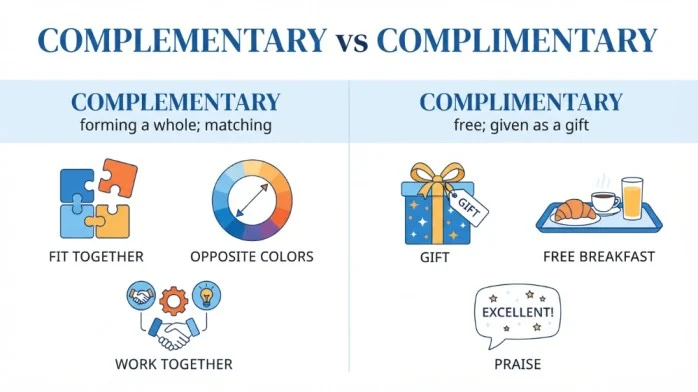
If something completes, matches, or goes well with something else, use complementary.
If something expresses praise, admiration, or is given for free, use complimentary.
Examples
- ✔ Blue and white are complementary colors.
- ✔ This software is complementary to our existing system.
- ✔ Thank you for your complimentary remarks.
- ✔ Guests receive a complimentary breakfast.
Simple trick:
- Complementary = Completes
- Complimentary = Compliment or Free
The Origin of Complementary or Complimentary
Although these two words look alike, they come from different roots and developed different meanings over time.
The Origin of “Complementary”
The word complementary comes from the noun complement, which entered English through Latin.
The Latin word complementum means:
- Something that fills up
- Something that completes
- Something that makes another thing whole
Because of this origin, complementary describes things that improve, complete, or work perfectly together.
Examples include:
- Complementary skills
- Complementary products
- Complementary colors
- Complementary business services
Example
A designer and a programmer have complementary skills because each contributes something different that completes the project.
The Origin of “Complimentary”
The word complimentary comes from compliment.
A compliment is praise, admiration, or polite appreciation.
Over time, another meaning developed in business and hospitality.
When a company gives something without charge, it is considered a polite gesture toward customers.
That is why hotels offer:
- Complimentary breakfast
- Complimentary parking
- Complimentary drinks
The meaning expanded from showing kindness to providing something free.
Why Do These Words Cause Confusion?
Several reasons explain why people mix them up.
They Look Almost the Same
Only one letter separates them.
- Complementary
- Complimentary
Many people overlook this small difference while typing.
They Sound Similar
When spoken quickly, both words sound nearly identical.
This makes it easy to choose the wrong spelling without realizing it.
Both Have Positive Meanings
Each word suggests something good.
For example:
- Complementary products work well together.
- Complimentary tickets are free.
Because both ideas are positive, writers sometimes choose the wrong one.
Spell Check Doesn’t Always Help
Since both words are real English words, spell check usually accepts both spellings.
It cannot tell whether you intended to write about matching things or free items.
British English vs American English Spelling
Unlike many English words, complementary and complimentary are spelled exactly the same in both British English and American English.
There is no spelling difference between the two varieties of English.
The only difference is choosing the correct word based on its meaning.
British English Examples
- These colours are complementary.
- Guests receive complimentary tea.
- Her complimentary comments were appreciated.
- Their services are complementary.
American English Examples
- These colors are complementary.
- Guests receive complimentary coffee.
- His complimentary email made everyone’s day.
- Their products are complementary.
Notice that only colour/colors changes between British and American English—not complementary or complimentary.
British vs American Usage Comparison
| Feature | British English | American English |
|---|---|---|
| Complementary | ✔ Correct | ✔ Correct |
| Complimentary | ✔ Correct | ✔ Correct |
| Meaning Changes | No | No |
| Spelling Difference | None | None |
| Used in Business | Yes | Yes |
| Used in Formal Writing | Yes | Yes |
| Used in Everyday English | Yes | Yes |
Which Word Appears More Often?
Both words are common, but they appear in different situations.
Complementary is common in:
- Education
- Technology
- Science
- Design
- Marketing
- Business
- Healthcare
Examples:
- Complementary services
- Complementary software
- Complementary skills
- Complementary treatments
Complimentary is common in:
- Hotels
- Airlines
- Restaurants
- Customer service
- Reviews
- Professional communication
Examples:
- Complimentary breakfast
- Complimentary drinks
- Complimentary tickets
- Complimentary upgrade
- Complimentary comments
Why Is There Confusion Between Complementary and Complimentary?
Many English learners and even native speakers mix up these words because they are close in spelling and pronunciation. However, the confusion goes deeper than that.
1. Nearly Identical Spelling
Compare them carefully:
- Complementary
- Complimentary
The only noticeable difference is the middle part of each word. When typing quickly, many people accidentally swap one for the other.
2. Similar Pronunciation
Both words have almost the same rhythm and sound.
If you only hear the word in conversation, it can be difficult to know which spelling the speaker intended.
For example:
“I received complimentary tickets.”
“I bought complementary products.”
Without context, the pronunciation offers very little help.
3. Typing Errors
Fast typing often produces mistakes.
Someone may intend to write:
“Our products are complementary.”
but accidentally type:
“Our products are complimentary.”
The sentence suddenly changes meaning.
4. Autocorrect Confusion
Modern keyboards recognize both words because both are correct English words.
Instead of fixing the mistake, autocorrect may leave the wrong word unchanged.
This is why proofreading remains important.
5. Search Behavior
Many people search online using questions such as:
- complementary or complimentary
- complimentary vs complementary
- which spelling is correct
- complementary meaning
- complimentary meaning
- complimentary or complementary breakfast
These searches show that people often know the words are different but need help deciding which one fits their sentence.
Which Spelling Should You Use?
The right spelling depends on what you want to say. Ask yourself one simple question:
Does it mean “works well together” or “free/praising”?
If it means works well together, use complementary.
If it means free or expresses praise, use complimentary.
For Writers in the United States
Use complementary when talking about things that complete or improve each other.
Examples:
- The two software programs are complementary.
- These colors are complementary.
Use complimentary when talking about praise or free items.
Examples:
- The hotel offers a complimentary breakfast.
- She received many complimentary emails.
For Writers in the United Kingdom and Commonwealth Countries
The same rule applies.
Examples:
- These services are complementary.
- Guests receive complimentary tea.
- The manager made complimentary remarks.
For Global Readers
No matter where your audience lives, the meanings stay the same.
Use:
- Complementary = completes, matches, supports
- Complimentary = praise or free
This rule works in formal writing, business documents, blogs, emails, and social media.
Quick Memory Trick
Think of these simple reminders:
- Complement = Complete
- Compliment = Praise
So:
- Complementary → Completes something.
- Complimentary → Gives praise or something free.
Common Mistakes with Complementary or Complimentary
Here are the mistakes people make most often.
Mistake 1: Using Complimentary Instead of Complementary
❌ The two courses are complimentary.
✔ The two courses are complementary.
Why?
The courses work well together. They are not praising each other.
Mistake 2: Using Complementary for Free Items
❌ Every guest receives a complementary drink.
✔ Every guest receives a complimentary drink.
Why?
The drink is free.
Mistake 3: Confusing Praise with Matching
❌ She gave me complementary comments.
✔ She gave me complimentary comments.
Why?
Comments can praise someone.
Mistake 4: Confusing Products and Gifts
❌ These shoes come with a complimentary belt because they match perfectly.
✔ These shoes have a complementary belt design because they match perfectly.
If the belt is free, then complimentary is correct.
Context matters.
Mistake 5: Assuming Both Words Mean the Same Thing
Many people think the words are interchangeable.
They are not.
Choosing the wrong one changes the meaning of the sentence.
Complementary or Complimentary in Everyday Examples
Seeing both words in real situations makes the difference much easier to remember.
In Emails
Complementary
- Our products are complementary and work well together.
- Your experience is complementary to our team’s skills.
Complimentary
- Thank you for your complimentary feedback.
- Please enjoy a complimentary consultation.
In Business
Complementary
- We offer complementary services.
- These departments have complementary responsibilities.
Complimentary
- Every customer receives a complimentary gift.
- The company offers complimentary shipping.
In News Articles
Complementary
- Experts recommend complementary training methods.
- The new bridge has a complementary design.
Complimentary
- Visitors enjoyed complimentary meals.
- The speaker received many complimentary reviews.
On Social Media
Complementary
“Our new phone case is complementary to every model.”
Complimentary
“Visit today for a complimentary coffee!”
In Formal Writing
Complementary
- The two research studies provide complementary evidence.
Complimentary
- The committee made several complimentary remarks about the project.
Search Trends & Usage Behavior
People often search for complementary or complimentary because they know both words exist but are unsure which one fits their sentence.
The most common searches include:
- complementary or complimentary
- complimentary vs complementary
- complementary meaning
- complimentary meaning
- complimentary breakfast meaning
- complementary colors meaning
- complimentary comments
- complementary products
Many searches happen while people are:
- Writing emails
- Preparing reports
- Creating websites
- Studying English
- Editing blog posts
- Writing business documents
Another reason for these searches is that spell check accepts both words. Since both spellings are correct English words, writing tools cannot always detect when the wrong one has been used.
Search interest comes from English speakers worldwide because the meanings remain the same across countries.
Comparison Table
| Feature | Complementary | Complimentary |
|---|---|---|
| Meaning | Completes or matches something | Expresses praise or is given free |
| Based On | Complement | Compliment |
| Correct English Word | Yes | Yes |
| Used for Matching Things | Yes | No |
| Used for Free Items | No | Yes |
| Used for Praise | No | Yes |
| Business Usage | Complementary services | Complimentary gifts |
| Common Example | Complementary colors | Complimentary breakfast |
Frequently Asked Questions
1. What is the difference between complementary and complimentary?
Complementary describes things that complete or match each other. Complimentary refers to praise or something given free of charge. Although the words look similar, they have different meanings and should not be used interchangeably.
2. Which spelling is correct: complementary or complimentary?
Both spellings are correct. The correct choice depends on your meaning. Use complementary for things that go well together and complimentary for praise or free items.
3. Does complimentary always mean free?
No. Complimentary can also mean expressing praise or admiration. For example, someone may make complimentary remarks during a meeting. It does not always refer to free products or services.
4. What does complementary mean?
Complementary means completing, improving, or matching something else. It is commonly used for colors, products, skills, business services, education, and design.
5. Why do people confuse complementary and complimentary?
People confuse them because they look almost identical, sound very similar, and are both correct English words. Fast typing, pronunciation, and spell check also contribute to the confusion.
6. Is a complimentary breakfast free?
Yes. A complimentary breakfast is a breakfast offered at no extra cost. Hotels often include complimentary meals as part of a guest’s stay.
7. What are complementary colors?
Complementary colors are colors opposite each other on the color wheel. They create strong contrast and make each other appear brighter when placed together.
8. How can I remember the difference?
Remember this simple rule:
- Complement = Complete
- Compliment = Praise
If something completes another thing, use complementary.
If it involves praise or something free, use complimentary.
Conclusion
The difference between complementary and complimentary becomes simple once you understand their meanings. Complementary describes things that complete, support, or match each other, while complimentary refers to praise, kind remarks, or something provided free of charge. Although the words look and sound similar, choosing the correct one makes your writing clearer and more professional.
Before using either word, think about your intended meaning. If it is about completing something, choose complementary. If it is about praise or a free service, choose complimentary. Following this simple rule will help you avoid common mistakes and write with confidence in every situation.
Read More Related Articles:
Tortoise or Turtle | What’s the Difference and Which Word …
Cringy or Cringey | Which Spelling Is Correct and When …