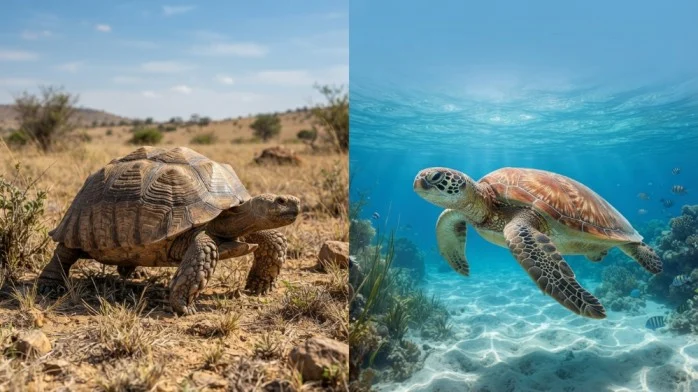
Have you ever wondered whether you should say tortoise or turtle? Many people search for these words because they are unsure if they mean the same animal or if there is an important difference. The confusion is common because both animals have shells, belong to the same reptile family, and look similar at first glance.
The good news is that the difference is easy to understand. A tortoise usually lives on land, while a turtle spends most of its life in water. Knowing which word to use helps you write correctly, speak clearly, and avoid common mistakes. This guide explains the difference, where the words came from, how they are used around the world, and how to choose the right one with confidence.
Quick Answer
A tortoise is a land-dwelling reptile with strong, sturdy legs and a dome-shaped shell. A turtle usually lives in water and has webbed feet or flippers for swimming.
Examples:
- The tortoise slowly walked across the dry field.
- The turtle swam through the lake.
In simple words:
- Tortoise = Lives mostly on land
- Turtle = Lives mostly in water
The Origin of Tortoise or Turtle
The words tortoise and turtle have different histories, even though they describe closely related reptiles.
The word tortoise came into English from the French word tortue, which itself has roots in Medieval Latin. Over time, English speakers used tortoise to describe reptiles that spend their lives on land.
The word turtle comes from the French word tortue as well, but its meaning changed in English. It became the common name for reptiles that live in rivers, lakes, oceans, and other bodies of water.
Because both words share a similar history and both animals belong to the order Testudines, many people think they are the same. In reality, they are different groups of reptiles with different habitats, body shapes, and behaviors.
The confusion also comes from the fact that some countries use the word turtle for nearly every shelled reptile, while others clearly separate tortoises, freshwater turtles, and sea turtles.
British English vs American English Usage
Unlike many English words, there is no spelling difference between British English and American English.
Both countries spell the words exactly the same:
- Tortoise
- Turtle
However, the way people use the words can sometimes differ.
In everyday conversation, many Americans use turtle as a broad term for nearly all shelled reptiles. British speakers are often more likely to use tortoise when talking about land species.
Comparison Table
| Feature | British English | American English |
|---|---|---|
| Spelling | Tortoise | Tortoise |
| Spelling | Turtle | Turtle |
| Land species | Usually called tortoise | Usually called tortoise |
| Water species | Usually called turtle | Usually called turtle |
| Sea species | Sea turtle | Sea turtle |
| Correct spelling | Yes | Yes |
Examples
British English:
- My neighbour keeps a pet tortoise.
- A turtle was swimming near the beach.
American English:
- The zoo has a giant tortoise.
- We watched a turtle cross the road after the rain.
Both forms are correct because there is no spelling difference.
Why Is There Confusion Between Tortoises and Turtles?
Many people mix up these animals because they look alike. Both have shells, move slowly, and belong to the same reptile group.
Here are the main reasons for the confusion.
1. They Look Very Similar
Both animals have hard shells, four legs, and beak-like mouths. Someone seeing one for the first time may not notice the differences.
2. Both Belong to the Same Animal Group
Tortoises and turtles are members of the reptile order Testudines. Because they are closely related, people often assume they are the same.
3. Movies and Cartoons
Many books, cartoons, and movies call every shelled reptile a “turtle,” even when the animal shown is actually a tortoise.
4. Regional Language Habits
Some countries use turtle as a general name for all shelled reptiles. Others separate them into tortoises, freshwater turtles, and sea turtles.
5. Internet Searches
Many users search for tortoise or turtle because they want a quick answer before writing an article, completing homework, buying a pet, or identifying an animal.
6. Similar Appearance When Young
Baby tortoises and baby turtles can look very similar. Without experience, it is difficult to tell them apart.
Easy Way to Remember
Remember this simple rule:
- Tortoise = Land
- Turtle = Water
If it spends almost all of its life on dry land, it is a tortoise.
If it spends most of its time swimming, it is a turtle.
Which Term Should You Use?
Choosing between tortoise and turtle is easy once you know where the animal lives and how it behaves. While both belong to the same reptile family, each word describes a different type of animal.
If You Are Writing for an American Audience
Use tortoise for animals that live on land.
Use turtle for animals that live in freshwater or the ocean.
Examples:
- The giant tortoise walked slowly across the island.
- The turtle swam through the pond.
This is the most common and accepted usage in the United States.
If You Are Writing for a British or Commonwealth Audience
The same rule applies.
British English, Australian English, Canadian English, and New Zealand English all use:
- Tortoise for land species.
- Turtle for water species.
Examples:
- Our pet tortoise enjoys warm weather.
- A turtle was spotted near the coast.
If You Are Writing for a Global Audience
Use the most accurate name whenever possible.
If you know the animal lives on land, write tortoise.
If it lives mainly in water, write turtle.
This makes your writing clear for readers everywhere.
In Formal Writing
Scientific articles, school assignments, books, and reports should always use the correct term.
Correct:
- The tortoise is adapted for life on land.
- The turtle has webbed feet for swimming.
Incorrect:
- Every shelled reptile is a turtle.
In Everyday Conversation
People sometimes say “turtle” for every animal with a shell.
Although many listeners understand the meaning, using the correct word is more accurate.
Quick Tip
Remember this simple guide:
- Tortoise = Land
- Turtle = Water
When in doubt, think about where the animal spends most of its life.
Common Mistakes with Tortoise or Turtle
Many people use these words incorrectly because the animals look alike. Here are some of the most common mistakes.
Mistake 1: Calling Every Shelled Reptile a Turtle
❌ The giant turtle walked across the desert.
✅ The giant tortoise walked across the desert.
Why?
Deserts are home to tortoises, not turtles.
Mistake 2: Calling Sea Turtles Tortoises
❌ We watched several tortoises swimming in the ocean.
✅ We watched several sea turtles swimming in the ocean.
Sea turtles are excellent swimmers.
Mistake 3: Thinking They Live the Same Way
❌ Tortoises spend most of their lives swimming.
✅ Tortoises spend most of their lives on land.
Mistake 4: Ignoring Their Feet
A simple way to tell them apart is by looking at their feet.
Tortoises have:
- Thick legs
- Strong claws
- Elephant-like feet
Turtles have:
- Webbed feet
- Flippers
- Streamlined bodies
Mistake 5: Using the Wrong Word in School Work
Teachers often expect students to use the correct animal name.
Incorrect:
- A turtle lives in dry deserts.
Correct:
- A tortoise lives in dry deserts.
Mistake 6: Believing Every Turtle Can Hide in Its Shell
Many turtles cannot pull their heads and flippers completely inside their shells.
Most tortoises can.
Tortoise or Turtle in Everyday Examples
Using the correct word makes your writing more accurate.
In Emails
Example 1
The zoo recently welcomed a giant tortoise to its reptile exhibit.
Example 2
We rescued a small turtle from the pond yesterday.
In News Articles
- Scientists discovered a rare tortoise species on a remote island.
- Conservation teams released young sea turtles into the ocean.
On Social Media
- Look at this adorable baby tortoise! 🐢
- We spotted a huge turtle while snorkeling today.
In School Assignments
Correct:
The tortoise has thick legs because it walks on land.
Correct:
The turtle has flippers that help it swim.
In Nature Guides
- Desert tortoises survive in hot, dry climates.
- Freshwater turtles live in rivers and lakes.
- Sea turtles spend almost their entire lives in the ocean.
In Children’s Books
The slow tortoise won the race because it never gave up.
The friendly turtle swam happily with colorful fish.
In Wildlife Documentaries
Researchers tracked a giant tortoise across the island.
Marine biologists studied endangered sea turtles along the coastline.
Search Trends & Usage Behavior
Many people search for tortoise or turtle because they want to know the difference between these similar-looking reptiles.
People often ask questions such as:
- Is a tortoise the same as a turtle?
- Which animal lives on land?
- Can turtles live in deserts?
- Are sea turtles actually tortoises?
- Which word should I use?
Searches also increase during:
- School science projects
- Wildlife documentaries
- Zoo visits
- Pet research
- Nature quizzes
Many users first type turtle because it is the more familiar word. After learning that not every shelled reptile is a turtle, they search for tortoise to understand the differences.
Across English-speaking countries, both words are widely recognized. However, turtle is often used more broadly in everyday conversation, while tortoise is preferred when referring specifically to land-dwelling species.
People also search for related terms such as:
- turtle vs tortoise
- tortoise and turtle difference
- land turtle or tortoise
- sea turtle facts
- freshwater turtle
- giant tortoise
- shell reptiles
- reptile identification
Understanding these terms helps readers identify animals correctly and communicate more clearly.
Comparison Table
| Feature | Tortoise | Turtle |
|---|---|---|
| Main Habitat | Land | Water |
| Lives In | Deserts, forests, grasslands | Oceans, lakes, rivers, ponds |
| Feet | Thick, sturdy, elephant-like | Webbed feet or flippers |
| Swimming Ability | Very limited | Excellent swimmer |
| Shell Shape | High, dome-shaped shell | Flatter, streamlined shell |
| Diet | Mostly plants | Plants, insects, fish, or mixed diet depending on species |
| Common Example | Galápagos tortoise | Green sea turtle |
| Best Word to Use | Land species | Water species |
| Correct Usage | ✔ Yes | ✔ Yes |
| Same Animal? | No | No |
Frequently Asked Questions
1. What is the difference between a tortoise and a turtle?
A tortoise lives almost entirely on land and has thick, sturdy legs for walking. A turtle spends most of its life in water and has webbed feet or flippers for swimming. Although they belong to the same reptile order, they have different habitats, body shapes, and lifestyles.
2. Is a tortoise a type of turtle?
Scientists place both tortoises and turtles in the reptile order Testudines. In everyday English, however, they are treated as different groups. A tortoise is a land-dwelling reptile, while the word turtle usually refers to species that live in freshwater or the ocean.
3. Which one lives on land, a tortoise or a turtle?
A tortoise lives mainly on land. It has strong, elephant-like legs that help it walk across dry ground. Most turtles spend much of their lives in water and come onto land mainly to rest, bask in the sun, or lay eggs.
4. Can a tortoise swim?
Most tortoises are not good swimmers. Their heavy shells and sturdy legs are designed for walking, not swimming. Deep water can be dangerous for them. Some tortoises may move through very shallow water, but they should never be treated like aquatic turtles.
5. Can turtles live on land?
Yes. Turtles come onto land for important activities such as basking in the sun, laying eggs, or moving between ponds. However, most turtles depend on water for feeding, swimming, and daily life, unlike tortoises that live almost completely on land.
6. Which is better as a pet, a tortoise or a turtle?
The answer depends on your lifestyle. A tortoise needs a dry, spacious enclosure and can live for many decades. A turtle requires both land and clean water, along with regular tank maintenance. Before choosing either animal, learn about its care needs and long-term commitment.
7. Why do people confuse tortoises and turtles?
People often confuse them because both have shells and belong to the same reptile group. Movies, cartoons, and everyday conversations sometimes call every shelled reptile a turtle. Their similar appearance also makes it difficult for beginners to tell them apart.
8. How can I quickly remember the difference?
A simple trick is to think about where the animal spends most of its life.
- Tortoise = Land
- Turtle = Water
If you remember this rule, you can identify and describe these reptiles correctly in most situations.
Conclusion
Understanding the difference between tortoise or turtle is easier than many people think. A tortoise is built for life on land with strong legs and a high, rounded shell, while a turtle is adapted for water with webbed feet or flippers and a smoother shell. Both are fascinating reptiles, but they live in different environments and have different needs. Using the correct word makes your writing more accurate and helps avoid confusion in school, work, and everyday conversations. Whenever you are unsure, remember the simple rule: tortoise equals land, turtle equals water. This easy tip will help you choose the right term with confidence.
Read More Related Articles:
Imperial or Metric | What’s the Difference and Which …
The Correct Spelling Explained Once and for All in 2026