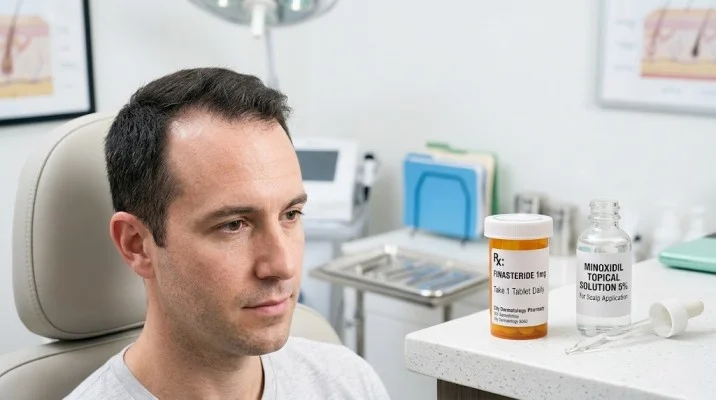
Hair thinning can turn a normal morning routine into a frustrating search for answers. You may notice more hair on your pillow, a wider part, a receding hairline, or a thinner crown. That is when the search for finasteride or minoxidil usually begins. Both are well-known treatments for pattern hair loss, but they do not work in exactly the same way. Finasteride mainly targets DHT, a hormone linked to male pattern hair loss, while minoxidil works directly on the hair-growth cycle.
The real challenge is knowing which option fits your situation. Age, sex, type of hair loss, medical history, and treatment goals all matter. This guide explains the key differences in simple language so you can understand what each medicine does, what to expect, and why a medical professional should help you choose.
Finasteride or Minoxidil?
Finasteride and minoxidil are both used for pattern hair loss, but they work differently. Finasteride reduces the conversion of testosterone into DHT, while minoxidil supports hair growth at the follicle. Finasteride is commonly used for male pattern hair loss, while minoxidil can be used by both men and women depending on the product and situation.
The Origin of Finasteride and Minoxidil
The two names come from different scientific backgrounds.
Finasteride belongs to a group of medicines called 5-alpha reductase inhibitors. Its name reflects its chemical and pharmacological structure rather than a common English word. The medicine became known for its ability to reduce DHT activity in the body.
DHT, or dihydrotestosterone, is produced when testosterone is converted by the enzyme 5-alpha reductase. In people with pattern hair loss, DHT can contribute to the gradual shrinking of susceptible hair follicles. Finasteride reduces this conversion, which can help slow hair loss and support regrowth in some men.
Minoxidil has a different history. It was originally developed as a medicine for blood pressure. Hair growth was later recognized as an effect, leading to its use as a topical treatment for hair loss. It is now available in forms such as solutions and foams for scalp use.
So, these are not two spellings of the same treatment. They are two different active medicines with different mechanisms.
Finasteride vs Minoxidil: What Is the Main Difference?
The easiest way to understand the difference is to look at what each treatment targets.
| Feature | Finasteride | Minoxidil |
|---|---|---|
| Main role | Reduces DHT production | Supports hair growth |
| Common form | Oral tablet | Topical solution or foam |
| Common hair-loss use | Male pattern hair loss | Male and female pattern hair loss |
| Main target | Hormonal pathway | Hair follicle and growth cycle |
| Prescription status | Prescription medicine in many places | Depends on country and product |
| Best known for | Slowing hair loss and maintaining hair | Stimulating or supporting regrowth |
| Suitable for everyone? | No | No |
Finasteride is commonly prescribed as 1 mg once daily for male pattern hair loss, while minoxidil is applied to the scalp according to the specific product instructions.
Neither treatment is guaranteed to work for every person. Hair loss can also have many causes, so identifying the cause is an important first step.
How Does Finasteride Work?
Finasteride works by blocking the enzyme 5-alpha reductase. This lowers the amount of testosterone converted into DHT.
Why does that matter?
In genetically susceptible people, DHT can contribute to the miniaturization of hair follicles. Over time, affected hairs may become thinner and shorter. By reducing DHT, finasteride can help slow this process.
For hair loss, improvement is not instant. The NHS notes that some people may see improvement after 3 to 6 months. Treatment generally needs to continue to maintain its benefit.
Finasteride is generally intended for adult men with appropriate medical guidance. It is not routinely recommended for women or children, and special precautions apply around pregnancy because of the risk associated with exposure to crushed or broken tablets.
How Does Minoxidil Work?
Minoxidil works differently. It is applied directly to the scalp and can help increase hair growth by affecting the hair follicle and growth cycle.
It may increase the size and diameter of hair follicles and prolong the growth phase of the hair cycle.
Topical minoxidil is available in different strengths and forms, including liquid solutions and foam. The correct application schedule depends on the product, so users should follow the package instructions or advice from a healthcare professional.
One important point is easy to miss: more product does not automatically mean better results. Using more than directed can increase the chance of unwanted effects without guaranteeing faster growth.
Why Is There Confusion Between Finasteride and Minoxidil?
People often compare these medicines because both appear in searches about thinning hair and pattern baldness.
The confusion usually comes from the fact that they can be discussed together in hair-loss clinics, articles, forums, and treatment plans. This can make them sound like competing versions of the same medicine.
They are not.
Finasteride mainly changes a hormonal pathway involving DHT, while minoxidil acts on the hair-growth process at the follicle.
Search behavior also adds to the confusion. Someone may search for one medicine after hearing about the other. Another person may type a question such as which is stronger, which is safer, or whether both can be used together.
The correct answer depends on the individual rather than one universal winner.
Which One Should You Use?
There is no single choice that is right for everyone.
For an adult man with male pattern hair loss, finasteride may be considered because it directly reduces DHT, one of the pathways involved in this type of hair loss. A doctor can assess whether it is appropriate based on medical history and risks.
For men or women with certain types of pattern hair loss, minoxidil may be an option. It can be used topically and is available in different formulations.
For women, finasteride requires particular caution and is generally not recommended without specialist medical advice.
If hair loss is sudden, patchy, painful, associated with scalp changes, or difficult to explain, getting a diagnosis is especially important. Not every form of hair loss is pattern baldness.
Common Mistakes When Comparing Finasteride and Minoxidil
Mistake: Thinking they are the same medicine.
They are different medicines with different actions.
Mistake: Expecting overnight regrowth.
Hair follicles follow a slow growth cycle. Results usually take time.
Mistake: Stopping as soon as hair looks better.
These treatments generally need ongoing use to maintain benefits. Hair loss may return after stopping.
Mistake: Assuming a higher dose is always better.
Medicine should be used exactly as prescribed or directed.
Mistake: Ignoring side effects.
Finasteride can cause sexual side effects in some users and has also been associated with mood changes. Minoxidil can cause scalp irritation and other unwanted effects.
Mistake: Treating unexplained hair loss without diagnosis.
Hair shedding can have several causes, including medical conditions, nutritional problems, stress, and other factors.
Finasteride or Minoxidil in Everyday Hair-Loss Questions
Here are some common ways people discuss the two medicines:
In an email:
I would like to speak with a doctor about whether finasteride or minoxidil is appropriate for my hair loss.
In a clinic:
My hair has become thinner around the crown, and I would like to know whether minoxidil or another treatment could help.
In a social media post:
I have been researching finasteride and minoxidil because my hairline has started changing.
In formal writing:
Finasteride and minoxidil are established treatment options for certain forms of pattern hair loss, but their mechanisms and safety considerations differ.
In everyday conversation:
I am trying to understand whether finasteride or minoxidil would make more sense for my type of hair loss.
These examples show why the two names often appear together even though they refer to different medicines.
Usage Insight: What People Search For
Search behavior around these medicines usually reflects decision-making intent, not spelling confusion.
People often want to know:
- Finasteride or minoxidil which is better
- Can finasteride and minoxidil be used together
- Finasteride vs minoxidil for hair loss
- Which works faster
- Which has fewer side effects
- Is minoxidil enough for hair loss
- Does finasteride regrow hair
- How long does minoxidil take to work
- What happens after stopping treatment
These searches reveal an important point: users are usually not looking for a simple definition. They want help making a treatment decision.
That is why a useful comparison should explain how the medicines work, who may use them, how long results can take, and what safety issues matter.
Comparison Table: Finasteride vs Minoxidil
| Point | Finasteride | Minoxidil |
|---|---|---|
| What is it? | A 5-alpha reductase inhibitor | A medicine used to support hair growth |
| Main action | Lowers DHT production | Acts on the hair-growth process |
| Typical hair-loss form | Tablet | Foam or liquid |
| Common use | Male pattern hair loss | Pattern hair loss in men and women |
| How it is used | Usually taken daily when prescribed | Applied to the scalp according to product directions |
| Results | May take several months | May take several months |
| Ongoing use | Usually needed to maintain benefit | Usually needed to maintain benefit |
| Medical advice | Important | Important, especially for unexplained hair loss |
Finasteride’s typical hair-loss dose is 1 mg once daily, while minoxidil schedules vary by formulation and product.
FAQs
What is the difference between finasteride and minoxidil?
Finasteride and minoxidil are different hair-loss medicines. Finasteride reduces the conversion of testosterone into DHT, while minoxidil supports the hair-growth process. Both may help certain types of pattern hair loss, but suitability depends on the person’s age, sex, health, and type of hair loss.
Is finasteride stronger than minoxidil?
It is not accurate to call one universally stronger. Finasteride and minoxidil work through different pathways. Finasteride targets DHT, while minoxidil acts on hair follicles. The better option depends on the cause of hair loss and the person’s medical situation, so professional advice matters.
Can you use finasteride and minoxidil together?
Some treatment plans may include both medicines, but combining them should be discussed with a qualified healthcare professional. They work differently, so using both may be considered in some cases. Do not combine treatments or change doses simply because another person reports good results.
How long does finasteride take to work?
Finasteride does not usually produce immediate visible changes. The NHS states that people using it for hair loss may notice improvement after about three to six months. Continued treatment is generally needed to maintain the benefit, so patience and regular use are important.
How long does minoxidil take to work?
Minoxidil also requires patience because hair grows through a gradual cycle. The exact timeline varies between people and products. Regular use is important, and stopping treatment can cause the benefits to fade. Always follow the instructions for the specific minoxidil product you use.
Is finasteride safe for everyone?
No. Finasteride is not appropriate for everyone. It is generally used in adult men for male pattern hair loss, while women and children usually should not use it unless specifically advised by a specialist. Sexual side effects and mood changes are among important safety considerations.
Can women use minoxidil?
Minoxidil can be used for certain forms of female pattern hair loss, depending on the product and medical advice. It is different from finasteride in this respect. Women with unexplained, sudden, or severe hair loss should seek medical assessment before starting treatment.
What happens if you stop finasteride or minoxidil?
The benefits of these treatments generally depend on continued use. If treatment is stopped, hair loss may return over time. Finasteride guidance specifically notes that hair loss usually comes back after stopping. Minoxidil also needs ongoing use to maintain its effect.
Final Takeaway
Choosing between finasteride or minoxidil is not simply a matter of picking the medicine with the biggest reputation. They work differently and are suited to different situations. Finasteride reduces DHT and is commonly used for male pattern hair loss, while minoxidil supports hair growth and can be used for certain forms of hair loss in both men and women.
Results take time, and continued treatment is usually needed to maintain improvement. Most importantly, unexplained or sudden hair loss should be assessed before treatment begins. A doctor or qualified healthcare professional can identify the likely cause and help you choose the safest approach for your situation.
Read More Related Articles:
Empathetic or Empathic | What’s the Difference and Which …
Aesthetic or Esthetic | Which Spelling Is Correct? …
Naxos or Paros| Which Greek Island Is Better for Your …