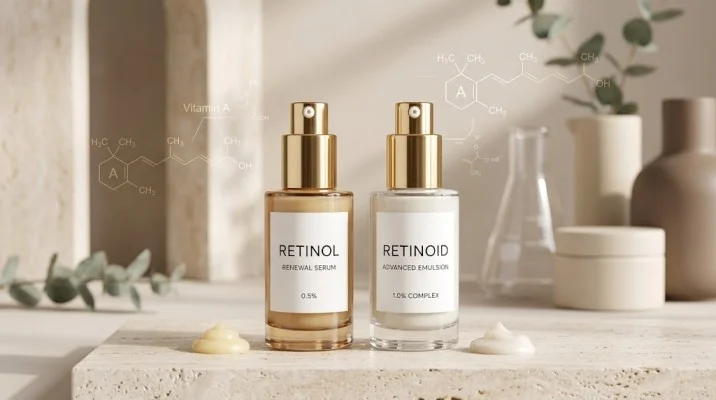
Choosing a skincare product can feel confusing when two terms sound almost identical but do not mean exactly the same thing. Retinol or retinoid is a common search because people see both words on skincare labels, beauty blogs, and product descriptions and want to know whether they are interchangeable. The confusion is understandable: both belong to the same vitamin A family and can support smoother, clearer-looking skin.
However, they are not identical terms. One describes a broader group, while the other refers to a specific type within that group. This guide explains the difference in simple language, clears up common usage mistakes, and shows where each term fits. Whether you are reading a product label or choosing skincare for the first time, you will leave with a much clearer understanding.
Quick Answer
Retinoid is the broad name for vitamin A based skincare ingredients, while retinol is one specific type of retinoid. Retinoids include ingredients such as retinol, retinal, adapalene, tretinoin, and other vitamin A derivatives. Retinol is commonly found in over-the-counter skincare products, while some stronger retinoids may require medical guidance.
The Origin of Retinol and Retinoid
The words retinol and retinoid come from the same scientific family. Their history is connected to retinoic acid and vitamin A, which play important roles in normal skin and cell processes.
The term retinol is linked to retina, reflecting the early scientific connection between vitamin A and vision. The ending -ol is used in chemistry for certain alcohol compounds.
Retinoid is a broader scientific term. The ending -oid generally means something resembling or belonging to a particular group. In skincare and dermatology, retinoid describes vitamin A–related compounds that act through similar biological pathways.
This shared origin explains why the two words look and sound so similar. They belong to the same family, but their meanings are not exactly the same.
A simple way to remember the relationship is:
Retinoid = the larger family
Retinol = one member of that family
That distinction is useful when reading ingredient lists, comparing skincare products, or discussing treatment options with a qualified professional.
British English vs American English Spelling
There is no major British-versus-American spelling difference between retinol and retinoid. Both forms are normally written the same way in British English, American English, Australian English, and other major varieties of English.
| Term | British English | American English | Correct Form |
|---|---|---|---|
| Retinol | retinol | retinol | Correct |
| Retinoid | retinoid | retinoid | Correct |
| Retinoids | retinoids | retinoids | Correct |
| Retinols | retinols | retinols | Correct when referring to multiple products or forms |
The real issue is therefore meaning, not regional spelling.
For example:
- Retinol is a type of retinoid.
- Some retinoids are stronger than typical retinol products.
- Retinol is widely used in cosmetic skincare.
You do not need to change the spelling when writing for readers in the UK or US.
Why Is There Confusion Between Retinol and Retinoid?
The confusion usually starts because the words look nearly identical. Both begin with retin-, and both are associated with vitamin A. A person reading a skincare label may easily assume they are two names for exactly the same ingredient.
Another reason is that skincare companies often use the terms close together. A product may contain retinol and describe itself as a retinoid product. That statement can be broadly correct because retinol belongs to the retinoid family.
Search behavior adds another layer of confusion. People may type one word while looking for information about the other. They may also search phrases such as retinol vs retinoid, retinoid vs retinol, or is retinol a retinoid because they want a quick comparison.
Pronunciation can also contribute. Both words begin with a similar sound, so someone who hears them before seeing them in writing may remember the terms incorrectly.
The important point is that the words are related, but they are not interchangeable in every sentence.
Which Term Should You Use?
Use retinol when you are talking about that specific ingredient.
For example:
- This moisturizer contains retinol.
- I am comparing two retinol creams.
- The product uses retinol as its vitamin A ingredient.
Use retinoid when you mean the wider category.
For example:
- Retinoids are commonly discussed in skincare.
- Different retinoids have different strengths and uses.
- A dermatologist may recommend a particular retinoid.
- For general readers, retinol is often the better term when discussing common non-prescription skincare products. For scientific, medical, or educational writing, retinoid is useful when discussing the entire family.
If you are writing for an international audience, keep the spelling exactly as retinol and retinoid. There is no need to choose a British or American spelling.
Common Mistakes with Retinol and Retinoid
One common mistake is treating the two terms as complete synonyms.
Incorrect idea: Retinol and retinoid always mean exactly the same thing.
Better: Retinol is one type of retinoid.
Another mistake is assuming every retinoid product contains retinol.
Better: Retinoid is a category that includes several different vitamin A–related ingredients.
People also sometimes write retinoal, retinoil, or other forms after hearing the word. These are usually spelling mistakes.
Correct:
This product contains retinol.
Not:
This product contains retinoil.
Another common mistake is using retinoids when discussing one specific ingredient.
Better:
This serum contains retinol.
Use retinoids when discussing multiple members of the vitamin A family or the category as a whole.
Finally, avoid assuming that a stronger-sounding ingredient is automatically better for everyone. Skincare ingredients can work differently depending on the person, product, concentration, and skin tolerance.
Retinol or Retinoid in Everyday Examples
Seeing the words in real sentences makes the difference easier to remember.
In an email:
“I am looking for a moisturizer that contains retinol.”
Here, retinol is the specific ingredient being discussed.
In a skincare article:
“Retinoids are widely studied for their effects on skin cell turnover.”
Here, retinoids refers to the broader group.
In a product description:
“This night serum contains retinol and is designed for an evening skincare routine.”
The sentence refers to one specific ingredient.
In a formal report:
“Retinoids include several vitamin A–related compounds with different properties.”
The broader category is appropriate.
On social media:
“I started using a retinol serum and am learning how to add it to my routine.”
Again, retinol refers to a particular ingredient rather than the entire family.
These examples show why choosing the right word depends on what you are actually describing.
Search Behavior and Usage Insight
People searching these terms usually have one of several intentions.
Some want a simple definition. They may search what is retinol or what is a retinoid.
Others want a comparison. Searches such as retinol or retinoid, retinol vs retinoid, and retinol and retinoid difference usually show that the user wants to understand the relationship between the terms.
Another group is shopping for skincare. They may see both words on product pages and want to know whether one is stronger, different, or more suitable for their needs.
There is also an educational intent. Students, writers, beauty readers, and people researching skincare may want the correct terminology before using it in an article or conversation.
This is why a useful explanation should not simply say that the words are related. It should explain the hierarchy clearly:
Retinoid is the category. Retinol is one member of that category.
That single distinction resolves much of the confusion.
Comparison Table – Retinol vs Retinoid Variations
| Term | Meaning | Correct or Incorrect | Context of Use |
|---|---|---|---|
| Retinol | A specific vitamin A derivative used in skincare | Correct | Product labels, skincare routines, cosmetic discussions |
| Retinoid | A broad family of vitamin A–related compounds | Correct | Medical, scientific, skincare, and educational writing |
| Retinoids | Plural form referring to multiple retinoid compounds | Correct | Research, dermatology, general education |
| Retinols | Plural form sometimes used for multiple retinol products or forms | Correct in suitable contexts | Product or ingredient discussions |
| Retinoil | Not the standard spelling for retinol | Incorrect | Usually a typing or spelling mistake |
| Retinoal | Not the standard term for the skincare ingredient | Incorrect | Usually a spelling mistake |
The key relationship remains simple: every retinol is a retinoid, but not every retinoid is retinol.
FAQs
Is retinol a retinoid?
Yes. Retinol is a type of retinoid. Retinoid is the broader term for vitamin A–related compounds used in skincare and dermatology. Retinol is one specific ingredient within that larger family and is commonly found in over-the-counter cosmetic products.
What is the difference between retinol and retinoid?
Retinol is one specific type of retinoid, while retinoid describes a wider family of vitamin A–related compounds. The terms are closely connected, but they should not always be used as exact substitutes when discussing specific ingredients.
Is retinoid stronger than retinol?
Not necessarily. Retinoid is a category, not one single strength level. Different retinoids have different properties and uses. Some may be stronger or more direct in their action than typical retinol products, but strength depends on the specific ingredient and formulation.
Is retinol the same as tretinoin?
No. Retinol and tretinoin are different vitamin A–related compounds. Both belong to the retinoid family, but they are not the same ingredient. Tretinoin is a prescription medication in many places, while retinol is commonly sold in cosmetic skincare products.
Are retinoids only used for skincare?
No. Retinoids have uses beyond everyday cosmetic skincare. Certain retinoids are used under medical supervision for specific skin conditions and other health-related purposes. The appropriate ingredient depends on the condition, treatment goal, and advice of a qualified healthcare professional.
Which word should I use on a product description?
Use retinol when the product specifically contains retinol. Use retinoid when discussing the wider vitamin A–related ingredient family. This makes the description more precise and helps readers understand exactly what ingredient you mean.
Why do people confuse retinol and retinoid?
People confuse them because the words look and sound similar and both relate to vitamin A. Skincare articles and product labels also frequently use the terms together. Remembering that retinoid is the family and retinol is one member makes the distinction easier.
Is retinol a spelling mistake for retinoid?
No. Retinol is a real and correctly spelled word. Retinoid is also a correctly spelled word. They have different meanings, although both belong to the same vitamin A–related family. The issue is usually confusion about meaning rather than spelling.
Conclusion
The difference between retinol and retinoid becomes much easier once you understand their relationship. Retinoid is the broader family name, while retinol is one specific type within that family. Both words are correctly spelled in British and American English, so this is not a regional spelling issue.
The main challenge is choosing the right term for the meaning you want to express. Use retinol when discussing that specific skincare ingredient, and use retinoid when referring to the wider group. If you remember one simple rule, make it this: retinol is a retinoid, but retinoid does not always mean retinol. That distinction will keep your writing accurate and your skincare research much clearer.
Read More Related Articles:
Empathetic or Empathic | What’s the Difference and Which …
Aesthetic or Esthetic | Which Spelling Is Correct? …
Naxos or Paros| Which Greek Island Is Better for Your …