You are writing an email, describing a caring friend, or polishing an important report when you suddenly pause. Should you write empathetic or empathic? Since both words seem correct and appear in dictionaries, it’s easy to wonder if one is wrong or if they mean different things.
Many English learners, students, professionals, and writers search for empathetic or empathic because the two words look almost identical and are often used in similar situations. This uncertainty can make anyone second-guess their writing.
This guide explains the difference in simple language. You’ll learn each word’s meaning, origin, usage, regional preferences, common mistakes, and practical examples so you can confidently choose the right word every time.
Quick Answer
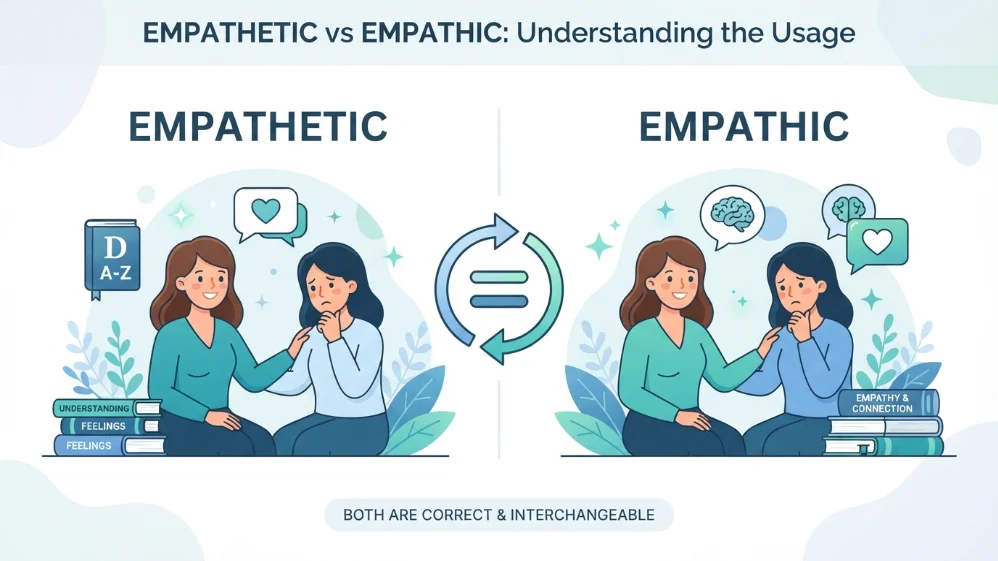
Both empathetic and empathic are correct English words. They have the same core meaning: being able to understand and share another person’s feelings. However, empathetic is far more common in everyday English, while empathic is often preferred in psychology, counseling, and academic writing.
Examples:
- She gave an empathetic response to her friend’s problems.
- The therapist remained empathic throughout the session.
The Origin of “Empathetic or Empathic”
The words empathic and empathetic both come from the noun empathy, which entered English in the early 1900s. The word empathy itself comes from the Greek roots:
- en = in
- pathos = feeling or emotion
Originally, empathic appeared first as the adjective related to empathy. Later, English speakers naturally formed empathetic, following the pattern of other adjectives like:
- sympathetic
- energetic
- athletic
Over time, empathetic became the preferred everyday choice because it sounded more familiar to English speakers. Today, both forms are accepted by major dictionaries.
British English vs American English Usage
Unlike many English words, this is not a British versus American spelling difference. Speakers in both countries understand and use both words.
The main difference is frequency, not correctness.
| Feature | British English | American English |
|---|---|---|
| Empathetic | Very common | Very common |
| Empathic | Common in psychology and formal writing | Common in psychology and research |
| Correct? | Yes | Yes |
| Everyday preference | Empathetic | Empathetic |
| Academic preference | Empathic or Empathetic | Empathic or Empathetic |
Examples
British English
- She was very empathetic toward her colleagues.
American English
- The doctor showed an empathetic attitude.
- Researchers described the counselor as highly empathic.
Why Is There Confusion Between “Empathetic or Empathic”?
Several reasons explain why people search for this pair of words.
Both Words Are Correct
Most spelling questions involve one correct word and one incorrect one. Here, both words are valid, making the choice less obvious.
They Have Nearly the Same Meaning
Since they describe understanding another person’s emotions, many writers assume they are interchangeable.
Similar Pronunciation
The words sound almost identical in everyday speech. The extra syllable in empathetic is often spoken quickly.
Different Writing Styles
Psychology books often use empathic, while newspapers, blogs, and business writing usually use empathetic.
Search Behavior
People often type empathetic or empathic because they want confirmation before submitting school work, professional documents, or emails.
Which Spelling Should You Use?
The best choice depends on your audience.
For Everyday Writing
Choose empathetic.
It sounds more natural and is the version most readers expect.
Examples include:
- emails
- blogs
- websites
- business communication
- school assignments
For Psychology or Academic Writing
Empathic is common in fields like:
- psychology
- counseling
- psychiatry
- social work
- behavioral science
Many research papers use empathic listening or empathic response.
For International Readers
If your audience includes readers from different countries, empathetic is usually the safest choice because it is more familiar worldwide.
Formal Writing
Either word is acceptable if you stay consistent throughout the document.
Common Mistakes with “Empathetic or Empathic”
Here are mistakes writers frequently make.
| Incorrect | Correct | Explanation |
|---|---|---|
| She is very empathy. | She is very empathetic. | “Empathy” is a noun. |
| He gave an empathy answer. | He gave an empathetic answer. | Use the adjective form. |
| Empathic means sympathy. | Empathic means understanding another person’s feelings. | Empathy and sympathy are different ideas. |
| Empathetic is wrong. | Empathetic is correct. | Both adjectives are accepted. |
| Only empathic is correct. | Both are correct. | Usage depends on context. |
Remember
- Empathy = noun
- Empathic = adjective
- Empathetic = adjective
“Empathetic or Empathic” in Everyday Examples
Emails
Thank you for your empathetic response during a difficult time.
Workplace
A good manager should be empathetic toward employees.
News
The mayor gave an empathetic speech after the disaster.
Psychology
The counselor used empathic listening techniques.
Social Media
I appreciate everyone who left such empathetic comments.
School Writing
Teachers should create an empathetic learning environment.
Healthcare
Nurses often build trust by being empathetic with patients.
Customer Service
An empathetic reply can calm an unhappy customer.
Google Trends and Usage Behavior
People search for empathetic or empathic because both words are correct, yet they appear in different types of writing. Many users want to know whether one is more accurate, more professional, or more widely accepted.
Common search intent includes:
- Which word is correct?
- Is empathetic better than empathic?
- Do the words have different meanings?
- Which form should I use in formal writing?
- Is one word American and the other British?
Search behavior also shows that many users encounter one word in books, articles, or conversations and then search online to compare it with the other. Students, writers, teachers, and professionals often verify the difference before publishing important content.
In general:
- Empathetic appears more often in everyday communication.
- Empathic appears more frequently in psychology, counseling, and academic writing.
- Both words are recognized by modern dictionaries and are considered correct.
Comparison Table
| Word | Meaning | Correct or Incorrect | Best Context |
|---|---|---|---|
| Empathetic | Able to understand and share another person’s feelings | ✔ Correct | Everyday writing, blogs, business, education |
| Empathic | Able to understand and share another person’s feelings | ✔ Correct | Psychology, counseling, academic writing |
| Empathy | The ability to understand another person’s feelings | ✔ Correct | Noun |
| Sympathetic | Showing care or concern for someone | ✔ Correct | Different meaning from empathy |
| Empathetically | In an understanding and caring way | ✔ Correct | Adverb |
| Empathically | In an empathic manner | ✔ Correct | Academic and professional writing |
Empathetic vs Empathic
| Feature | Empathetic | Empathic |
|---|---|---|
| Correct English word | ✔ Yes | ✔ Yes |
| Meaning | Understanding another person’s emotions | Understanding another person’s emotions |
| Everyday use | Very common | Less common |
| Academic use | Common | Very common |
| Psychology | Used | Frequently preferred |
| Business writing | Excellent choice | Acceptable |
| Emails | Recommended | Acceptable |
| News articles | Very common | Less common |
| Easy for general readers | ✔ Yes | ✔ Yes |
Frequently Asked Questions
What is the difference between empathetic and empathic?
Both words describe someone who understands another person’s emotions. The main difference is usage rather than meaning. Empathetic is more common in everyday English, while empathic appears more often in psychology, counseling, and academic writing. Both are correct and accepted.
Is empathetic the correct spelling?
Yes. Empathetic is a correct English adjective recognized by major dictionaries. It is the version most people use in everyday speech, business communication, education, and online writing.
Is empathic a real word?
Yes. Empathic is a genuine English word. It has been used for many years and remains common in psychology, therapy, and research. Although it is less frequent in everyday writing, it is completely correct.
Which word is more common, empathetic or empathic?
Empathetic is generally more common in daily communication. Newspapers, websites, emails, and business documents often use this form. Empathic is still widely used, especially in professional and academic settings related to mental health.
Should I use empathetic in formal writing?
Yes. Empathetic works well in formal writing, reports, presentations, and professional communication. If you are writing for a psychology or counseling audience, empathic may also be appropriate depending on the style guide.
Are empathetic and empathic interchangeable?
In most situations, yes. They share the same basic meaning and can often replace one another without changing the sentence. However, empathic is slightly more common in academic discussions about psychology and emotional behavior.
Is empathetic American and empathic British?
No. Both British and American English accept empathetic and empathic. The difference is not based on country but on writing style and context. Empathetic is simply the more common choice in everyday English worldwide.
Which word should students and writers use?
For school assignments, blogs, emails, articles, and general writing, empathetic is usually the safest choice because it is familiar to most readers. If you are writing about psychology or counseling, empathic may better match the subject.
Final Thoughts
Choosing between empathetic or empathic is easier once you know that both words are correct. They share the same meaning and describe the ability to understand another person’s feelings. The biggest difference is how often each word is used. Empathetic is the preferred choice for everyday conversations, business communication, education, and online content because it feels more natural to most readers. Empathic remains an excellent option in psychology, counseling, and academic writing. By understanding the context and your audience, you can confidently select the word that fits your writing and avoid unnecessary confusion.
Read More Related Articles:
Christening or Baptism| What’s the Difference and Which …
Fiending or Feening| Which Word Is Correct? Meaning …