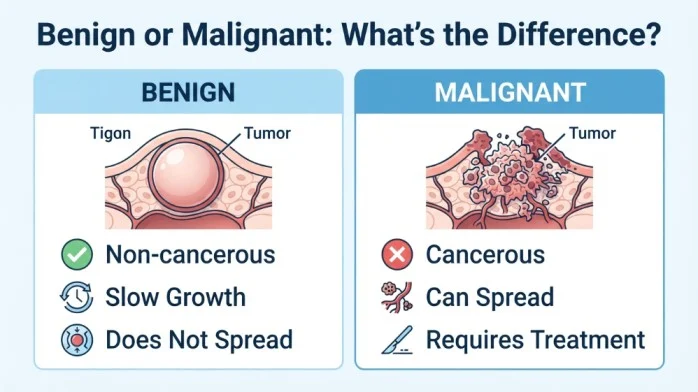
Have you ever heard a doctor say a lump is benign or malignant and wondered what those words really mean? Many people search for benign or malignant because they want to understand a medical report, test result, or diagnosis. These two terms sound similar, but they have very different meanings.
Knowing the difference can help you better understand your health and ask the right questions during medical visits. While both words describe tumors or abnormal growths, only one is linked to cancer. This guide explains the meaning of benign or malignant in simple language. You will also learn where these words came from, why people confuse them, and how they are used in medical and everyday writing.
Quick Answer
A benign tumor is not cancer. It usually grows slowly, stays in one place, and does not spread to other parts of the body.
A malignant tumor is cancer. It can grow into nearby tissues and spread to other parts of the body through the blood or lymph system.
Simple Examples
- A benign skin lump may need little or no treatment.
- A malignant breast tumor requires medical care because it can spread.
The easiest way to remember the difference is this:
- Benign = Not cancer
- Malignant = Cancer
What Does Benign Mean?
The word benign describes a condition, growth, or tumor that is not harmful in the way cancer is. A benign tumor stays in one place and usually grows slowly.
Many benign tumors never become dangerous. Some do not even need treatment unless they cause pain, pressure, or other problems.
Common Features of a Benign Tumor
- Not cancer
- Grows slowly
- Does not spread to other organs
- Often has clear borders
- May only need monitoring
Examples of Benign Conditions
- Lipoma (fatty lump)
- Uterine fibroids
- Skin moles
- Benign cysts
- Benign thyroid nodules
A doctor may recommend regular checkups to make sure the growth stays harmless.
What Does Malignant Mean?
The word malignant describes a tumor that is cancerous. These tumors grow without normal control and may invade nearby tissues.
Cancer cells can also travel to other parts of the body. This process is called metastasis.
Because malignant tumors can spread, they usually require treatment.
Common Features of a Malignant Tumor
- Cancerous
- May grow quickly
- Invades nearby tissue
- Can spread through the body
- Usually requires treatment
Examples of Malignant Conditions
- Breast cancer
- Lung cancer
- Colon cancer
- Skin melanoma
- Brain cancer
Doctors may treat malignant tumors with surgery, radiation therapy, chemotherapy, targeted therapy, or other treatments.
Benign vs Malignant at a Glance
| Feature | Benign | Malignant |
|---|---|---|
| Cancer | No | Yes |
| Growth Speed | Usually slow | Often faster |
| Spread to Other Organs | No | Yes |
| Invades Nearby Tissue | No | Yes |
| Life-Threatening | Usually not | Can be |
| Treatment Needed | Sometimes | Usually |
This table shows the biggest difference. A benign tumor stays where it starts, while a malignant tumor can spread and damage other parts of the body.
The Origin of Benign or Malignant
Understanding where these words come from can make them easier to remember.
Origin of “Benign”
The word benign comes from the Latin word benignus.
It means:
- Kind
- Gentle
- Favorable
- Harmless
Doctors began using benign many years ago to describe diseases or tumors that were not aggressive.
Today, it still means a condition that is generally harmless compared with cancer.
Origin of “Malignant”
The word malignant comes from the Latin word malignus.
It means:
- Harmful
- Dangerous
- Bad
- Causing damage
Medical experts use this word to describe cancer because cancer cells can damage healthy tissue and spread throughout the body.
Why These Words Sound Confusing
Many people mix up benign and malignant because:
- They are often used together.
- Both describe tumors.
- Both appear in medical reports.
- They are unfamiliar medical words.
- Many people hear them before they read them.
For someone receiving test results, the words may sound similar even though they have opposite meanings.
A simple memory trick is:
- Benign = Better
- Malignant = Mean
While this trick is not a medical definition, it helps many people remember which word is associated with cancer.
British English vs American English Usage
Unlike words such as colour and color, there is no spelling difference between benign and malignant in British English and American English.
Doctors, hospitals, universities, and medical journals around the world use the same spellings.
Comparison Table
| Feature | British English | American English |
|---|---|---|
| Benign | ✔ Benign | ✔ Benign |
| Malignant | ✔ Malignant | ✔ Malignant |
| Medical Meaning | Same | Same |
| Pronunciation | Nearly identical | Nearly identical |
| Correct Medical Spelling | Benign / Malignant | Benign / Malignant |
Whether you are reading a medical report from the United States, the United Kingdom, Canada, Australia, or New Zealand, you will see the same spellings.
Why Do People Confuse Benign and Malignant?
People rarely confuse the spelling of these words. Instead, they confuse their meanings.
Here are the most common reasons.
1. Both Words Appear Together
Doctors often explain results by saying a growth is either benign or malignant.
People hear the pair so often that they may forget which one means cancer.
2. Medical Language Can Feel Difficult
Most people do not use these words in everyday conversation.
When they first see them in a medical report, they may not know what they mean.
3. Stress During Medical Visits
People often learn these words while waiting for test results.
Stress and worry can make it harder to remember the difference.
4. Similar Medical Context
Both words describe:
- Tumors
- Lumps
- Growths
- Biopsy results
- Medical imaging reports
Because they are used in the same situations, people sometimes think they have similar meanings.
5. Online Searches
Many users search questions such as:
- benign or malignant
- benign meaning
- malignant meaning
- benign vs malignant
- is benign cancer
- is malignant always cancer
These searches show that people are looking for a quick, trustworthy explanation.
Easy Ways to Remember the Difference
Here are simple tricks that many people find helpful.
Remember “Benign”
Think of Benign = Better.
A benign tumor is not cancer and usually stays where it is.
Remember “Malignant”
Think of Malignant = Mean.
A malignant tumor behaves aggressively and can spread through the body.
Think About Treatment
A benign tumor may only need observation.
A malignant tumor often needs treatment such as surgery, medicine, radiation therapy, or chemotherapy.
Compare Them Side by Side
| Benign | Malignant |
|---|---|
| Not cancer | Cancer |
| Usually slow | Often faster |
| Does not spread | Can spread |
| Less dangerous | More dangerous |
| Often monitored | Usually treated |
Keeping this simple comparison in mind makes it much easier to understand medical reports and discussions.
Why Knowing the Difference Matters
Understanding the meaning of benign or malignant helps you:
- Better understand biopsy results.
- Read medical reports with more confidence.
- Ask informed questions during doctor visits.
- Reduce confusion when reading health information.
- Support family members who receive a diagnosis.
Remember that only a qualified healthcare professional can determine whether a growth is benign or malignant through proper medical evaluation and testing. Reading about these terms can improve your understanding, but it should never replace professional medical advice or diagnosis.
Which Term Should You Use?
The correct word depends on the medical condition being described. Benign and malignant are not different spellings of the same word. They have different meanings.
A doctor chooses the term after examining a lump, growth, or tumor through medical tests, imaging, or a biopsy.
If You Are Writing for a U.S. Audience
Use the same medical terms:
- Benign
- Malignant
Examples:
- The biopsy showed the lump was benign.
- The patient began treatment after doctors confirmed the tumor was malignant.
If You Are Writing for a U.K. Audience
British English uses the same spellings.
Examples:
- The scan found a benign cyst.
- Further tests confirmed a malignant tumor.
If You Are Writing for an International Audience
Use benign and malignant because they are accepted medical terms worldwide. They are understood by doctors, researchers, hospitals, and health organizations across English-speaking countries.
Formal Writing
These words are commonly used in:
- Medical reports
- Hospital records
- Research papers
- Health articles
- Educational materials
Example:
The laboratory report identified the growth as benign, with no evidence of cancer.
Informal Writing
You may also see these words in everyday conversations about health.
Example:
- My doctor said the lump is benign, so I don’t need to worry.
- The family is waiting for the biopsy results to learn whether the tumor is malignant.
Always use these words correctly because they describe important medical conditions.
Common Mistakes with Benign or Malignant
Many people misunderstand these terms. Here are the most common mistakes and the correct explanations.
Mistake 1: Thinking Benign Means Small
❌ Incorrect:
The lump is small, so it must be benign.
✅ Correct:
A benign tumor is not defined by its size. Some benign tumors can become quite large.
Mistake 2: Thinking Malignant Always Means Large
❌ Incorrect:
A small tumor cannot be malignant.
✅ Correct:
Some malignant tumors are very small when first discovered. Even small cancers require medical attention.
Mistake 3: Believing Every Tumor Is Cancer
❌ Incorrect:
Every tumor is malignant.
✅ Correct:
Many tumors are benign. A tumor simply means an abnormal growth.
Mistake 4: Assuming Benign Means No Treatment
❌ Incorrect:
Benign tumors never need treatment.
✅ Correct:
Some benign tumors are removed if they cause pain, pressure, bleeding, or affect nearby organs.
Mistake 5: Using the Words Interchangeably
❌ Incorrect:
The doctor said the lump is benign, so it is cancer.
✅ Correct:
Benign means not cancer.
Malignant means cancer.
Mistake 6: Guessing Without Medical Tests
❌ Incorrect:
The lump feels soft, so it must be benign.
✅ Correct:
Only a healthcare professional can determine whether a growth is benign or malignant using appropriate medical tests.
Mistake 7: Ignoring Follow-Up Care
❌ Incorrect:
My tumor is benign, so I never need another checkup.
✅ Correct:
Doctors sometimes recommend follow-up visits to monitor benign growths.
Benign or Malignant in Everyday Examples
These words appear in many real-life situations.
In Emails
Example 1
Hello Dr. Ahmed,
Thank you for explaining that the biopsy showed a benign growth. I appreciate your guidance regarding future checkups.
Example 2
The specialist confirmed that the tumor is malignant, and treatment will begin next week.
In Hospital Reports
Example:
The examination found a benign thyroid nodule with no signs of cancer.
Example:
Laboratory testing confirmed a malignant breast tumor requiring additional treatment.
In News Articles
Example:
Researchers are developing new methods to identify malignant tumors earlier.
Example:
Doctors successfully removed a benign brain tumor, and the patient recovered well.
On Social Media
Example:
I’m thankful my biopsy showed the lump is benign.
Example:
Early testing helped doctors find the malignant tumor before it spread.
During Conversations
Friend:
Was the lump cancer?
Answer:
No, thankfully it was benign.
Patient:
What happens if it’s malignant?
Doctor:
We’ll discuss the best treatment plan and support you through every step.
In Medical Education
Medical students often learn to compare benign and malignant tumors by looking at:
- Growth rate
- Cell appearance
- Ability to spread
- Tissue invasion
- Treatment options
Understanding these differences helps healthcare professionals make accurate diagnoses.
Search Behavior and Usage Insights
Many people search benign or malignant after hearing these words during a medical appointment or reading a test report.
Common searches include:
- benign or malignant meaning
- benign vs malignant
- benign tumor
- malignant tumor
- is benign cancer
- is malignant cancer
- difference between benign and malignant
- biopsy benign or malignant
These searches show that people want a simple explanation rather than complex medical language.
Why People Search This Topic
People often search because they:
- Received biopsy results.
- Read a medical report.
- Had an ultrasound or CT scan.
- Found a lump.
- Want to understand a loved one’s diagnosis.
- Heard these words during a doctor’s appointment.
Most users are looking for clear answers that reduce confusion.
Common Search Intent
People usually want to know:
- Which condition is cancer?
- Which one is more dangerous?
- Can a benign tumor become malignant?
- Will surgery be needed?
- What happens next?
Providing simple explanations helps answer these common questions.
Benign vs Malignant Comparison Table
| Feature | Benign | Malignant |
|---|---|---|
| Meaning | Non-cancerous growth | Cancerous growth |
| Cancer | No | Yes |
| Growth Speed | Usually slow | Often faster |
| Invades Nearby Tissue | No | Yes |
| Spreads to Other Organs | No | Yes |
| Cell Appearance | More like normal cells | More abnormal cells |
| Risk to Health | Usually lower | Can be serious |
| Medical Monitoring | Sometimes | Almost always |
| Treatment | Observation or surgery if needed | Surgery, medicines, radiation, chemotherapy, or other treatments |
| Chance of Returning | Lower | Depends on cancer type and treatment |
Simple Comparison
| Question | Benign | Malignant |
|---|---|---|
| Is it cancer? | No | Yes |
| Can it spread? | No | Yes |
| Is treatment always needed? | Not always | Usually |
| Can doctors remove it? | Often | Sometimes, depending on the stage |
| Is it dangerous? | Usually less dangerous | Can become life-threatening |
Key Differences at a Glance
| Benign | Malignant |
|---|---|
| Stays in one place | Can spread through the body |
| Usually grows slowly | May grow more quickly |
| Less likely to threaten life | Can damage organs |
| Often monitored | Requires careful medical treatment |
| Better overall outlook in many cases | Outlook depends on early detection and treatment |
Practical Tips for Understanding Medical Reports
If you receive a medical report, keep these points in mind:
- Read the report carefully.
- Do not assume every lump is cancer.
- Ask your doctor to explain unfamiliar terms.
- Follow recommended tests and appointments.
- Avoid diagnosing yourself using internet searches alone.
If your report includes the words benign or malignant, ask your healthcare provider what the findings mean for your specific situation. Every person’s medical condition is different, and the best advice comes from a qualified medical professional.
Frequently Asked Questions
1. What is the difference between benign and malignant?
A benign tumor is not cancer. It usually grows slowly, stays in one place, and does not spread to other parts of the body. A malignant tumor is cancer. It can invade nearby tissues and spread through the blood or lymph system. This is the biggest difference between the two terms.
2. Is a benign tumor cancer?
No. A benign tumor is not cancer. Although it is an abnormal growth of cells, it does not spread to other parts of the body like cancer does. Some benign tumors may need treatment if they cause pain, pressure, or affect nearby organs, but many only require regular monitoring.
3. Is every malignant tumor cancer?
Yes. In medical terms, a malignant tumor is a cancerous tumor. Malignant cells can grow into nearby tissues and may spread to other organs. Because of this, doctors usually recommend treatment such as surgery, radiation therapy, medicines, or other cancer treatments.
4. Can a benign tumor become malignant?
Most benign tumors remain benign throughout a person’s life. However, a small number of certain tumors may change over time. This depends on the type of tumor and the person’s health. Your doctor can explain whether follow-up visits or additional tests are recommended for your specific condition.
5. How do doctors know if a tumor is benign or malignant?
Doctors use several methods to evaluate a tumor. These may include a physical examination, imaging tests such as ultrasound, CT scans, or MRI scans, and a biopsy. During a biopsy, a small sample of tissue is examined under a microscope to determine whether the cells are benign or malignant.
6. Which is more dangerous: benign or malignant?
A malignant tumor is generally more dangerous because it is cancer and may spread to other parts of the body. A benign tumor is usually less harmful because it stays in one place. However, some benign tumors can still cause problems if they grow large or press on important organs or nerves.
7. Can benign tumors be removed?
Yes. Doctors sometimes remove benign tumors if they cause pain, affect normal body functions, continue growing, or create cosmetic concerns. In other cases, no treatment is needed, and the doctor may simply monitor the tumor during regular checkups.
8. Should I worry if my medical report says “benign”?
A benign result is usually reassuring because it means the growth is not cancer. Even so, you should discuss the report with your healthcare provider. They can explain whether any follow-up care, treatment, or future monitoring is recommended based on your individual health and the type of growth.
Final Thoughts
Understanding the difference between benign or malignant is important because these words describe very different medical conditions. A benign tumor is not cancer and usually remains in one place, while a malignant tumor is cancer and can spread to nearby tissues or other parts of the body.
Knowing these definitions can help you better understand medical reports, ask informed questions, and communicate confidently with healthcare professionals. If you ever receive test results containing these terms, rely on your doctor for an accurate explanation and the most appropriate treatment plan. Learning the difference today can help reduce confusion and make future health discussions much easier.
Read More Related Articles:
Imperial or Metric | What’s the Difference and Which …
Manual or Automatic | Which Is Better Complete Guide to …