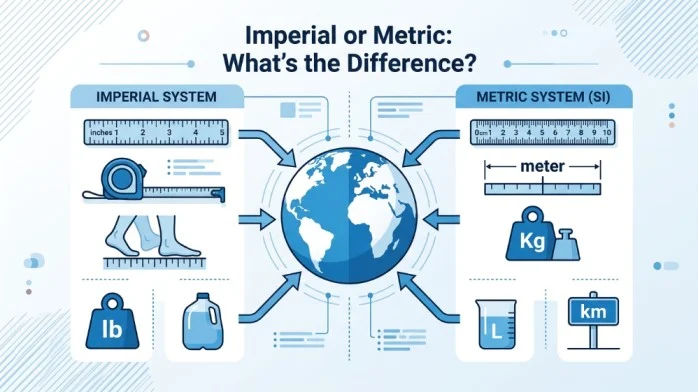
When measuring distance, weight, or temperature, have you ever wondered whether to use the metric system or imperial? You are not alone. The metric vs imperial debate can be confusing because both systems are still widely used around the world. One uses meters, kilograms, and Celsius, while the other relies on units such as feet, pounds, inches, and Fahrenheit.
Understanding metric system vs imperial is useful for travel, cooking, science, construction, shopping, and everyday measurements. You may also see metric system vs imperial system, imperial vs metric, or imperial system vs metric when comparing how different countries measure things. But which system is easier, and when should you use each one?
In this guide, we’ll explain metric or imperial, compare metric vs imperial system, and break down imperial units vs metric measurements in simple terms. You’ll also learn how metric measurements vs imperial units differ and when to choose imperial or metric.
Quick Answer
The metric system is the standard measurement system used by most countries around the world. The imperial system is mainly used in the United States, with limited use in a few other places. Metric uses units like meters, kilograms, and liters, while imperial uses feet, pounds, and gallons.
Quick Examples
| Metric | Imperial |
|---|---|
| 1 kilometer | About 0.62 mile |
| 1 kilogram | About 2.2 pounds |
| 1 liter | About 1.06 quarts |
| 1 meter | About 3.28 feet |
For international communication, science, education, and trade, the metric system is usually the preferred choice.
The Origin of Imperial or Metric
Understanding where these systems came from makes it easier to see why both still exist today.
The History of the Imperial System
The imperial system has its roots in old England. Long before modern measuring tools, people used parts of the human body to estimate distance. A foot was based on the length of a person’s foot, while an inch was linked to the width of a thumb.
As trade increased, England needed standard measurements. In 1824, the British government officially introduced the Imperial System through the Weights and Measures Act. This created common units for weight, length, and volume across the country.
Some familiar imperial units include:
- Inch
- Foot
- Yard
- Mile
- Pound
- Ounce
- Pint
- Gallon
Many of these units are still recognized today.
The History of the Metric System
The metric system was created in France during the late 1700s.
Scientists wanted a measurement system that was simple, logical, and easy to calculate. Instead of using different conversion numbers, they built everything around multiples of 10.
This made calculations much easier.
For example:
- 10 millimeters = 1 centimeter
- 100 centimeters = 1 meter
- 1,000 meters = 1 kilometer
The metric system quickly spread across Europe and later throughout most of the world.
Why Do Both Systems Still Exist?
Many countries changed from imperial to metric because it made education, science, engineering, and trade easier.
However, some countries kept parts of the imperial system because people were already familiar with it.
Today:
- Most countries use the metric system.
- The United States mainly uses the customary system, which is closely related to the imperial system.
- The United Kingdom uses both systems in everyday life.
This is why travelers often see miles on British roads but kilograms in supermarkets.
British English vs American English Usage
Many people believe there are different spellings for imperial or metric, but there are not.
Both British English and American English spell these words exactly the same.
The main difference is how the measurement systems are used, not how the words are written.
British Usage
People in the United Kingdom commonly use both systems.
Examples include:
- Road distances in miles
- People’s height in feet and inches
- Beer sold in pints
- Food packaged in grams and kilograms
- Petrol sold in liters
This creates a mixed measurement environment.
American Usage
The United States mainly uses its customary measurement system, which closely resembles the imperial system.
Examples include:
- Miles for driving
- Feet and inches for height
- Pounds for weight
- Gallons for fuel
- Fahrenheit for temperature
Metric units appear mostly in science, medicine, and international trade.
Comparison Table
| Feature | British English | American English |
|---|---|---|
| Spelling of Imperial | Imperial | Imperial |
| Spelling of Metric | Metric | Metric |
| Road Distance | Miles | Miles |
| Fuel | Liters | Gallons |
| Food Packaging | Mostly Metric | Mostly Customary Units |
| Scientific Work | Metric | Metric |
| Everyday Measurements | Mixed | Mostly Customary |
The spelling never changes. Only the preferred measurement units differ.
Why Is There Confusion Between Imperial or Metric?
People often become confused because both systems are used around the world.
Someone may learn centimeters in school but see inches when buying a television.
Another person may follow a recipe that uses grams while their kitchen scale measures ounces.
Here are the most common reasons for the confusion.
Different Countries Use Different Systems
Each country has its own habits.
For example:
- Canada mainly uses metric.
- Australia uses metric.
- Germany uses metric.
- Japan uses metric.
- The United States mainly uses customary units.
This means travelers often need to convert measurements.
Products Are Sold with Both Units
Many companies print both systems on packaging.
Examples include:
- 500 g (17.6 oz)
- 2 L (67.6 fl oz)
- 30 cm (12 in)
This helps customers from different countries understand the size.
School and Workplace Differences
Students may learn one system at school but use another at work.
For example:
- Science classes usually teach metric.
- Construction workers may use feet and inches.
- Aviation and shipping sometimes use nautical miles.
- International engineering projects usually use metric measurements.
Online Shopping
Buying products from another country can be confusing.
Examples include:
- Shoe sizes
- Clothing sizes
- Television screen sizes
- Furniture dimensions
Knowing both systems helps avoid buying the wrong size.
Conversion Can Be Difficult
Unlike the metric system, imperial measurements do not follow multiples of ten.
For example:
- 12 inches = 1 foot
- 3 feet = 1 yard
- 1,760 yards = 1 mile
These numbers are harder to remember than the metric system.
Which Measurement System Should You Use?
The best choice depends on where you live and who will read your work.
If Your Audience Is in the United States
Use the measurement system your audience expects.
Examples include:
- Feet
- Inches
- Pounds
- Miles
- Gallons
These units are familiar to most American readers.
If Your Audience Is in the United Kingdom
A mixed approach is often best.
For example:
- Road travel uses miles.
- Grocery shopping often uses kilograms.
- Drinks may use pints.
- Fuel uses liters.
Choose the unit that fits the situation.
If Your Audience Is in Canada, Australia, New Zealand, or Europe
The metric system is the standard choice.
Common measurements include:
- Millimeters
- Centimeters
- Meters
- Kilometers
- Grams
- Kilograms
- Liters
These units are easy to understand and widely accepted.
If Your Audience Is Global
The metric system is usually the safest option because it is recognized by most countries.
Many international companies, schools, universities, manufacturers, and scientific organizations use metric measurements in manuals, reports, research papers, and product information.
If needed, you can include imperial units in brackets to help readers who are more familiar with them.
Example:
The table is 2 meters (6.6 feet) long.
Providing both measurements improves clarity and helps readers from different regions understand the information without needing to perform conversions themselves.
Common Mistakes with Imperial or Metric
Even people who use measurements every day can make mistakes. Most errors happen because the two systems use different units. Learning these common mistakes can help you measure more accurately and avoid confusion.
Mistake 1: Mixing Metric and Imperial Units
Using both systems in the same calculation can produce incorrect results.
❌ Incorrect: The table is 2 meters long and 3 feet wide.
✅ Better: The table is 2 meters long and 0.9 meters wide.
OR
✅ Better: The table is about 6.6 feet long and 3 feet wide.
Try to keep all measurements in the same system whenever possible.
Mistake 2: Forgetting to Convert Units
Many people assume the numbers are close enough, but even small differences matter.
❌ Incorrect: One kilogram equals one pound.
✅ Correct: One kilogram is about 2.2 pounds.
Mistake 3: Using the Wrong Unit
Choosing the wrong unit can make information confusing.
Examples:
❌ The road is 10 meters long.
✅ The road is 10 kilometers long.
❌ The pencil weighs 5 kilograms.
✅ The pencil weighs 5 grams.
Always choose a unit that matches the size of the object.
Mistake 4: Confusing Weight and Volume
Weight and volume measure different things.
Weight measures how heavy something is.
Examples:
- Gram
- Kilogram
- Ounce
- Pound
Volume measures how much space a liquid takes.
Examples:
- Milliliter
- Liter
- Pint
- Gallon
Mixing these units can cause mistakes, especially in cooking.
Mistake 5: Guessing Instead of Measuring
Never guess measurements for building projects, science work, or recipes.
Using the correct measuring tools helps improve accuracy and prevents costly errors.
Imperial or Metric in Everyday Examples
You may not notice it, but measurements appear in daily life everywhere. Here are simple examples showing how both systems are used.
In Emails
Metric Example
Please cut the pipe to 150 centimeters before delivery.
Imperial Example
Please cut the pipe to 5 feet before delivery.
In News Articles
Metric
Heavy rain reached 120 millimeters in one day.
Imperial
The storm dropped 5 inches of rain overnight.
On Social Media
Metric
I ran 10 kilometers today!
Imperial
I finished my first 6-mile run today!
In Formal Writing
Metric
The laboratory measured the sample at 250 milliliters.
Imperial
The container holds one gallon of water.
In Recipes
Metric
- 250 grams of flour
- 500 milliliters of milk
- 100 grams of sugar
Imperial
- 2 cups of flour
- 1 pint of milk
- 4 ounces of butter
Many modern recipes include both systems to help readers around the world.
In Construction
Metric measurements are common in many countries.
Example:
- The wall is 3 meters high.
Imperial measurements are common in the United States.
Example:
- The wall is 10 feet high.
In Travel
Metric countries display:
- Kilometers
- Kilometers per hour
Countries using customary or imperial units may display:
- Miles
- Miles per hour
Understanding both systems makes traveling much easier.
Google Trends & Usage Behavior
People search for imperial or metric because they want quick and reliable answers about measurement systems.
Many users are trying to understand which system is correct for their country, schoolwork, workplace, or travel plans.
The topic is popular among:
- Students
- Teachers
- Travelers
- Engineers
- Builders
- Scientists
- Home cooks
- Online shoppers
People also search when they need fast conversions between common units such as:
- Miles and kilometers
- Inches and centimeters
- Pounds and kilograms
- Gallons and liters
Search interest also increases when people purchase products from other countries. Product sizes, clothing, furniture, televisions, and recipes often use unfamiliar measurements, leading users to compare both systems.
Regional search behavior also differs.
People in Europe, Asia, Australia, and most of Africa usually look for information about metric measurements. Users in the United States often search for conversion help when dealing with international products or travel.
This shows that both systems remain important because they are used in different parts of the world.
Comparison Table
| Feature | Imperial | Metric |
|---|---|---|
| Main Use | Everyday measurements in a few countries | Standard system in most countries |
| Length | Inch, Foot, Yard, Mile | Millimeter, Centimeter, Meter, Kilometer |
| Weight | Ounce, Pound | Gram, Kilogram |
| Liquid Volume | Pint, Quart, Gallon | Milliliter, Liter |
| Number Pattern | Different conversion values | Based on multiples of 10 |
| Easy to Learn | Less consistent | Very easy |
| Scientific Use | Rare | Standard worldwide |
| International Trade | Limited | Widely accepted |
| Best For | Traditional everyday use | Education, science, engineering, and global communication |
Frequently Asked Questions
1. What is the difference between imperial and metric?
The imperial system uses units such as inches, feet, pounds, and gallons. The metric system uses millimeters, meters, kilograms, and liters. Metric follows a base-10 structure, making calculations easier. Imperial uses different conversion numbers that are harder to remember.
2. Which is better, imperial or metric?
Neither system is completely better for every situation. Metric is easier for learning, science, engineering, and international communication because it uses simple base-10 conversions. Imperial remains familiar for many people in the United States and is still used in everyday activities there.
3. Which countries use the metric system?
Most countries use the metric system, including Canada, Australia, France, Germany, Japan, India, China, and nearly every nation in Europe, Asia, Africa, and South America. It is the international standard for education, science, medicine, and trade.
4. Does the United States use the imperial system?
The United States mainly uses the U.S. customary system, which is very similar to the British imperial system. Americans commonly measure distance in miles, height in feet and inches, weight in pounds, and fuel in gallons, although metric units appear in science and medicine.
5. Why is the metric system easier?
The metric system is based on multiples of ten. You simply move the decimal point when converting between units. For example, 1,000 millimeters equal 1 meter. This simple structure makes calculations faster and reduces mistakes.
6. Why do some countries still use imperial measurements?
Many countries have used imperial measurements for hundreds of years. People are familiar with these units in daily life, so changing everything would require updating road signs, educational materials, equipment, and business practices. As a result, some traditional units remain in use.
7. Should I learn both systems?
Yes. Knowing both systems is useful for travel, shopping, cooking, education, and work. You will understand instructions more easily and communicate better with people from different countries.
8. Can I use both systems in one document?
Yes, but use them carefully. Choose one system as the main measurement style and provide the other in brackets if needed. This helps readers from different regions understand the information while keeping the document clear and consistent.
Conclusion
Choosing between imperial or metric depends on where you live, who your audience is, and the purpose of your measurements. The metric system is the global standard because it is simple, consistent, and easy to convert. The imperial system remains familiar in the United States and is still used in some everyday situations in other countries. Understanding both systems helps you travel with confidence, follow recipes correctly, complete school or work projects accurately, and avoid costly mistakes.
When writing for an international audience, the metric system is usually the clearest choice, while adding imperial equivalents can make your content easier for everyone to understand.
Read More Related Articles:
Nits or Dandruff | What’s the Difference and How Can You …
Fazed or Phased | The Correct Word, Meaning, Examples, …