Have you ever paused while writing and wondered, “Should I use relief or relieve?” You are not alone. These two words look almost identical, but they play different roles in a sentence. Knowing the relief and relieve difference can help you write with confidence and avoid common grammar mistakes.
The confusion often appears in phrases such as relieve pain, feel relief, or provide relief. Even experienced writers may search relief vs relieve or relieve vs relief when they are unsure which word fits. This guide explains relief and relieve in simple terms, with clear examples and practical usage tips. You will also learn about reliefs or relieves, as well as the common mistake of using relieved or relief incorrectly. By the end, you will know exactly when to use relief or relieve and why the difference matters.
Quick Answer
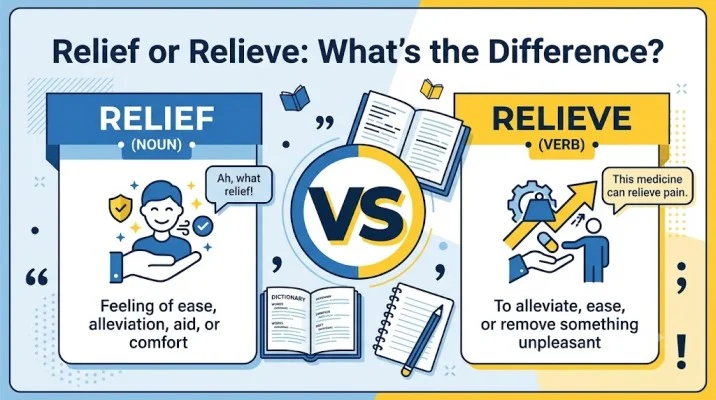
Relief is a noun. It means comfort, help, or the removal of pain, stress, or worry.
Relieve is a verb. It means to reduce pain, stress, or another problem.
Examples
- The medicine gave me relief from my headache.
- The medicine helped relieve my headache.
Simple Rule
- Use relief when naming the feeling or result.
- Use relieve when talking about the action.
The Origin of Relief or Relieve
The words relief and relieve come from the same language family. Both entered English through Old French and have roots in the Latin word relevare, which means to raise up, lift, or make lighter.
Long ago, people used these words to describe removing a heavy burden. Over time, the meaning expanded to include reducing pain, stress, worry, or difficulty.
Although the words share the same origin, English gave them different grammatical roles.
- Relief became the noun.
- Relieve became the verb.
Because they have similar spelling and pronunciation, many learners think they can replace one another. However, each word has its own purpose in a sentence.
Why Do People Confuse Them?
Several reasons explain the confusion.
- They begin with the same letters.
- They come from the same root word.
- They have nearly the same pronunciation.
- Both relate to reducing pain or stress.
- English learners often confuse nouns and verbs.
Once you remember that relief is a thing and relieve is an action, choosing the correct word becomes much easier.
British English vs American English Spelling
Unlike many English words, relief and relieve have exactly the same spelling in both British English and American English.
There is no spelling difference between the two varieties of English.
British English Examples
- The doctor gave her medicine for pain relief.
- These tablets relieve headaches quickly.
American English Examples
- The workers felt relief after the project ended.
- This cream helps relieve itching.
The spelling remains identical around the world.
Comparison Table
| Feature | British English | American English |
|---|---|---|
| Noun | Relief | Relief |
| Verb | Relieve | Relieve |
| Standard spelling | Yes | Yes |
| Formal writing | Relief / Relieve | Relief / Relieve |
| Everyday writing | Relief / Relieve | Relief / Relieve |
Which Version Is Correct?
Both are correct.
Whether you write for readers in the United States, the United Kingdom, Canada, Australia, or New Zealand, always use:
- Relief (noun)
- Relieve (verb)
There is no alternative spelling.
Why Is There Confusion Between Relief and Relieve?
Many people search for relief or relieve because they know the words are connected but are unsure which one fits their sentence.
Here are the most common reasons.
1. Similar Spelling
The words differ by only two letters at the end.
- Relief
- Relieve
When typing quickly, it is easy to choose the wrong one.
2. Similar Pronunciation
Both words sound alike because they share the same beginning and stress pattern.
People often hear the word before seeing it written, making spelling mistakes more likely.
3. Grammar Confusion
The biggest reason is grammar.
Many writers forget that one word is a noun and the other is a verb.
For example:
❌ I need some relieve from this pain.
✅ I need some relief from this pain.
Another example:
❌ This medicine gives relieve.
✅ This medicine gives relief.
Or:
❌ This medicine can relief your pain.
✅ This medicine can relieve your pain.
4. Autocorrect and Predictive Typing
Phones and computers sometimes suggest the wrong word because both are common English words.
Always read your sentence before sending it.
5. Search Engine Behavior
People often type only part of a word into a search engine.
Common searches include:
- relief or relieve
- relief meaning
- relieve meaning
- relief vs relieve
- relief grammar
- relieve definition
- when to use relief
- when to use relieve
These searches show that users usually want a quick grammar answer before using the word in writing.
Easy Memory Trick
Remember this simple rule:
- Relief = Result
- Relieve = Action
Or think of it another way:
If you can replace the word with comfort, choose relief.
If you can replace the word with help, reduce, or ease, choose relieve.
Practice Examples
Correct:
- We all felt relief after hearing the good news.
- The nurse tried to relieve the patient’s pain.
- Deep breathing gives relief from stress.
- Exercise can relieve anxiety.
- Everyone showed relief when the storm ended.
- The cool towel helped relieve the fever.
These examples show that relief names the feeling or benefit, while relieve describes the action that creates it.
Which Word Should You Use?
Choosing between relief and relieve is simple once you know the role each word plays in a sentence.
If You Need a Noun
Choose relief.
A noun names a person, place, thing, feeling, or idea.
Examples:
- The medicine brought relief.
- Everyone felt relief after the test.
- She smiled with relief.
If You Need a Verb
Choose relieve.
A verb shows an action.
Examples:
- This cream can relieve itching.
- Drinking water may relieve dehydration.
- Rest helps relieve stress.
For American Readers
Use:
- Relief for the noun.
- Relieve for the verb.
For British and Commonwealth Readers
The same rule applies.
- Relief
- Relieve
There are no spelling differences.
For Global Readers
Whether your audience is international, academic, or professional, always follow standard English grammar.
Quick Tip
Ask yourself:
Am I naming a feeling or result?
Use relief.
Am I describing an action?
Use relieve.
Common Mistakes with Relief or Relieve
Many writers know both words but use the wrong one because they forget the grammar.
Mistake 1
❌ I finally found relieve after the exam.
✅ I finally found relief after the exam.
Explanation:
The sentence needs a noun.
Mistake 2
❌ This medicine reliefs pain.
✅ This medicine relieves pain.
Explanation:
The sentence needs a verb.
Mistake 3
❌ She wanted some relieve.
✅ She wanted some relief.
Explanation:
“Some” is followed by a noun.
Mistake 4
❌ The doctor gave me relieve.
✅ The doctor gave me relief.
Explanation:
The doctor gave a result, not an action.
Mistake 5
❌ These exercises relief stress.
✅ These exercises relieve stress.
Explanation:
The sentence needs an action word.
Relief or Relieve in Everyday Examples
Understanding the difference becomes easier when you see real-life examples.
In Emails
✔ I hope these suggestions bring you some relief.
✔ This guide may relieve some of your concerns.
In News Articles
✔ Emergency aid brought relief to many families.
✔ Doctors worked hard to relieve patients’ pain.
On Social Media
✔ Finally finished my exams. What a relief!
✔ A short walk always helps relieve stress.
In Business Writing
✔ The new policy provided financial relief.
✔ The company introduced changes to relieve employee workload.
In Healthcare
✔ The tablets offer fast relief from headaches.
✔ These tablets help relieve headaches quickly.
In Everyday Conversation
Person A:
I’m so worried.
Person B:
Take a deep breath. It may relieve your stress.
Later…
Person A:
That really gave me some relief.
Google Trends & Search Behavior
People search for relief or relieve because they are unsure which word belongs in their sentence.
Common searches include:
- relief or relieve
- relief meaning
- relieve meaning
- relief vs relieve
- relief grammar
- relieve grammar
- when to use relief
- when to use relieve
- relief definition
- relieve definition
Most users are looking for a quick grammar answer before writing an email, assignment, article, or message.
Search interest comes from:
- Students
- English learners
- Teachers
- Business professionals
- Content writers
The confusion is not about spelling differences between countries. Instead, it comes from choosing the correct part of speech.
Comparison Table
| Word | Part of Speech | Meaning | Correct Usage | Example |
|---|---|---|---|---|
| Relief | Noun | Comfort after pain, stress, or worry | ✔ Correct | She felt relief after hearing the news. |
| Relieve | Verb | To reduce pain, stress, or worry | ✔ Correct | This medicine can relieve pain. |
Quick Comparison
| Feature | Relief | Relieve |
|---|---|---|
| Noun | ✔ | ✘ |
| Verb | ✘ | ✔ |
| Formal Writing | ✔ | ✔ |
| Everyday English | ✔ | ✔ |
| British English | Same | Same |
| American English | Same | Same |
Frequently Asked Questions
1. What is the difference between relief and relieve?
Relief is a noun that describes comfort after pain, stress, or worry has been reduced. Relieve is a verb that describes the action of reducing pain, stress, or another problem. Use relief for the result and relieve for the action.
2. Which word is correct: relief or relieve?
Both words are correct. They simply have different meanings. Choose relief when you need a noun and relieve when you need a verb.
3. Is relief a noun?
Yes.
Examples:
- What a relief!
- The medicine gave instant relief.
4. Is relieve a verb?
Yes.
Examples:
- Exercise can relieve stress.
- Drinking water may relieve dehydration.
5. Is there a British spelling difference?
No.
British English and American English both use:
- Relief
- Relieve
The spelling is exactly the same.
6. Why do people confuse relief and relieve?
The words have similar spelling, pronunciation, and meaning. They also come from the same historical root. Most confusion happens because writers mix up nouns and verbs.
7. How can I remember the difference?
Use this memory trick:
Relief = Result
Relieve = Action
This simple rule works almost every time.
8. Can I use relief and relieve in the same sentence?
Yes.
Example:
This medicine helped relieve my pain and gave me immediate relief.
This sentence is grammatically correct because each word has its proper role.
Conclusion
Understanding the difference between relief and relieve is easier than it first appears. Although the words share the same origin and are closely related in meaning, they serve different purposes in English grammar. Relief is always a noun that names the comfort or benefit felt after pain, stress, or worry is reduced. Relieve is always a verb that describes the action of reducing those problems. There is no spelling difference between British English and American English, making the rule consistent worldwide. Remember the simple tip: relief is the result, relieve is the action. Following this rule will help you write clearly and confidently in every situation.
Read More Related Articles:
Medical or Abbreviation | Meaning, Usage, Examples, and …
Tries or Trys | The Correct Spelling Explained Complete …