Have you ever typed “trys” and wondered if it is correct? Many English learners, students, writers, and professionals search for tries or trys because the two words look similar. The confusion often happens when people add endings to the verb try and are unsure which spelling rule applies.
The good news is that the answer is simple. In standard English, tries is the correct third-person singular form of the verb try, while trys is generally considered incorrect. Understanding this difference can help you avoid grammar mistakes in emails, essays, business writing, social media posts, and everyday communication.
This guide explains the correct spelling, why confusion exists, common mistakes, usage examples, grammar rules, and frequently asked questions so you can use the word confidently.
Quick Answer
Tries is the correct spelling in standard English. It is the third-person singular form of the verb try.
Examples:
- She tries her best every day.
- He tries to arrive on time.
Trys is not considered correct in modern English grammar and should generally be avoided in writing.
The Origin of Tries or Trys
The word try comes from the Old French word trier, meaning “to test,” “to examine,” or “to attempt.” Over time, it became part of the English language and developed different verb forms.
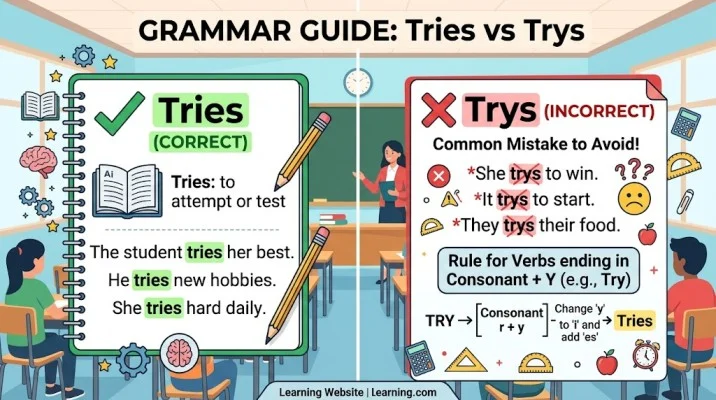
English spelling follows a common rule for verbs ending in a consonant followed by y. When forming the third-person singular present tense, the y changes to i and es is added.
Examples:
| Base Verb | Correct Form |
|---|---|
| Try | Tries |
| Cry | Cries |
| Fly | Flies |
| Carry | Carries |
| Reply | Replies |
Because of this grammar rule, tries became the accepted spelling while trys never became standard English.
Why Does the Confusion Exist?
Many people assume they can simply add s to any verb. While this works for words like:
- Walk → Walks
- Jump → Jumps
- Run → Runs
It does not work for verbs ending in a consonant + y.
Therefore:
- Try → Tries ✅
- Try → Trys ❌
British English vs American English Spelling
One interesting fact is that there is no spelling difference between British English and American English for this word.
Both language varieties use tries.
Comparison Table
| Language Version | Correct Form | Incorrect Form | Example |
|---|---|---|---|
| American English | Tries | Trys | She tries every day. |
| British English | Tries | Trys | He tries to help. |
| Canadian English | Tries | Trys | The student tries hard. |
| Australian English | Tries | Trys | The team tries again. |
Unlike words such as color/colour or center/centre, tries remains unchanged worldwide.
Why Is There Confusion Between “Tries” and “Trys”?
The confusion between tries and trys is very common.
1. Simple Typing Habits
Many people naturally add s to verbs without considering spelling rules.
Example:
- Try + s = Trys ❌
This feels logical but does not follow English grammar rules.
2. Pronunciation Similarity
When spoken aloud, listeners may not immediately recognize the spelling difference.
For example:
- She tries.
- She trys.
They sound nearly identical, leading to spelling mistakes.
3. Learning English Grammar Rules
Students often learn grammar rules gradually. The consonant + y rule can be confusing when first encountered.
4. Fast Digital Communication
People typing quickly on phones, tablets, or computers may accidentally write trys.
5. Search Engine Queries
Many users search for tries or trys simply to verify which spelling is correct before using it in school assignments, business writing, or online content.
Which Spelling Should You Use?
For American Audiences
Always use tries.
Example:
- She tries to improve her writing skills.
For British Audiences
Always use tries.
Example:
- He tries to complete the project early.
For International Audiences
Use tries in all formal and informal writing.
In Professional Writing
Examples include:
- Business emails
- Reports
- Academic papers
- News articles
- Company documents
In all these situations, tries is the correct choice.
In Casual Writing
Even in text messages and social media posts, tries remains the proper spelling.
Example:
- My friend always tries to make everyone laugh.
Common Mistakes with Tries or Trys
Mistake #1: Adding Only “S”
❌ She trys her best.
✅ She tries her best.
Explanation: Change the y to i before adding es.
Mistake #2: Using Trys in Formal Writing
❌ The company trys to provide excellent service.
✅ The company tries to provide excellent service.
Explanation: Professional writing should always follow standard grammar.
Mistake #3: Assuming Trys Is an American Spelling
❌ Trys is American English.
✅ Tries is correct in both American and British English.
Mistake #4: Copying Incorrect Online Usage
Some websites or social media posts may contain mistakes.
Always verify grammar before publishing important content.
Tries or Trys in Everyday Examples
In Emails
Correct:
- She tries to respond within one business day.
- Our team tries to solve customer issues quickly.
Incorrect:
- She trys to respond within one business day.
In News Articles
Correct:
- The government tries to reduce inflation.
- The athlete tries to break the record.
On Social Media
Correct:
- He tries to stay positive every day.
- She tries new recipes every weekend.
In Formal Writing
Correct:
- The organization tries to improve efficiency through training programs.
- The researcher tries to identify patterns in the data.
Usage Examples Across Different Contexts
Education
- The student tries to improve his grades.
- She tries to finish homework before dinner.
Business
- The company tries to meet customer expectations.
- Management tries to improve workplace productivity.
Sports
- The team tries to score before halftime.
- The player tries to break through the defense.
Family Life
- He tries to help his parents.
- She tries to spend more time with her children.
Search Behavior and Usage Patterns
People frequently search for tries or trys because:
- They are unsure about English grammar rules.
- They want to avoid mistakes in school assignments.
- They need correct spelling for professional writing.
- They have seen both spellings online.
- They want quick confirmation before publishing content.
Most grammar references recognize tries as the accepted spelling, while trys is generally treated as a spelling error.
Comparison Table – Keyword Variations
| Word | Meaning | Correct or Incorrect | Context |
|---|---|---|---|
| Tries | Third-person form of try | Correct | Standard English |
| Trys | Misspelling of tries | Incorrect | Grammar error |
| Try | Base verb | Correct | Dictionary form |
| Tried | Past tense of try | Correct | Past actions |
| Trying | Present participle | Correct | Ongoing actions |
FAQs
1. What is the correct spelling: tries or trys?
The correct spelling is tries. It is the standard third-person singular form of the verb try. Modern grammar guides, dictionaries, schools, and professional writers use tries. The form trys is generally considered incorrect and should be avoided in formal and informal writing.
2. Is trys a real word?
The spelling trys occasionally appears online, but it is not accepted as the standard third-person singular form of try. Most dictionaries and grammar references recognize tries as the correct spelling. In normal writing, you should use tries instead of trys.
3. Why do people confuse tries and trys?
People often confuse them because many English verbs simply add s. Since try ends with y, some writers assume trys follows the same pattern. However, grammar rules require changing y to i and adding es, resulting in tries.
4. Which spelling is correct in English?
The correct spelling in standard English is tries. This rule applies in American English, British English, Canadian English, Australian English, and other English-speaking regions.
5. Is trys a typo?
In most situations, yes. Trys is usually a typing or spelling mistake. Writers often type it quickly without remembering the grammar rule for verbs ending in a consonant followed by y.
6. Do British people use trys?
No. British English follows the same grammar rule as American English. British writers use tries, not trys.
7. How can I remember the correct spelling?
Remember the simple rule: if a verb ends in a consonant and y, change the y to i before adding es. Therefore, try becomes tries.
8. Is tries used in professional writing?
Yes. Business documents, academic papers, news reports, books, and official communications all use tries as the correct spelling.
Conclusion
The debate over tries or trys has a simple answer: tries is the correct spelling in standard English. It follows a common grammar rule that changes a consonant-ending y into i before adding es. While trys may appear in online searches, text messages, or typing mistakes, it is not considered correct in formal writing. Whether you are writing an email, school assignment, article, report, or social media post, using tries will ensure your writing looks professional and accurate. Remember the rule, practice it regularly, and you will avoid this common spelling mistake with confidence.
Read More Related Articles:
Osaka or Kyoto | Which Japanese City Is Better for Your …
Nits or Dandruff | What’s the Difference and How Can You …