When you’re writing an email, completing homework, or posting on social media, a tiny grammar choice can make a big difference. Many English learners and even native speakers pause when deciding between does or do, wondering which one fits the sentence correctly. It’s one of the most common grammar questions because the two words look similar but follow different rules.
This confusion happens because does or do depends on the subject of a sentence, and the rules are not always obvious. Thousands of people search for this topic every month to avoid grammar mistakes, improve their writing, and speak English with more confidence.
In this guide, you’ll learn the correct usage, understand why each form is used, see plenty of real-life examples, and discover simple tips to avoid making the same mistake again. Keep reading to master this common grammar confusion with ease.
Quick Answer
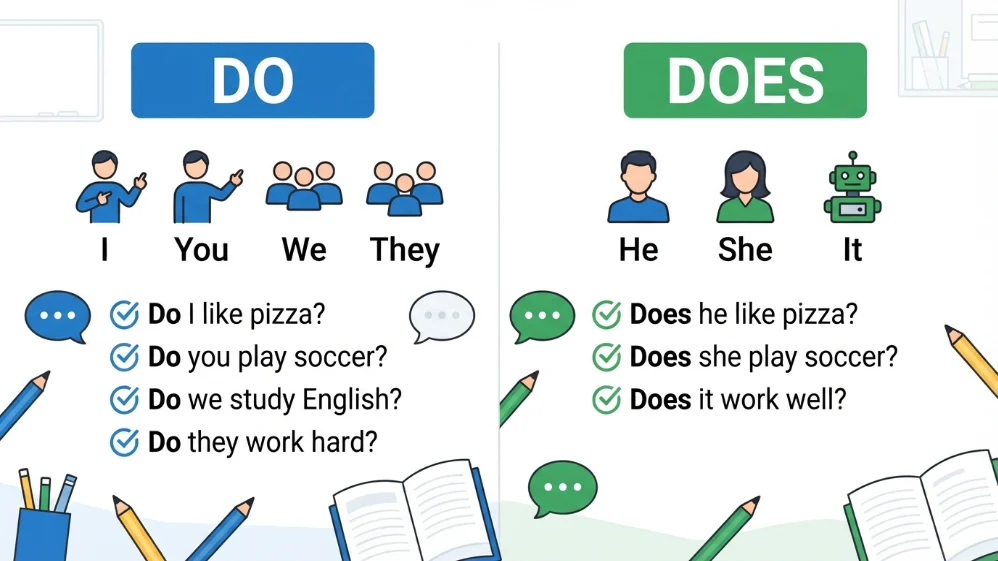
Do is used with the pronouns I, you, we, and they. Does is used with he, she, and it.
Examples:
- I do my homework every day.
- They do their work on time.
- She does her homework every day.
- He does his work on time.
If the subject is singular third person (he, she, it), use does. Otherwise, use do.
The Origin of Does or Do
The words do and does come from the Old English verb dōn, which meant “to perform,” “to act,” or “to carry out.”
Over time, English grammar developed different forms of the verb depending on the subject. As a result, do became the base form, while does developed as the present-tense form used with third-person singular subjects.
Examples:
- I do
- You do
- We do
- They do
- He does
- She does
- It does
The reason people become confused is that both words share the same meaning but follow different grammar rules. Unlike many English verbs, do is also used as a helping verb in questions and negative sentences, which creates even more opportunities for mistakes.
Why the Difference Exists
English verbs often change depending on the subject.
Consider these examples:
| Subject | Verb Form |
|---|---|
| I | Do |
| You | Do |
| We | Do |
| They | Do |
| He | Does |
| She | Does |
| It | Does |
This pattern is similar to other verbs:
- I work → He works
- They play → She plays
- We run → It runs
In the same way:
- I do → He does
British English vs American English Usage
One important fact is that does and do are used the same way in British English and American English.
Unlike words such as colour/color or centre/center, there is no spelling difference between these forms.
British English Examples
- Do you like football?
- She does her work carefully.
- They do not agree.
American English Examples
- Do you like soccer?
- She does her work carefully.
- They do not agree.
The grammar rule remains identical.
British vs American Usage Table
| Feature | British English | American English |
| Base Form | Do | Do |
| Third-Person Singular | Does | Does |
| Spelling Difference | None | None |
| Grammar Rule | Same | Same |
| Formal Writing | Do/Does | Do/Does |
| Everyday Speech | Do/Does | Do/Does |
Is One More Correct Than the Other?
No. Both countries follow the same grammatical rules.
These examples are correct everywhere:
- Do you understand?
- Does she understand?
- Do they know?
- Does he know?
Because the rules are universal, learners can confidently use the same structure in any English-speaking country.
Why Is There Confusion Between “Does” and “Do”?
Many people struggle with does or do because the words are closely related and often appear in similar sentences.
1. Both Come from the Same Verb
Since both words belong to the verb to do, writers often think they can be used interchangeably.
Incorrect:
- He do his homework.
Correct:
- He does his homework.
2. Questions Create Confusion
Questions often begin with either do or does, making it difficult for learners to know which one fits.
Examples:
- Do they play football?
- Does he play football?
The subject determines the correct choice.
3. Negative Sentences Cause Mistakes
Negative sentences use helping verbs.
Examples:
- I do not understand.
- They do not agree.
- She does not understand.
- He does not agree.
People sometimes mix these forms because both sentences look very similar.
4. Pronunciation Similarity
In casual speech, does and do can sound alike, especially to new learners.
Because of this, many users search online to confirm the correct form before writing.
5. Typing and Autocorrect Errors
Fast typing can lead to mistakes such as:
- He do not know.
- She do her work.
Autocorrect may not always catch grammar errors because both words are correctly spelled English words.
6. Learning English as a Second Language
Many languages do not change verbs based on the subject. English does, which makes does and do harder for learners.
For example:
- I do
- He does
The meaning stays the same, but the verb changes.
Which Spelling Should You Use?
The answer depends on the subject of your sentence.
Use “Do” With:
- I
- You
- We
- They
Examples:
- I do my best every day.
- You do a great job.
- We do our homework together.
- They do the cleaning every weekend.
Use “Does” With:
- He
- She
- It
Examples:
- He does his work quickly.
- She does her homework after school.
- It does not work properly.
For Formal Writing
Always match the verb to the subject.
Correct:
- The company does its best to help customers.
Incorrect:
- The company do its best to help customers.
For Informal Writing
The same rule applies.
Correct:
- She does not like coffee.
- They do not like coffee.
Whether you are writing an email, report, article, social media post, or text message, the grammar remains unchanged.
Common Mistakes with Does or Do
Understanding common mistakes helps you avoid them.
Mistake 1: Using “Do” with He, She, or It
Incorrect:
- He do his homework every day.
Correct:
- He does his homework every day.
Explanation:
The subject he requires does.
Mistake 2: Using “Does” with I, We, You, or They
Incorrect:
- They does their work well.
Correct:
- They do their work well.
Explanation:
The subject they requires do.
Mistake 3: Using “Does” with Another Verb Ending in -s
Incorrect:
- She does likes pizza.
Correct:
- She does like pizza.
Explanation:
After does, use the base form of the main verb.
Mistake 4: Incorrect Questions
Incorrect:
- Does they live here?
Correct:
- Do they live here?
Explanation:
The pronoun they takes do, not does.
Mistake 5: Incorrect Negative Sentences
Incorrect:
- He do not understand.
Correct:
- He does not understand.
Explanation:
Use does not with he, she, and it.
Mistake 6: Forgetting Subject Agreement
Incorrect:
- My brother do the dishes.
Correct:
- My brother does the dishes.
Explanation:
“My brother” is singular, so it takes does.
Quick Correction Table
| Incorrect | Correct |
| He do his work. | He does his work. |
| She do not know. | She does not know. |
| They does not agree. | They do not agree. |
| We does our best. | We do our best. |
| Does they live here? | Do they live here? |
| It do not work. | It does not work. |
Does or Do in Everyday Examples
Knowing the rule is helpful, but seeing does and do in real situations makes it much easier to remember. Below are examples from everyday writing.
In Emails
- Do you have time for a meeting tomorrow?
- Does the report need any changes?
- Do we need to send another copy?
- Does your team require more information?
In News Articles
- The company does expect higher sales this year.
- Local schools do plan to reopen next week.
- The government does support the new project.
- Scientists do believe more research is needed.
On Social Media
- Do you agree with this idea?
- She does look amazing today!
- They do make great videos.
- He does know how to entertain people.
In Formal Writing
- The applicant does meet all requirements.
- Employees do receive annual training.
- This policy does improve workplace safety.
- All participants do follow the guidelines.
In Daily Conversations
- Do you like pizza?
- Does your brother play football?
- Do they live nearby?
- Does it work now?
The more you read and write these patterns, the more natural they become.
Google Trends & Usage Behavior
Many people search for does or do because they are unsure which verb matches the subject. This question is common among students, English learners, writers, and professionals.
Common Search Intent
Users often search for:
- does or do
- when to use does
- when to use do
- does vs do
- do or does grammar
- do and does examples
- does or do in questions
Why People Search This Topic
People usually search because they:
- Forget the subject-verb agreement rule.
- Need help writing an email or assignment.
- Want to avoid grammar mistakes.
- Are learning English.
- Need a quick answer before publishing content.
Regional Usage
The grammar rule is the same in:
- United States
- United Kingdom
- Canada
- Australia
- New Zealand
- Other English-speaking countries
Although pronunciation may differ slightly, does and do follow the same grammar rules everywhere.
Comparison Table
| Feature | Do | Does |
|---|---|---|
| Meaning | Present tense form of do | Present tense form of do |
| Used With | I, You, We, They, plural nouns | He, She, It, singular nouns |
| Correct Usage | ✔ Yes | ✔ Yes |
| Questions | Do you…? | Does he…? |
| Negative Form | Do not (Don’t) | Does not (Doesn’t) |
| Formal Writing | Yes | Yes |
| Informal Writing | Yes | Yes |
Quick Reminder
| Subject | Correct Word |
|---|---|
| I | Do |
| You | Do |
| We | Do |
| They | Do |
| He | Does |
| She | Does |
| It | Does |
Frequently Asked Questions
1. Which is correct: does or do?
Both are correct, but they are used with different subjects. Use do with I, you, we, and they. Use does with he, she, and it. Choosing the correct form depends on the subject of the sentence, not personal preference.
2. What is the difference between do and does?
Both words come from the same verb. Do is used with plural subjects and the pronouns I and you, while does is used only with singular third-person subjects such as he, she, and it in the present tense.
3. Do British and American English use different spellings?
No. British English and American English use exactly the same spellings and grammar rules for do and does. There is no regional spelling difference between them, making the rule easy to remember for all English learners.
4. Why do people confuse does and do?
The confusion usually happens because both words belong to the same verb. Fast speech, subject-verb agreement mistakes, typing quickly, and uncertainty while writing questions or negative sentences also contribute to the problem.
5. Can I use does with plural nouns?
No. Does should not be used with plural nouns. For plural subjects, always use do.
Correct example:
- The students do their homework.
Incorrect example:
- The students does their homework.
6. Is “Does you” correct?
No. “Does you” is grammatically incorrect.
Correct examples:
- Do you understand?
- Do you need help?
Use does only with he, she, or it.
7. How can I remember the rule easily?
A simple memory trick is:
- He, She, It = Does
- I, You, We, They = Do
Repeating this pattern while reading or writing English will help you remember it naturally.
8. Can does and do be used in formal writing?
Yes. Both words are standard English and are used in formal reports, academic writing, business emails, newspapers, books, and everyday conversations. The important part is choosing the correct form according to the subject.
Conclusion
Understanding the difference between does or do is easier than it first appears. Both words come from the same verb, but each has a specific role in English grammar. Use do with I, you, we, they, and plural nouns. Use does with he, she, it, and singular nouns. This simple rule works in both British and American English and applies to formal as well as informal writing. By checking the subject before choosing the verb and practicing with everyday examples, you can avoid common grammar mistakes and write with greater confidence and clarity every time.
Read More Related Articles:
Parent or Guardian | Everything You Need to Know Before …
Osaka or Kyoto | Which Japanese City Is Better for Your …