Have you ever paused while writing and wondered whether over or under is the right word to use? These two common English words seem simple, but they often confuse learners and even fluent speakers because their meanings change depending on the situation. People search for over or under to understand which word fits best in measurements, directions, numbers, sports, business, and everyday conversations.
This guide clears up that confusion with easy explanations, real-life examples, comparison tables, and practical writing tips. By the end, you’ll know exactly when to use over and when under is the better choice, helping you write and speak with more confidence.
Quick Answer
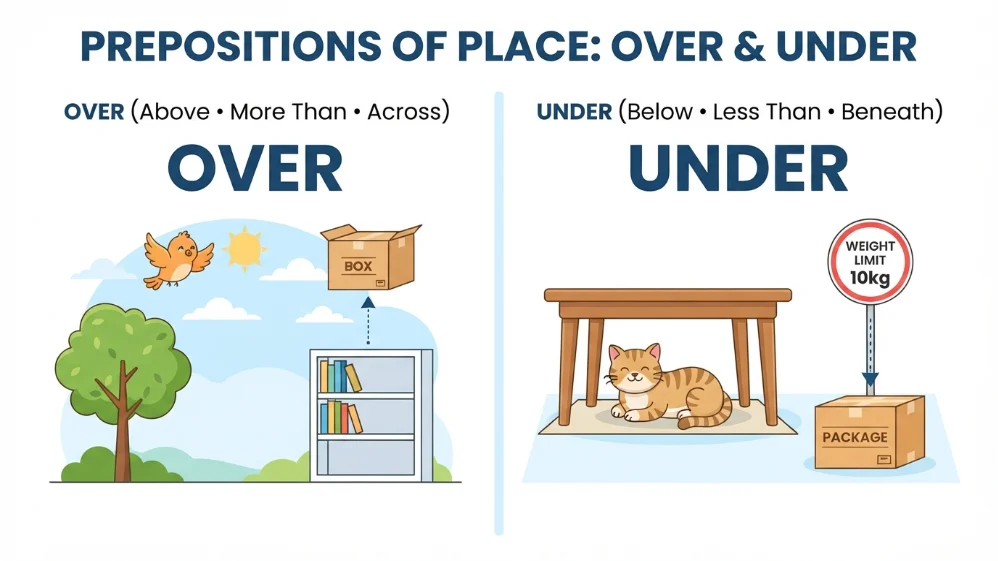
Over usually means above, more than, across, or on top of, while under means below, less than, beneath, or lower than. They are opposite words and are both correct. The right choice depends on the meaning you want to express.
Examples:
- The lamp hangs over the table.
- The cat is under the chair.
- She is over 18 years old.
- The package weighs under five kilograms.
The Origin of Over or Under
The words over and under are among the oldest words in the English language. They have been used for more than a thousand years and come from Old English.
Origin of “Over”
The word over comes from the Old English word ofer, meaning:
- Above
- Across
- Beyond
- Higher than
Its roots go back to the ancient Germanic languages, where similar words described something positioned higher or moving across another object.
Over time, English speakers began using over in many different ways. Today, it can describe:
- Position
- Direction
- Amount
- Time
- Control
- Completion
Examples:
- The airplane flew over the city.
- Sales increased over the past year.
- The meeting is over.
Origin of “Under”
The word under comes from the Old English word under, which has almost the same spelling and meaning as it does today.
It originally meant:
- Beneath
- Below
- Lower than
Like over, it also developed additional meanings over time.
Today, under can describe:
- Physical position
- Lower numbers
- Age limits
- Authority
- Conditions
Examples:
- The keys are under the pillow.
- Children under twelve enter free.
- The project is under review.
Why Do People Confuse Over and Under?
The confusion does not come from spelling. Both words are spelled correctly and have existed in English for centuries.
People become confused because:
- They are opposite words.
- Both describe position and numbers.
- Some sentences can change meaning completely when one replaces the other.
- Learners translate directly from another language.
- Certain expressions use one word naturally, while others require the opposite.
For example:
✔ The temperature is over 30°C.
✔ The temperature is under 30°C.
Both sentences are correct, but they describe different temperatures.
British English vs American English Spelling
Unlike many English words, over and under have exactly the same spelling in both British English and American English.
There are no spelling differences.
Comparison Table
| Feature | British English | American English |
|---|---|---|
| Correct spelling | Over | Over |
| Correct spelling | Under | Under |
| Meaning | Same | Same |
| Pronunciation | Nearly identical | Nearly identical |
| Formal writing | Same | Same |
| Everyday speech | Same | Same |
Examples in British English
- The bridge goes over the river.
- Keep your bag under the seat.
- The child is under ten years old.
Examples in American English
- The helicopter flew over the highway.
- The shoes are under the bed.
- Tickets cost over fifty dollars.
Are There Any Regional Differences?
The spelling does not change anywhere in the English-speaking world.
Whether you are writing for readers in:
- United States
- United Kingdom
- Canada
- Australia
- New Zealand
- Ireland
you should always write:
- Over
- Under
There is no alternative spelling in standard English.
Why Is There Confusion Between “Over or Under”?
Although over and under are easy to spell, many people still search for them because choosing the correct word depends on context.
Here are the most common reasons for the confusion.
1. Opposite Meanings
These words are opposites, making it easy to choose the wrong one while writing quickly.
Example:
- The picture hangs over the fireplace.
- The shoes are under the table.
Changing one word changes the meaning completely.
2. Numbers and Measurements
Many writers hesitate when talking about age, money, distance, or weight.
Examples:
- Over 100 people attended.
- Under 100 people attended.
Both are correct but describe different amounts.
3. Similar Sentence Patterns
Many English sentences work with either word.
Examples:
- The plane flew over the mountains.
- A tunnel runs under the mountains.
Because both sentences are grammatically correct, learners often mix them up.
4. Idioms and Expressions
English contains many fixed expressions that use only one of these words.
Examples with over:
- Over time
- Over again
- Over the moon
- Over and over
Examples with under:
- Under pressure
- Under control
- Under construction
- Under discussion
Replacing one with the other makes the phrase incorrect.
5. Learning English as a Second Language
Many languages use one word for ideas that English expresses with two different words. This causes learners to translate directly instead of choosing the natural English expression.
6. Search Intent
Many people type over or under into search engines because they want to know:
- Which word fits their sentence.
- Whether the words are interchangeable.
- How they differ in grammar.
- Which one sounds more natural.
- Which word native speakers use in specific situations.
Which Word Should You Use?
The answer depends entirely on your meaning. Neither word is more correct than the other.
If You Mean “Above”
Use over.
Examples:
- The bird flew over the trees.
- Hang the mirror over the fireplace.
If You Mean “Below”
Use under.
Examples:
- The wallet is under the sofa.
- The tunnel runs under the road.
If You Mean “More Than”
Choose over.
Examples:
- The event attracted over 2,000 visitors.
- She has over ten years of experience.
If You Mean “Less Than”
Choose under.
Examples:
- The package weighs under one kilogram.
- Children under five travel free.
For American Readers
Use over and under exactly as shown in standard English. Both words are accepted in formal writing, education, journalism, and business communication.
For British Readers
The same rules apply. British English does not use different spellings or meanings for these words.
For Global Readers
Whether your audience is international or local, use:
- Over for above, across, or more than.
- Under for below, beneath, or less than.
Choosing the correct word based on meaning makes your writing clear, natural, and easy to understand.
Common Mistakes with Over or Under
Even though over and under are simple words, they are often used incorrectly. Most mistakes happen because writers focus on the sentence structure instead of the meaning. Here are some common errors and how to fix them.
Mistake 1: Using “Over” Instead of “Under”
❌ The box is over the table.
✅ The box is under the table.
Why?
If something is below another object, under is the correct choice.
Mistake 2: Using “Under” Instead of “Over”
❌ The airplane flew under the clouds.
✅ The airplane flew over the clouds.
Why?
If something is higher than another object, use over.
Mistake 3: Confusing Numbers
❌ Only over 10 students attended. (When the number was 8)
✅ Only under 10 students attended.
Why?
Use over for amounts greater than a number and under for amounts less than a number.
Mistake 4: Mixing Fixed Expressions
❌ The project is over review.
✅ The project is under review.
❌ The children are under the moon.
✅ The children are over the moon.
Why?
Many English expressions are fixed and cannot be changed.
Mistake 5: Direct Translation
Some learners translate directly from their native language.
Example:
❌ My office is under the street. (Meaning “across”)
✅ My office is over the street.
Always think about the relationship between the two objects instead of translating word for word.
Over or Under in Everyday Examples
Seeing these words in real situations makes them easier to remember.
In Emails
- Please place the files under the blue folder.
- The total cost is over our original budget.
- Keep your reply under 200 words.
- The banner should appear over the company logo.
In News Articles
- Rainfall reached over 100 millimeters overnight.
- Temperatures stayed under freezing all week.
- The bridge passes over the river.
- The tunnel runs under the city.
On Social Media
- This movie is over three hours long!
- My puppy is hiding under the bed again.
- We finished the race in under an hour.
- Fireworks exploded over the lake.
In Business Writing
- Sales increased by over 20 percent this year.
- Expenses remained under budget.
- The report is under review.
- The manager has authority over the entire department.
In Everyday Conversation
- Your jacket is over the chair.
- The cat is sleeping under the table.
- She is over eighteen years old.
- The baby is under one year old.
Google Trends & Usage Behavior
People search for over or under for many different reasons. In most cases, they are not unsure about the spelling. Instead, they want to understand which word matches their sentence.
Common search intentions include:
- Learning the difference between the two words.
- Finding the correct word for writing.
- Understanding grammar rules.
- Checking school homework.
- Improving spoken and written English.
The search interest is especially strong among:
- English language learners.
- Students.
- Teachers.
- Professional writers.
- Business professionals.
Regional searches are common in countries where English is spoken as a first or second language, including the United States, the United Kingdom, Canada, Australia, India, Pakistan, and many other regions.
Because over and under appear in thousands of everyday expressions, people continue searching for their meanings and correct usage.
Comparison Table
| Word | Meaning | Correct Usage | Common Context |
|---|---|---|---|
| Over | Above, across, more than | ✔ Correct | Position, numbers, movement, authority, time |
| Under | Below, beneath, less than | ✔ Correct | Position, limits, measurements, conditions, age |
Quick Comparison
| Feature | Over | Under |
|---|---|---|
| Shows higher position | ✔ | ✘ |
| Shows lower position | ✘ | ✔ |
| Means more than | ✔ | ✘ |
| Means less than | ✘ | ✔ |
| Used in formal writing | ✔ | ✔ |
| Used in everyday speech | ✔ | ✔ |
Frequently Asked Questions
1. What is the difference between over and under?
Over means above, across, or more than, while under means below, beneath, or less than. They are opposite words and are both correct. The right choice depends on the meaning of your sentence, not on grammar or spelling differences.
2. Are over and under spelled differently in British and American English?
No. Both British English and American English use the same spellings: over and under. Their meanings and grammar are also the same, making them consistent across all major English-speaking countries.
3. Can over and under be used with numbers?
Yes. Use over for amounts greater than a number and under for amounts smaller than a number. For example, over 50 people attended means more than 50, while under 50 people attended means fewer than 50.
4. Why do people confuse over and under?
The confusion happens because they are opposite words used in similar situations. Both appear with numbers, positions, measurements, and common expressions. Learners often know both words but struggle to choose the one that matches the intended meaning.
5. Can I replace over with under?
No. These words are not interchangeable. Replacing one with the other changes the meaning of the sentence. Always think about whether you mean above or below, more than or less than, before choosing the correct word.
6. Which word should I use in formal writing?
Use whichever word accurately expresses your meaning. Both over and under are accepted in formal reports, academic papers, business writing, newspapers, and professional communication. The important point is choosing the one that fits the context.
7. Are over and under prepositions?
Yes. They are commonly used as prepositions, but they can also function as adverbs, adjectives, and prefixes in different contexts. Their role depends on how they are used within a sentence.
8. How can I remember the difference?
Think of a simple picture. If something is higher, use over. If something is lower, use under. This easy rule works in most everyday situations and helps you choose the correct word quickly.
Conclusion
Understanding the difference between over or under is easier once you focus on the meaning rather than the words themselves. Over refers to something above, across, or greater than, while under refers to something below, beneath, or less than.
Both words are correct, but they cannot replace each other because they express opposite ideas. Whether you are writing an email, preparing a report, posting on social media, or speaking in everyday conversation, selecting the right word makes your message clearer and more accurate. Remember the simple rule: higher or more means over, while lower or less means under. With regular practice, choosing the correct word will soon become natural.
Read More Related Articles:
Parent or Guardian | Everything You Need to Know Before …
Osaka or Kyoto | Which Japanese City Is Better for Your …