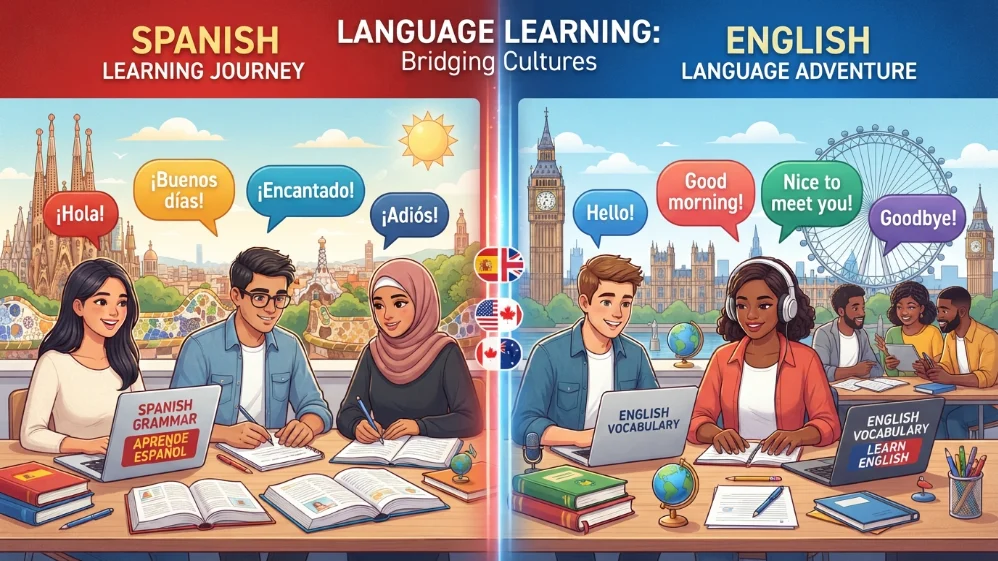
Choosing between Spanish or English is one of the most common questions language learners ask. Some people want a language that helps them travel, while others need one for work, school, or daily life. Because both languages are spoken by millions of people, deciding where to begin can feel difficult.
The truth is that there is no single answer for everyone. The best choice depends on your goals, where you live, and how you plan to use the language. This guide explains the differences between Spanish and English in a simple way. You will learn about their history, global use, learning difficulty, and practical benefits so you can choose the language that fits your needs.
Quick Answer
If your goal is global business, education, or international communication, English is usually the better first choice. If you want an easier language to learn, travel across Spain and Latin America, or communicate with millions of native speakers, Spanish is an excellent option.
Example:
- Learn English if you need it for work, university, or international travel.
- Learn Spanish if you plan to visit Spanish-speaking countries or enjoy Spanish culture.
The right choice depends on your personal goals rather than one language being better than the other.
The Origin of Spanish or English
Both Spanish and English have long and fascinating histories, but they come from different language families.
The Origin of Spanish
Spanish developed from Vulgar Latin, the language spoken by ordinary people in the Roman Empire. After Rome ruled much of the Iberian Peninsula, Latin slowly changed over hundreds of years. These changes eventually created modern Spanish.
Today, Spanish is the official language in Spain and most countries in Central and South America. It is also widely spoken in the United States and many other parts of the world.
The Origin of English
English belongs to the Germanic language family. It began in England when Germanic tribes, including the Angles, Saxons, and Jutes, settled there during the fifth century.
Over time, English borrowed thousands of words from Latin, French, Greek, and many other languages. This mixing helped create the modern English spoken today.
Why Do People Compare Spanish and English?
People often compare these languages because they are two of the world’s most spoken languages. Both are useful for travel, education, entertainment, and international communication.
Unlike spelling comparisons such as “color or colour,” Spanish or English is not about choosing the correct spelling. Instead, it is about choosing which language best matches your personal or professional goals.
British English vs American English
If you decide to learn English, you will notice two major varieties: British English and American English. They follow the same grammar in most situations, but some spellings, vocabulary, and pronunciation are different.
Common Spelling Differences
| American English | British English | Meaning |
|---|---|---|
| Color | Colour | Same meaning |
| Favorite | Favourite | Same meaning |
| Center | Centre | Same meaning |
| Theater | Theatre | Same meaning |
| Traveling | Travelling | Same meaning |
| Organize | Organise | Same meaning in many UK publications |
Vocabulary Differences
| American English | British English |
|---|---|
| Elevator | Lift |
| Apartment | Flat |
| Truck | Lorry |
| Vacation | Holiday |
| Cookie | Biscuit |
| Gas | Petrol |
Which Version Should You Learn?
Choose American English if:
- You plan to live or work in the United States.
- You enjoy American movies and television.
- Your company communicates mainly with American clients.
Choose British English if:
- You plan to study or work in the United Kingdom.
- You live in many Commonwealth countries.
- Your school follows British spelling.
No matter which version you learn, speakers of both varieties understand each other very well.
Why Do People Compare Spanish and English?
Many learners search for Spanish or English because they want to invest their time wisely. Learning a new language takes effort, so choosing the right one matters.
Here are the most common reasons people compare these languages.
Career Opportunities
English is the leading language of international business, science, technology, and higher education. Many multinational companies expect employees to communicate in English.
Spanish is also valuable because it is one of the most widely spoken native languages in the world. It opens doors in healthcare, education, tourism, customer service, and international trade.
Travel
English is useful in almost every country because it is often taught as a second language.
Spanish is especially helpful when traveling through Spain, Mexico, Central America, South America, and many parts of the Caribbean.
Entertainment
Learning English gives you access to a huge collection of books, movies, websites, podcasts, and online courses.
Learning Spanish lets you enjoy Spanish-language music, films, television shows, and literature without translation.
Education
Many universities offer courses in English.
Spanish is also a popular second language in schools and universities worldwide.
Communication
English helps people communicate across countries where native languages are different.
Spanish allows direct communication with hundreds of millions of native speakers across multiple continents.
Which Language Should You Choose?
There is no wrong answer. The best language depends on your goals.
- Choose English If You Want To
- Work for an international company.
- Study abroad.
- Access more online learning resources.
- Travel almost anywhere.
- Improve career opportunities worldwide.
- Choose Spanish If You Want To
- Travel across Spain and Latin America.
- Speak with Spanish-speaking friends or family.
- Enjoy Spanish music, movies, and books.
- Learn a language with more consistent pronunciation.
- Build communication skills in many growing communities.
- Choose Both If Possible
Many learners eventually study both languages. Learning one language can even make learning another easier because it strengthens memory, vocabulary, and communication skills.
If you need a language for global communication, English is usually the first choice. If your interests focus on Spanish-speaking countries or culture, Spanish may be the better starting point.
The most important step is to begin learning and practice every day. Consistent study brings better results than waiting for the perfect time to start.
Common Mistakes When Choosing Between Spanish or English
Many people believe one language is always better than the other. In reality, each language has its own advantages. Choosing the right one depends on your goals.
Mistake 1: Thinking English Is Spoken Everywhere
English is the most common international language, but not everyone speaks it fluently. In many countries, local languages are still used in daily life.
Correct Idea:
English is widely understood, but learning the local language can make travel and communication much easier.
Mistake 2: Believing Spanish Is Only Useful in Spain
Many learners think Spanish is only spoken in Spain.
Correct Idea:
Spanish is the official language in more than 20 countries. Millions of people also speak Spanish in the United States.
Mistake 3: Choosing a Language Because Friends Are Learning It
Some people follow others without thinking about their own needs.
Better Choice:
Select the language that matches your career plans, travel goals, education, or personal interests.
Mistake 4: Expecting Fast Results
Learning any language takes time and practice.
Correct Idea:
Daily study, listening, reading, and speaking will help you improve much faster than studying once in a while.
Mistake 5: Being Afraid of Making Mistakes
Many beginners avoid speaking because they worry about making errors.
Correct Idea:
Mistakes are a normal part of learning. Every conversation helps you become more confident.
Spanish or English in Everyday Examples
Both languages appear in daily life around the world. Here are simple examples showing how they are used.
In Emails
English
Thank you for your message. I will reply tomorrow.
Spanish
Gracias por su mensaje. Responderé mañana.
In News Articles
English
The city opened a new public library this week.
Spanish
La ciudad abrió una nueva biblioteca pública esta semana.
On Social Media
English
Had an amazing trip today!
Spanish
¡Qué viaje tan increíble hoy!
In Business
English
Please review the report before the meeting.
Spanish
Por favor, revise el informe antes de la reunión.
In Schools
English
Students around the world study English as a second language.
Spanish
Spanish is one of the most popular foreign languages taught in schools.
During Travel
English
English is often used at airports, hotels, and tourist attractions.
Spanish
Spanish is helpful when traveling across Spain, Mexico, and much of Latin America.
Google Trends and Usage Behavior
People search for Spanish or English for many different reasons.
Some want to know which language is easier to learn. Others compare job opportunities, travel benefits, or education options.
Common search intentions include:
- Which language should I learn first?
- Is Spanish easier than English?
- Which language is more useful?
- Which language has more speakers?
- Which language helps my career?
- Which language is better for travel?
Search interest also changes by region.
- English is often searched by people looking for international jobs, universities, and business opportunities.
- Spanish is popular among travelers, students, healthcare workers, and people communicating with Spanish-speaking communities.
Many users also compare pronunciation, grammar, vocabulary, and learning time before making their decision.
Comparison Table
| Feature | Spanish | English |
|---|---|---|
| Language Family | Romance | Germanic |
| Writing System | Latin Alphabet | Latin Alphabet |
| Global Use | Very High | Extremely High |
| Native Speakers | More native speakers | Fewer native speakers than Spanish |
| Second-Language Learners | Very Popular | Most popular worldwide |
| Pronunciation | More consistent | Less predictable |
| Grammar | More verb forms | Simpler verb system |
| International Business | Growing | Leading global language |
| Travel | Best in Spain and Latin America | Useful almost everywhere |
| Best For | Culture, travel, communication | Business, education, technology |
Frequently Asked Questions
1. Should I learn Spanish or English first?
If your goal is international business, education, or worldwide communication, English is usually the best first choice. If you want to travel through Spain or Latin America, connect with Spanish-speaking communities, or enjoy Hispanic culture, Spanish may be the better option. Choose the language that matches your personal goals.
2. Which language is easier to learn?
Many beginners find Spanish easier because most words are pronounced as they are written. English has more irregular spelling and pronunciation rules. However, your native language and daily practice will greatly affect how quickly you learn either language.
3. Is English more useful than Spanish?
English is the most widely used international language for business, science, technology, and higher education. Spanish is also highly valuable because it is spoken by hundreds of millions of people across many countries. Both languages offer excellent opportunities depending on your needs.
4. Can I learn both languages at the same time?
Yes. Many learners successfully study both. If you have enough time, practice, and motivation, learning two languages together is possible. Start with simple lessons, review often, and avoid trying to learn too much at once.
5. Which language has more native speakers?
Spanish has more native speakers than English. However, English has far more second-language speakers and is used internationally in business, education, travel, and online communication, making it one of the world’s most influential languages.
6. Which language is better for travel?
If you travel worldwide, English is generally more useful because it is understood in many countries. If your trips focus on Spain, Mexico, Central America, or South America, Spanish will make communication much easier and more enjoyable.
7. Is Spanish grammar harder than English?
Spanish grammar includes more verb conjugations and gender rules for nouns. English grammar is often simpler, but its spelling and pronunciation can be less predictable. Each language has challenges, and regular practice helps overcome them.
8. Can learning one language help me learn another?
Yes. Learning any new language improves memory, listening, reading, and communication skills. It also makes it easier to understand grammar, vocabulary, and learning strategies when studying additional languages in the future.
Conclusion
Choosing between Spanish or English depends on what you want to achieve. English is the leading language for international communication, business, education, and technology, making it a great choice for global opportunities. Spanish is spoken by millions of native speakers across many countries and is an excellent language for travel, culture, and personal connections. Neither language is better for everyone. The right choice depends on your career plans, travel goals, interests, and daily life. Once you decide, stay consistent with your practice. Learning even a little every day will build confidence and help you communicate naturally over time.
Read More Related Articles:
Which Word Is Correct and When Should You Use Each One
Parent or Guardian | Everything You Need to Know Before …
Halves or Halfs | Which Spelling Is Correct? The Complete …