Legal papers, court documents, and everyday conversations often use different words for the same profession, leaving many people unsure which one is correct. That’s why thousands of people search for attorney or lawyer every month, hoping to understand the real difference and use the right term with confidence. The confusion usually comes from meaning, legal usage, and regional preferences rather than spelling.
This guide will clear up the attorney or lawyer confusion in simple English. You’ll learn what each word means, why both terms exist, when to use each one, and see practical examples that make everything easy to remember. By the end, you’ll know how to avoid this common mistake with confidence so keep reading.
Quick Answer
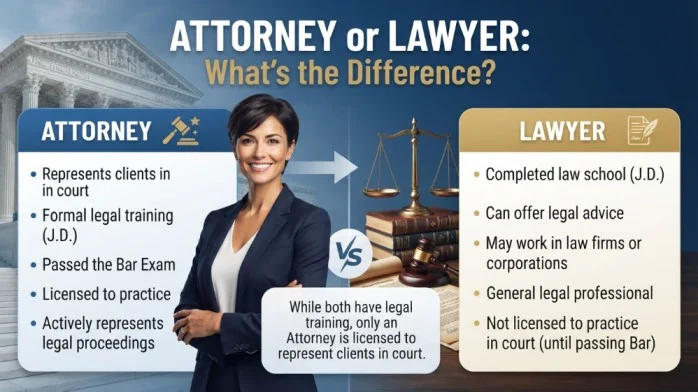
A lawyer is a person who has studied law and is qualified to give legal advice. An attorney is a lawyer who is authorized to represent clients in legal matters, especially in court. In everyday conversation, many people use the two words interchangeably, but attorney is more common in the United States, while lawyer is the preferred term in many other English-speaking countries.
Examples
- She hired a lawyer to review her contract.
- He is an attorney who represents clients in court.
- Our family spoke with a lawyer before buying the house.
- The attorney presented evidence during the trial.
The Origin of Attorney or Lawyer
Although attorney and lawyer are closely related, they come from different historical backgrounds.
The word lawyer comes from the English word law, with the ending -yer, meaning a person who works with or practices law. The term has been used in English for hundreds of years to describe someone trained in legal matters.
The word attorney has a different origin. It comes from the Old French word atorné, meaning a person appointed to act on another person’s behalf. Over time, the term became closely connected with legal professionals who represent clients in court or handle legal matters for them.
Because both words describe legal professionals, many people assume they always mean exactly the same thing. In modern English, the difference is often based on legal systems and regional usage rather than spelling.
Why the Confusion Exists
Several reasons explain why people mix up these terms:
- Both refer to legal professionals.
- Movies and television often use attorney and lawyer as if they are identical.
- Different countries prefer different terms.
- Law firms sometimes use both words on the same website.
- Online searches often show similar results for each term.
As a result, many people search for attorney or lawyer to understand whether there is an important difference.
British English vs American English Usage
Unlike words such as color and colour, attorney and lawyer are not spelling variations. They are two different words that are used differently depending on the country and legal system.
In the United States, both words are common. However, attorney is often the preferred term in legal settings because it refers to someone who can act on behalf of a client.
In the United Kingdom, lawyer is the general word used for legal professionals. More specific titles such as solicitor and barrister are also widely used. The word attorney is uncommon in everyday British English and usually appears only in certain legal phrases, such as power of attorney.
British vs American Usage
| Feature | American English | British English |
|---|---|---|
| General term | Lawyer | Lawyer |
| Common legal title | Attorney | Solicitor or Barrister |
| Used in court | Attorney | Barrister or Solicitor |
| Everyday conversations | Attorney and Lawyer | Lawyer |
| Correct usage | Both are correct | Lawyer is more common |
Example Sentences
| Situation | American English | British English |
|---|---|---|
| Hiring legal help | I need an attorney. | I need a lawyer. |
| General profession | She is a lawyer. | She is a lawyer. |
| Court representation | My attorney represented me. | My solicitor represented me. |
Understanding these regional preferences helps you choose the most natural term for your readers.
Why Is There Confusion Between Attorney and Lawyer?
Many people believe attorney and lawyer are exactly the same because they often appear in similar situations. While they share many meanings, their usage depends on legal tradition, location, and context.
Here are the most common reasons for the confusion.
Similar Meanings
Both words describe someone who has legal knowledge and helps people with legal issues. Because of this, they are often treated as synonyms.
Different Regional Preferences
People in the United States frequently use attorney, while people in the United Kingdom, Canada, Australia, and many other countries usually prefer lawyer.
Movies and Television
American legal dramas almost always use the word attorney. Viewers from other countries begin using the same term, even if lawyer is more common where they live.
Online Searches
Many people search for attorney or lawyer because they are unsure which word fits their situation. Search engines often display results using both terms, which can make the distinction seem unclear.
Legal Documents
Contracts, court papers, and government forms may use attorney, while newspapers and everyday conversations often use lawyer. Seeing both terms in different places leads many people to believe there is a hidden difference.
Which Term Should You Use?
The best choice depends on your audience and the type of writing.
If Your Audience Is in the United States
Use attorney when discussing court cases, legal representation, or official legal services. It sounds more formal and is widely recognized in American legal practice.
Examples:
- Contact an experienced attorney before signing the agreement.
- Her attorney handled the court hearing.
If Your Audience Is in the United Kingdom
Use lawyer as the general term. If you know the person’s exact role, use solicitor or barrister instead.
Examples:
- She is an experienced lawyer.
- We spoke with a solicitor about the property purchase.
If Your Audience Is in Canada, Australia, or New Zealand
Lawyer is generally the better choice because it is the most familiar and widely understood term.
If Your Audience Is Global
Choose lawyer unless you are specifically referring to the American legal system. It is easier for international readers to understand and is accepted in most English-speaking countries.
Formal vs Informal Writing
| Writing Type | Recommended Term |
|---|---|
| Legal contracts | Attorney (US) |
| Court documents | Attorney (US) |
| News articles | Lawyer |
| Blog posts | Lawyer |
| Educational content | Lawyer |
| Everyday conversation | Lawyer |
| International audience | Lawyer |
Final Advice
If you are writing for a worldwide audience, lawyer is usually the safest and clearest choice. If your content focuses on American law or legal procedures, attorney is often more accurate. Knowing your readers will help you choose the term that feels the most natural and professional.
Common Mistakes with Attorney or Lawyer
Many people use attorney and lawyer as if they always mean the same thing. While this is acceptable in casual conversation, it can create confusion in formal or legal writing. Here are the most common mistakes and how to avoid them.
Mistake 1: Thinking They Are Always Identical
❌ An attorney and a lawyer always mean exactly the same thing.
✅ They are closely related, but “attorney” often refers to a lawyer who represents clients in legal matters, especially in the United States.
Mistake 2: Using “Attorney” Everywhere
❌ I need an attorney in London.
✅ I need a lawyer in London.
In the United Kingdom, lawyer is the more common general term. You may also hear solicitor or barrister, depending on the legal role.
Mistake 3: Assuming Lawyer Is Informal
❌ Lawyer is only for casual conversation.
✅ Lawyer is correct in both formal and informal writing.
Many legal organizations, newspapers, and universities use the word lawyer.
Mistake 4: Ignoring Your Audience
Using the wrong term for your readers may sound unnatural.
- For American readers, attorney is common in legal contexts.
- For international readers, lawyer is usually easier to understand.
Mistake 5: Confusing Legal Titles
Not every legal professional has the same title in every country.
For example:
- Attorney is widely used in the United States.
- Solicitor and Barrister are common in the United Kingdom.
- Lawyer works as a general term in many English-speaking countries.
Choosing the correct title makes your writing clearer and more accurate.
Attorney or Lawyer in Everyday Examples
Here are examples showing how each term is used in different situations.
In Emails
American English
Please contact your attorney before signing the agreement.
International English
Please speak with your lawyer if you have any legal questions.
In News Articles
- The attorney presented new evidence during the trial.
- The lawyer defended the client in court.
On Social Media
- Looking for a good family lawyer in my area.
- My attorney helped me resolve the case quickly.
In Business Writing
- Our attorney reviewed the contract before we signed it.
- The company’s lawyer prepared the legal documents.
In Everyday Conversation
- My lawyer explained everything clearly.
- She became an attorney after passing the bar exam.
- We hired a lawyer to help with our house purchase.
- The attorney represented the family during the hearing.
These examples show that both words are correct, but the best choice depends on your audience and the legal system being discussed.
Google Trends & Usage Behavior
People search for attorney or lawyer because they want to know whether the two words have different meanings or whether one is more correct than the other.
Common search intentions include:
- Understanding the difference between attorney and lawyer.
- Choosing the right word for school or work.
- Learning which term is used in the United States or the United Kingdom.
- Finding the correct word for legal documents.
- Avoiding mistakes in professional writing.
Regional Usage
Attorney is searched more often in the United States because it is commonly used in legal practice and court-related matters.
Lawyer is more popular in many other English-speaking countries, including:
- United Kingdom
- Canada
- Australia
- New Zealand
- Ireland
Search Behavior
Many users search questions such as:
- Attorney vs lawyer
- Is an attorney the same as a lawyer?
- Which word is correct?
- Should I say attorney or lawyer?
This shows that people are looking for a simple explanation rather than a spelling correction.
Comparison Table – Attorney vs Lawyer
| Feature | Attorney | Lawyer |
|---|---|---|
| Meaning | A lawyer authorized to represent clients in legal matters | A person trained in law |
| Correct Word | Yes | Yes |
| Main Usage | Common in the United States | Common worldwide |
| Used in Court | Frequently | Yes, depending on the country |
| Best for International Readers | Sometimes | Yes |
| Formal Writing | Excellent | Excellent |
| Everyday Conversation | Common in the US | Very common worldwide |
Frequently Asked Questions
1. What is the difference between an attorney and a lawyer?
A lawyer is someone who has studied law and is qualified to provide legal advice. An attorney is generally a lawyer who is authorized to represent clients in legal matters, especially in court. In everyday conversation, many people use the two terms interchangeably.
2. Is attorney the same as lawyer?
In many situations, yes. Both words refer to legal professionals. However, attorney often has a more specific meaning in the United States, while lawyer is the broader and more widely used term around the world.
3. Which term is more common in the United States?
Attorney is widely used in legal documents, courts, and law firms across the United States. However, Americans also use lawyer in everyday conversations, news reports, and general discussions about legal services.
4. Which word should I use in the United Kingdom?
In the United Kingdom, lawyer is the preferred general term. Depending on the person’s role, you may also use solicitor or barrister, which are official legal titles within the British legal system.
5. Can I use attorney and lawyer interchangeably?
Yes, in most everyday situations you can. If you are writing about American law, attorney may be the more accurate choice. For international readers or general topics, lawyer is usually the clearer option.
6. Is lawyer the better choice for international readers?
Yes. Lawyer is understood across most English-speaking countries and is the safest choice when writing for a global audience. It avoids regional differences and is familiar to most readers.
7. Why do legal websites use both attorney and lawyer?
Many legal websites include both words because people search using different terms. Using both helps readers quickly find the information they need while making the content easier to understand for different audiences.
8. Are attorney and lawyer different professions?
No. They are not separate professions. Both describe people who work in the legal field. The difference mainly comes from legal traditions, regional preferences, and how each term is used within a particular legal system.
Conclusion
The choice between attorney or lawyer depends mainly on your audience and the legal system you are discussing. Both terms are correct and refer to legal professionals, but attorney is more common in the United States, while lawyer is the preferred general term in many other English-speaking countries. If you are writing for an international audience, lawyer is usually the clearest option. If your content focuses on American law or court procedures, attorney may be more appropriate. Understanding this difference helps you communicate clearly, write with confidence, and avoid unnecessary confusion.
Read More Related Articles:
Parent or Guardian | Everything You Need to Know Before …
Medical or Abbreviation | Meaning, Usage, Examples, and …