Choosing a countertop for a new kitchen or bathroom can quickly become confusing, especially when you have to decide between granite or quartz. You’re not the only one facing this choice. Thousands of homeowners search for this keyword every month because both materials look beautiful, offer unique benefits, and can make the final decision feel overwhelming. Understanding the differences is the key to making a smart investment.
This guide will clear up the granite or quartz confusion by explaining what sets each material apart, why people often compare them, and which option may suit different needs. You’ll also find easy-to-understand examples, practical tips, and expert insights to help you avoid costly mistakes. Keep reading to make your choice with confidence.
Quick Answer
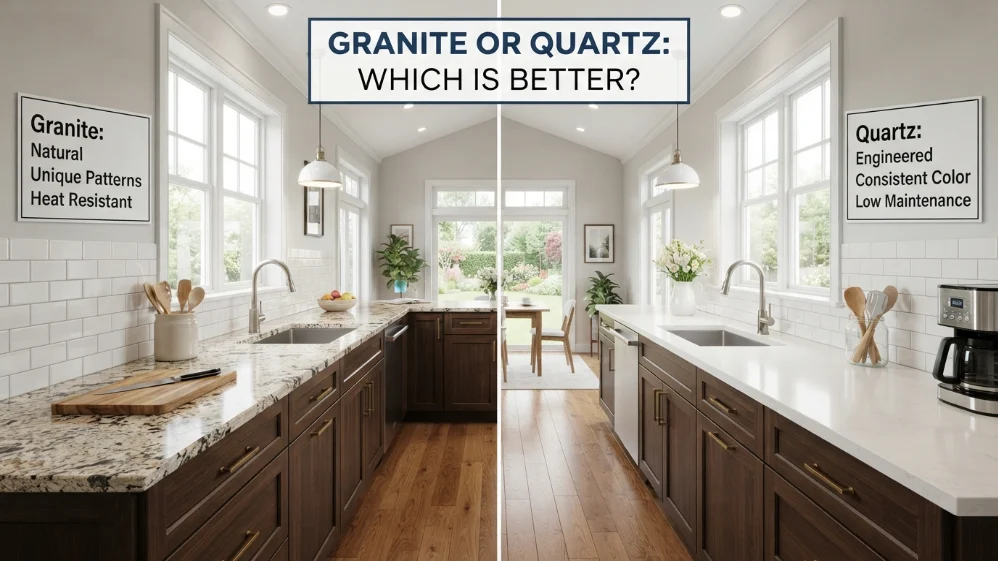
If you want a natural stone with unique patterns, granite is an excellent choice. If you prefer a low-maintenance surface with a modern and consistent look, quartz is usually the better option. Both are durable, but quartz requires less care because it does not need regular sealing.
Quick Examples
- Choose granite if you love natural beauty and every slab being unique.
- Choose quartz if you want an easy-to-clean countertop with consistent colors.
The Origin of Granite or Quartz
Although many people compare granite or quartz, they are not the same material.
What Is Granite?
Granite is a natural igneous rock formed deep inside the Earth. It develops when molten magma cools slowly over millions of years. This slow cooling creates large mineral crystals that give granite its beautiful natural appearance.
Granite mainly contains:
- Quartz
- Feldspar
- Mica
Because nature creates every slab, no two granite countertops are exactly alike.
What Is Quartz?
Quartz is one of the most common minerals found on Earth. However, quartz countertops are usually engineered stone rather than solid natural quartz.
Manufacturers combine:
- Natural quartz crystals
- Resin
- Pigments
This process creates a strong, smooth, and non-porous surface with consistent colors and patterns.
Granite vs Quartz at a Glance
| Feature | Granite | Quartz |
|---|---|---|
| Material | Natural stone | Engineered stone |
| Appearance | Unique natural patterns | Consistent colors and designs |
| Maintenance | Needs sealing | Very low maintenance |
| Heat Resistance | Excellent | Good |
| Water Resistance | Good when sealed | Excellent |
| Color Consistency | Every slab is different | Uniform appearance |
| Best For | Natural luxury | Busy households |
Why Do People Compare Granite and Quartz?
People often compare these materials because they look similar but perform differently.
The biggest reasons include:
- Kitchen remodeling
- Bathroom renovations
- Building a new home
- Replacing old countertops
- Comparing long-term value
- Choosing the easiest material to maintain
Both materials are premium choices, so buyers want to make the right investment.
Granite vs Quartz: Appearance
Appearance is one of the first things homeowners notice.
Granite
Granite offers natural beauty that cannot be copied perfectly.
Each slab has:
- Unique veins
- Natural colors
- Mineral crystals
- Organic patterns
Popular granite colors include:
- Black
- White
- Gray
- Brown
- Blue
- Green
- Gold
Because granite comes directly from nature, every countertop looks one of a kind.
Quartz
Quartz provides a cleaner and more consistent appearance.
Manufacturers can create designs that resemble:
- Marble
- Granite
- Concrete
- Solid colors
Quartz is popular among homeowners who want a modern kitchen with matching patterns throughout the countertop.
Appearance Winner
If you love natural stone, granite wins.
If you prefer a sleek and uniform design, quartz wins.
Durability Comparison
Both materials are strong enough for everyday use.
Granite Durability
Granite is one of the hardest natural stones.
It resists:
- Scratches
- Chips
- Heat
- Daily wear
However, because it is a natural stone, it has tiny pores that can absorb liquids if it is not sealed properly.
Quartz Durability
Quartz is also extremely durable.
Its engineered design makes it:
- Non-porous
- Stain resistant
- Scratch resistant
- Easy to maintain
Quartz performs especially well in busy family kitchens.
Durability Comparison Table
| Feature | Granite | Quartz |
|---|---|---|
| Scratch Resistance | Excellent | Excellent |
| Stain Resistance | Good (sealed) | Excellent |
| Crack Resistance | Very Good | Very Good |
| Daily Wear | Excellent | Excellent |
Heat Resistance
Heat resistance is another important factor.
Granite
Granite handles heat very well because it formed under extreme temperatures inside the Earth.
Hot pots and pans usually do not damage granite surfaces.
Quartz
Quartz is heat resistant, but the resin used during manufacturing can become damaged by very high temperatures.
Experts recommend using trivets or hot pads on quartz countertops.
Heat Resistance Winner
Granite has the advantage for homeowners who cook frequently.
Maintenance Requirements
Cleaning and maintenance can influence your decision.
Granite Maintenance
Granite should be sealed regularly to protect it from stains.
Daily cleaning only requires:
- Warm water
- Mild soap
- Soft cloth
Avoid harsh chemicals whenever possible.
Quartz Maintenance
Quartz is much easier to maintain.
Because it is non-porous:
- No sealing required
- Easy to clean
- Resists bacteria
- Handles everyday spills well
Most homeowners only need a damp cloth and mild cleaner.
Maintenance Winner
Quartz is the better choice for homeowners who want less maintenance.
Which Material Lasts Longer?
Both granite and quartz can last for decades with proper care.
Typical lifespan:
| Material | Expected Lifespan |
|---|---|
| Granite | 50–100 years or more |
| Quartz | 30–50 years or more |
Proper installation and regular care can help either material remain beautiful for many years.
Is Granite or Quartz Better for Kitchens?
The answer depends on your priorities.
Choose granite if you want:
- Natural beauty
- Excellent heat resistance
- A unique countertop
Choose quartz if you want:
- Easy maintenance
- Better stain resistance
- Consistent appearance
- Less upkeep
Both materials are outstanding choices for modern kitchens.
Granite vs Quartz Cost Comparison
Price is one of the biggest factors when choosing between granite and quartz. The total cost depends on the quality of the material, the size of the countertop, and installation.
Granite
Granite is available in many price ranges. Common colors usually cost less, while rare colors and unique patterns cost more.
Quartz
Quartz is also sold in different price ranges. Premium brands and designer colors often have a higher price.
Cost Comparison Table
| Feature | Granite | Quartz |
|---|---|---|
| Material Cost | Moderate to High | Moderate to High |
| Installation | Professional installation recommended | Professional installation recommended |
| Long-Term Maintenance | Needs periodic sealing | No sealing required |
| Overall Value | Excellent | Excellent |
Although prices often overlap, quartz may save money over time because it requires less maintenance.
Granite vs Quartz: Pros and Cons
- Granite Pros
- 100% natural stone
- Every slab is unique
- Excellent heat resistance
- Long lifespan
- Adds value to a home
- Granite Cons
- Needs sealing
- Can absorb stains if not sealed
- Heavy material
- Natural patterns may vary
- Quartz Pros
- Non-porous surface
- Easy to clean
- No sealing needed
- Many colors and designs
- Consistent appearance
- Quartz Cons
- Less heat resistant than granite
- Can be more expensive for premium designs
- Not completely natural because it contains resin
Which Is Better for Bathrooms?
Both materials work well in bathrooms.
Choose Granite If You Want
- A natural stone look
- Unique patterns
- High-end appearance
Choose Quartz If You Want
- Better resistance to moisture
- Easier cleaning
- Less maintenance
- A smooth, modern finish
For busy family bathrooms, quartz is often the more practical choice.
Environmental Impact
Many homeowners also consider sustainability.
Granite
Granite is a natural resource that is cut directly from the earth. Quarrying and transportation can increase its environmental impact.
Quartz
Quartz countertops use natural quartz mixed with resins and recycled materials. Some manufacturers also follow environmentally friendly production methods.
If sustainability matters to you, check the manufacturer’s environmental certifications before buying.
Home Value and Resale
Both granite and quartz are considered premium countertop materials.
They can make a home more attractive to buyers because they offer:
- Beautiful appearance
- Long-lasting durability
- Modern style
- Premium quality
Many real estate professionals consider either material a valuable upgrade for kitchens and bathrooms.
Installation Differences
Granite and quartz are both heavy materials.
Professional installation is recommended because installers have the proper equipment to:
- Measure accurately
- Cut safely
- Level the countertop
- Secure the surface correctly
Improper installation can lead to cracks or uneven surfaces.
Common Myths About Granite and Quartz
Myth 1: Granite Never Needs Maintenance
Truth: Granite should be sealed from time to time to help prevent stains.
Myth 2: Quartz Is Fake Stone
Truth: Quartz countertops contain natural quartz crystals mixed with resin, making them engineered stone.
Myth 3: Granite Is Always Better
Truth: Granite is better for some homeowners, while quartz is better for others. The right choice depends on your needs.
Myth 4: Quartz Cannot Scratch
Truth: Quartz is highly scratch resistant, but sharp objects can still damage the surface.
Myth 5: Granite and Quartz Look Exactly the Same
Truth: Granite has natural variations, while quartz offers a more consistent appearance.
Granite or Quartz in Everyday Examples
In an Email
We decided to install quartz countertops because they require less maintenance than granite.
In a News Article
Homeowners continue to compare granite and quartz when upgrading kitchens.
On Social Media
We finally chose granite for our dream kitchen. Every slab has its own natural beauty!
In Formal Writing
Quartz countertops provide excellent stain resistance, making them suitable for residential and commercial spaces.
Search Trends and User Behavior
People search for granite or quartz because they want help making a buying decision rather than solving a spelling problem.
Common search topics include:
- Which is better for kitchens?
- Which lasts longer?
- Which is easier to clean?
- Which is cheaper?
- Which adds more value to a home?
- Which is better for families?
- Which resists stains?
Search interest is strong in countries where kitchen remodeling and home improvement projects are popular. Buyers usually compare durability, maintenance, appearance, and long-term value before making a final decision.
Comparison Table – Granite vs Quartz
| Feature | Granite | Quartz |
|---|---|---|
| Material Type | Natural stone | Engineered stone |
| Appearance | Natural and unique | Consistent and modern |
| Heat Resistance | Excellent | Good |
| Stain Resistance | Good when sealed | Excellent |
| Maintenance | Moderate | Low |
| Sealing Required | Yes | No |
| Lifespan | Very long | Very long |
| Best For | Natural beauty | Easy maintenance |
Frequently Asked Questions
1. Which is better, granite or quartz?
Neither is better for everyone. Granite is ideal if you love natural stone and excellent heat resistance. Quartz is a better choice if you want a countertop that is easy to clean, resists stains, and requires very little maintenance.
2. Is granite cheaper than quartz?
It depends on the color, quality, and brand. Entry-level options for both materials are often similarly priced, while premium designs can cost significantly more.
3. Which countertop lasts longer?
Both granite and quartz can last for decades with proper care. Granite may last longer if it is regularly sealed, while quartz offers excellent durability with less maintenance.
4. Which is easier to maintain?
Quartz is easier to maintain because it is non-porous and does not require sealing. Granite needs occasional sealing to help protect it from stains and moisture.
5. Does granite stain easily?
Granite is naturally porous, so it can absorb liquids if it is not properly sealed. Regular sealing helps protect the surface from stains.
6. Is quartz completely natural?
No. Quartz countertops are made from natural quartz crystals combined with resins and pigments to create a durable engineered surface.
7. Which is better for busy families?
Quartz is often the preferred choice for busy households because it resists stains, is easy to clean, and requires very little maintenance.
8. Does granite increase home value?
Yes. Granite and quartz are both considered premium countertop materials and can improve the appearance and value of a home.
Conclusion
Choosing between granite or quartz depends on your lifestyle, budget, and design preferences. Granite offers timeless natural beauty, unique patterns, and excellent heat resistance, making it a favorite for homeowners who appreciate real stone. Quartz stands out for its low maintenance, stain resistance, and consistent appearance, making it ideal for busy kitchens and modern homes. Both materials are durable, attractive, and capable of lasting for many years when properly cared for. By understanding their strengths and differences, you can confidently select the countertop that best fits your needs and enjoy a beautiful, long-lasting surface in your home.
Read More Related Articles:
Medical or Abbreviation | Meaning, Usage, Examples, and …
Osaka or Kyoto | Which Japanese City Is Better for Your …