Many English learners and even native speakers pause when writing through or threw because the two words sound almost the same. A single wrong choice can completely change the meaning of a sentence, making emails, schoolwork, and professional writing confusing. This spelling mix-up happens every day because English has many words that share the same pronunciation but have different meanings and spellings.
If you’ve ever wondered whether to write through or threw, you’re in the right place. This guide explains the difference in simple language, shows when to use each word, highlights common mistakes, and provides easy examples you can remember. By the end, you’ll know exactly which word fits your sentence every time.
Quick Answer
Through and threw are both correct English words, but they have different meanings.
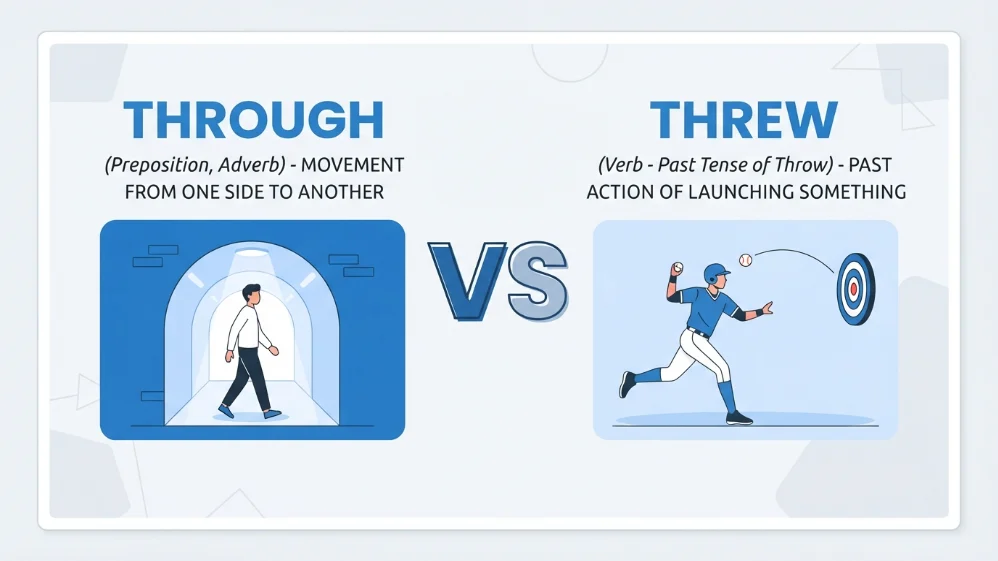
- Through means moving from one side to another, finishing something, or continuing until the end.
- Threw is the past tense of throw, meaning to send something through the air with your hand.
Examples:
- She walked through the park.
- He threw the ball to his friend.
The Origin of Through or Threw
Although through and threw sound alike, they come from different Old English words and developed different meanings over hundreds of years.
Origin of Through
The word through comes from the Old English word þurh (thurh), which meant from one side to another, across, or by means of. Over time, its spelling changed while its meaning stayed almost the same.
Today, through can work as:
- A preposition
- An adverb
- An adjective
Examples:
- We walked through the forest.
- The meeting is finally through.
- Traffic passed through the tunnel.
Origin of Threw
The word threw comes from the Old English verb þrāwan, which meant to twist, turn, or throw. As English evolved, throw became the base verb, and threw became its simple past tense.
Examples:
- She threw the keys onto the table.
- The player threw the ball across the field.
Why Do They Sound the Same?
English pronunciation has changed much faster than spelling. As a result, many words now sound alike even though they have different spellings and meanings. These are called homophones.
Through and threw are perfect examples of homophones.
British English vs American English Spelling
Unlike words such as colour and color, there is no spelling difference between British English and American English.
Both countries use:
- Through
- Threw
The only difference is how each word is used in a sentence.
| Feature | British English | American English |
|---|---|---|
| Correct spelling | Through | Through |
| Past tense of throw | Threw | Threw |
| Standard spelling | Same | Same |
| Meaning | Same | Same |
| Grammar rules | Same | Same |
British Examples
- We drove through London.
- He threw the newspaper onto the chair.
American Examples
- She walked through the shopping mall.
- The pitcher threw a fastball.
No English-speaking country treats one spelling as more correct than the other.
Why Is There Confusion Between “Through” and “Threw”?
The confusion happens because these words are pronounced almost exactly the same but have completely different meanings.
Here are the most common reasons people mix them up.
1. They Are Homophones
Both words sound like throo in everyday speech.
When people hear the word before seeing it written, they often guess the spelling.
2. Fast Typing
Many writers type quickly and accidentally choose the wrong word because both look familiar.
Example:
❌ I threw the tunnel.
✅ I went through the tunnel.
3. Autocorrect Doesn’t Always Help
Since through and threw are both real English words, spell check usually accepts both. That means the mistake may go unnoticed.
4. Learning English
People learning English often remember pronunciation before spelling, making homophones especially confusing.
5. Search Intent
Many users search through or threw because they want to know:
- Which word is correct?
- What is the difference?
- Which word fits their sentence?
- Is one spelling American and the other British?
Which Spelling Should You Use?
The correct choice depends entirely on your meaning.
Use Through When You Mean
- Moving from one side to another
- Completing something
- Continuing until the end
- Passing across or inside something
Examples:
- We walked through the museum.
- She read through the report.
- They drove through the city.
Use Threw When You Mean
- Tossed
- Hurled
- Sent something through the air
Examples:
- He threw the football.
- She threw the letter into the bin.
- The child threw the toy.
Writing Advice
For formal writing:
- Read your sentence carefully.
- Replace the word with its meaning.
- If it means passed across, choose through.
- If it means tossed, choose threw.
This simple trick helps avoid mistakes.
Common Mistakes with Through or Threw
Here are mistakes people commonly make and the correct versions.
Mistake 1
❌ She threw the hallway quietly.
✅ She walked through the hallway quietly.
Why?
She is moving across the hallway, not throwing it.
Mistake 2
❌ He through the ball.
✅ He threw the ball.
Why?
The sentence needs the past tense of throw.
Mistake 3
❌ We drove threw the tunnel.
✅ We drove through the tunnel.
Why?
The sentence describes movement across the tunnel.
Mistake 4
❌ She through her backpack on the bed.
✅ She threw her backpack on the bed.
Why?
The action is throwing.
Mistake 5
❌ I’m threw with my homework.
✅ I’m through with my homework.
Why?
The phrase through with means finished.
Easy Memory Trick
Remember this simple rule:
- Through = Travel or Finish
- Threw = Throw in the Past
Whenever you feel unsure, ask yourself:
Am I talking about movement or completion? Use through.
Am I talking about tossing something? Use threw.
Through or Threw in Everyday Examples
Understanding the difference becomes much easier when you see these words in real-life situations.
In Emails
Through
- I looked through your proposal this morning.
- We worked through every issue before the meeting.
- Please read through the document before signing it.
Threw
- Someone accidentally threw the old files away.
- He threw the package onto my desk.
- She threw the damaged papers into the recycling bin.
In News Articles
Through
- Rescue teams moved through the flooded streets.
- The train passed through the tunnel safely.
- The storm moved through the region overnight.
Threw
- The player threw the winning touchdown.
- Protesters threw stones at empty buildings.
- The child threw the ball into the crowd.
On Social Media
Through
- Finally made it through Monday!
- We walked through the old city today.
- Just got through my final exam.
Threw
- My little brother threw my phone onto the sofa.
- Someone threw water balloons at us!
- He threw the perfect pass during the game.
In Formal Writing
Through
- The committee reviewed the report through careful analysis.
- Goods were transported through the shipping channel.
- Visitors entered through the main gate.
Threw
- The witness stated that the suspect threw the object into the river.
- The athlete threw the javelin with impressive accuracy.
- The worker threw the damaged material away.
Search Trends & Usage Behavior
People often search for through or threw because the words sound almost identical but have different meanings. This is one of the most common homophone questions in English.
Searches usually come from:
- Students checking homework.
- English learners improving grammar.
- Writers proofreading articles.
- Professionals reviewing emails.
- People using voice search.
- Users correcting spelling mistakes.
Many people first type the wrong word and then search online to confirm which one fits their sentence. Others simply want a quick explanation with examples they can remember.
Although both words are correct, through appears much more often in everyday writing because it has several meanings. Threw is mainly used as the past tense of throw, making it less frequent but equally important.
Comparison Table – Through vs Threw
| Word | Meaning | Correct Usage | Common Context |
|---|---|---|---|
| Through | From one side to another, completed, until the end | ✅ Correct | Travel, reading, finishing, movement |
| Threw | Past tense of throw | ✅ Correct | Sports, tossing objects, actions |
| Through | Indicates movement or completion | ✅ Correct | Formal and informal writing |
| Threw | Indicates a past action of throwing | ✅ Correct | Everyday conversation and storytelling |
Quick Memory Guide
| If You Mean… | Use |
|---|---|
| Passed across | Through |
| Finished | Through |
| Tossed something | Threw |
| Past tense of throw | Threw |
Frequently Asked Questions
1. What is the difference between through and threw?
Through means moving from one side to another, continuing until the end, or finishing something. Threw is the past tense of throw and describes the action of tossing or sending something through the air. Although they sound alike, they have completely different meanings and uses.
2. Which is correct: through or threw?
Both words are correct, but they are used in different situations. Use through when talking about movement, completion, or passing across something. Use threw when describing the past action of throwing an object.
3. Why do through and threw sound the same?
They are homophones, meaning they share the same pronunciation but have different spellings and meanings. English pronunciation changed over time while many spellings remained the same, creating pairs like through and threw.
4. Is threw the past tense of through?
No. Threw is the past tense of the verb throw. It has no grammatical connection to through. The two words only sound alike but belong to different parts of speech.
5. How can I remember the difference?
Think about the meaning of your sentence. If it involves movement, passing, or finishing, choose through. If someone tossed an object, choose threw. Remember: threw always relates to the verb throw.
6. Are through and threw spelled differently in British and American English?
No. Both British English and American English use the same spellings: through and threw. There is no regional spelling difference between these words.
7. Can spell check catch mistakes between through and threw?
Not always. Since both are real English words, spell check usually accepts them. That’s why proofreading your sentence for meaning is important before sending or publishing your writing.
8. Which word is used more often?
Through is generally more common because it appears in many everyday expressions and situations. Threw is used only when describing something that was thrown in the past.
Conclusion
The difference between through or threw is simple once you understand each word’s purpose. Through describes movement, completion, or passing from one side to another, while threw is the past tense of throw and refers to tossing something. Although they sound almost identical, they cannot replace each other in a sentence. Reading your sentence carefully and focusing on the meaning will help you choose the correct word every time. Whether you’re writing an email, school assignment, report, or social media post, using the right spelling makes your writing clearer, more professional, and easier for everyone to understand.
Read More Related Articles:
Halves or Halfs | Which Spelling Is Correct? The Complete …
Osaka or Kyoto | Which Japanese City Is Better for Your …