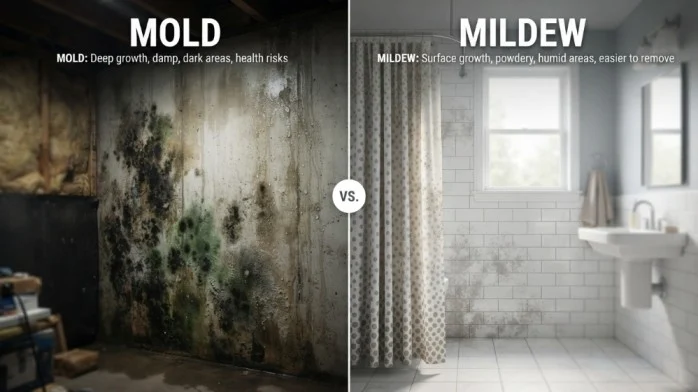
Moisture stains on a bathroom wall or a fuzzy patch in the basement can make any home look unhealthy. Many people notice these spots and immediately search mold or mildew, unsure which term is correct or whether both mean the same thing. It’s a common confusion, and thousands of people look up this keyword because the two words are often used interchangeably in everyday conversations.
Although mold or mildew may seem similar, they are not always used in the same way, which is why the mix-up happens so often. This guide will explain the difference, the reason behind the confusion, provide clear examples, and help you avoid making the same mistake in the future. Keep reading to learn which term fits the situation best and why it matters.
Quick Answer
Mold and mildew are both fungi, but they are different. Mildew usually appears as a white, gray, or yellow powdery layer on damp surfaces and is easier to remove. Mold often looks black, green, brown, or orange, grows deeper into materials, spreads quickly, and may cause greater damage and health concerns.
Quick Examples
- Bathroom tiles with a white film: Usually mildew.
- Black spots on drywall or wood: Usually mold.
- Musty smell in a damp basement: Often caused by mold growth.
The Origin of Mold or Mildew
Understanding where these words come from makes their meanings easier to remember.
Origin of Mold
The word mold comes from the Old English word molde, meaning earth or soil. Over time, the meaning expanded to describe fungi that grow naturally on organic materials such as wood, paper, food, and plants.
Today, mold refers to many different fungal species that thrive in warm, damp environments. Some molds are harmless, while others can damage buildings or trigger allergies.
Origin of Mildew
The word mildew comes from Old English meledēaw, which combines words meaning honey and dew. Early English speakers used it to describe the light coating that appeared on crops and plants after damp weather.
Modern English uses mildew for a surface fungus that grows in moist places, especially on fabric, paper, leather, painted walls, bathroom tiles, and plants.
Why People Get Confused
Several reasons cause people to mix up mold and mildew.
- Both grow in damp places.
- Both belong to the fungus family.
- Both can create musty smells.
- Both may appear on walls, ceilings, and bathrooms.
- Many people use the words as if they have the same meaning.
Although they are closely related, they are different types of fungal growth with different characteristics.
British English vs American English Spelling
Unlike many English words, mold has different preferred spellings depending on the country, while mildew stays the same everywhere.
American English
Americans normally write mold.
Examples:
- There is mold behind the washing machine.
- Experts removed the mold from the basement.
British English
British English usually prefers mould.
Examples:
- There is mould on the kitchen wall.
- The house was inspected for mould.
The word mildew is spelled exactly the same in both British and American English.
Comparison Table
| Meaning | American English | British English | Correct? |
|---|---|---|---|
| Fungus growing indoors | Mold | Mould | ✅ Both are correct |
| Surface fungus | Mildew | Mildew | ✅ Same spelling |
| Black fungal growth | Mold | Mould | ✅ Regional difference |
| Powdery fungal growth | Mildew | Mildew | ✅ Universal spelling |
Which Version Should You Choose?
- Writing for an American audience? Use mold.
- Writing for a British audience? Use mould.
- Writing for Canada, Australia, or New Zealand? Follow the local style guide, though mould is more common.
- The spelling mildew never changes.
Why Is There Confusion Between Mold and Mildew?
Many people think mold and mildew are exactly the same because they often appear in similar places. However, they have noticeable differences once you know what to look for.
They Grow in Similar Places
Both prefer damp environments, including:
- Bathrooms
- Kitchens
- Basements
- Laundry rooms
- Window frames
- Roof spaces
- Damp walls
Because they often grow side by side, people assume they are the same.
Their Appearance Can Look Similar
At first glance, both may appear as stains or patches on a wall or ceiling.
However:
- Mildew usually stays flat and powdery.
- Mold often appears fuzzy, thick, or raised.
Search Intent
Many online searches ask questions like:
- Is mold the same as mildew?
- Which is worse, mold or mildew?
- Can mildew become mold?
- How do I remove mold from walls?
- Is mildew dangerous?
People are usually trying to identify a problem they have found at home.
Pronunciation
The words do not sound alike, but because they often appear together in cleaning guides and home improvement articles, many readers believe they are interchangeable.
Cleaning Products
Many cleaning sprays advertise that they remove mold and mildew, making it easy to assume they are identical.
In reality, one product may work well on mildew but not remove deeper mold growing inside walls or wood.
Which Term Should You Use?
The correct word depends on what you are describing.
Use “Mold” When Talking About:
- Black spots on walls
- Green patches on wood
- Fungi growing inside drywall
- Water-damaged buildings
- Food spoilage
- Indoor air quality concerns
Example:
The basement developed mold after the flood.
Use “Mildew” When Talking About:
- White powdery growth
- Bathroom shower curtains
- Damp clothing
- Plant diseases
- Surface fungus on tiles
Example:
Mildew formed on the shower curtain after several weeks.
Writing for an American Audience
Use mold and mildew.
Writing for a British Audience
Use mould and mildew.
For International Readers
Choose the spelling style that matches your audience and stay consistent throughout your writing.
Common Mistakes with Mold or Mildew
Many people use these words incorrectly. Here are the most common mistakes.
Mistake 1: Using Mold and Mildew as Exact Synonyms
❌ The bathroom has mold, which is always the same as mildew.
✅ Mold and mildew are related fungi, but they are not exactly the same.
Mistake 2: Thinking Mildew Is Always Dangerous
❌ Every bit of mildew is highly dangerous.
✅ Mildew is usually easier to remove and often causes less damage than mold.
Mistake 3: Ignoring Black Mold
❌ I’ll paint over the black mold and forget about it.
✅ Mold should be cleaned properly, and serious infestations may require professional removal.
Mistake 4: Using the Wrong Spelling
❌ Mould is wrong in every country.
✅ Mold is preferred in American English, while mould is preferred in British English.
Mistake 5: Assuming All Fungi Look the Same
❌ Every dark stain is mildew.
✅ Mold often appears darker and grows deeper, while mildew usually stays on the surface.
Mold or Mildew in Everyday Examples
Knowing how these words appear in real-life situations makes them much easier to understand.
In Emails
Example 1
We found mold behind the office cabinets after the water leak. A professional inspection has been scheduled.
Example 2
Please clean the mildew from the bathroom walls before the guests arrive.
In News Articles
- Health officials warned homeowners to remove mold after severe flooding.
- Damp weather increased mildew growth on local farms.
More Everyday Examples
On Social Media
- We finally removed the mold from our basement after weeks of cleaning.
- Our shower curtain had mildew, but a good cleaner made it look new again.
- Don’t ignore black mold after a water leak. It can spread quickly.
- Keeping your home dry is the best way to prevent mold and mildew.
In Formal Writing
- The inspection report identified mold growth behind the damaged drywall.
- Regular ventilation helps reduce the risk of mildew in humid rooms.
- Moisture control is essential for preventing mold inside residential buildings.
- The maintenance team removed mildew from the bathroom ceiling before repainting.
In Daily Conversation
- I think there’s mold under the sink.
- The towels smell because mildew has started to grow.
- We opened the windows to stop mold from forming.
- The old carpet was removed because it had mold damage.
These examples show that mold is commonly used when discussing serious fungal growth, while mildew usually describes light surface growth that is easier to clean.
Google Trends & Usage Behavior
People search for mold or mildew because they want to know which problem they have and how to fix it. The search is usually based on a real situation, such as finding dark spots on a wall, noticing a musty smell, or seeing stains in a bathroom.
Common Search Intent
Users often search for:
- Mold or mildew difference
- Is mold worse than mildew?
- How to identify mold or mildew
- Mold vs mildew on walls
- Mold vs mildew on wood
- Bathroom mold or mildew
- Black mold or mildew
- How to remove mold safely
- Does mildew turn into mold?
Regional Usage
Search behavior also changes by country.
- United States: Most people search for mold or mildew.
- United Kingdom: Many users search for mould or mildew because British English prefers the spelling mould.
- Canada, Australia, and New Zealand: Both spellings may appear, although mould is more common in formal writing.
Why Do People Search This Topic?
Most searches happen because people:
- Notice stains on walls or ceilings.
- Smell something musty indoors.
- Want to know if the fungus is dangerous.
- Need cleaning advice.
- Are buying or selling a home.
- Want to prevent moisture damage.
Because mold and mildew often appear together, many users are unsure which one they have. Understanding the difference helps people choose the right cleaning method and decide whether professional help is needed.
Comparison Table – Mold vs Mildew
| Feature | Mold | Mildew |
|---|---|---|
| Type | Fungus | Fungus |
| Appearance | Black, green, brown, blue, or orange | White, gray, or yellow |
| Texture | Fuzzy, raised, or slimy | Flat or powdery |
| Growth | Can grow deep into materials | Usually stays on the surface |
| Common Locations | Drywall, wood, ceilings, insulation, food | Shower curtains, tiles, fabric, plants |
| Damage | Can damage building materials | Usually causes surface staining |
| Removal | May require professional treatment | Often cleaned with household products |
| Health Concerns | Can trigger allergies and respiratory problems | Usually less harmful but may still irritate sensitive people |
| Spread | Spreads quickly in damp conditions | Spreads more slowly |
| Prevention | Control moisture and fix leaks | Keep surfaces clean and dry |
Frequently Asked Questions
1. What is the difference between mold and mildew?
Mold and mildew are both fungi, but they are not the same. Mold usually grows deeper into materials and appears in darker colors like black or green. Mildew is often white or gray, grows on the surface, and is generally easier to remove.
2. Which is worse, mold or mildew?
Mold is usually considered more serious because it can spread through walls, wood, and insulation. It may damage building materials and affect indoor air quality. Mildew is normally limited to the surface and is easier to clean if treated early.
3. Can mildew turn into mold?
No. Mildew does not change into mold. They are different types of fungi. However, if moisture problems continue, mold may begin growing in the same area where mildew first appeared.
4. How can I tell if I have mold or mildew?
Look at the color and texture. Mildew is usually white, gray, or yellow and has a powdery appearance. Mold often looks black, green, or brown and may appear fuzzy, raised, or slimy. A musty smell is more commonly linked to mold.
5. Is mold always black?
No. Mold can be black, green, brown, blue, white, or even orange. Many people use the term “black mold,” but mold comes in several colors depending on the species and where it grows.
6. Can I clean mold myself?
Small areas of mold can often be cleaned using suitable cleaning products and proper safety precautions. If mold covers a large area, keeps returning, or was caused by flooding, professional removal is usually the safest option.
7. How do I prevent mold and mildew?
The best way is to reduce moisture. Repair leaks quickly, improve ventilation, use exhaust fans, keep indoor humidity low, and dry wet surfaces as soon as possible. A dry environment makes it difficult for fungi to grow.
8. Are mold and mildew harmful to health?
Both can cause problems for some people, especially those with allergies, asthma, or weakened immune systems. Mold is generally linked to greater health concerns because it often spreads more deeply and releases more airborne spores.
Conclusion
Understanding the difference between mold or mildew can help you protect your home and your health. Although both are fungi that grow in damp places, they are not identical. Mildew usually stays on the surface and is easier to remove, while mold often grows deeper, spreads faster, and may cause more serious damage. Learning to identify their appearance, growth patterns, and common locations makes choosing the right cleaning method much easier. Whether you are reading a home inspection report, cleaning a bathroom, or dealing with water damage, using the correct term improves communication and helps you respond with confidence.
Read More Related Articles:
Parent or Guardian | Everything You Need to Know Before …
Medical or Abbreviation | Meaning, Usage, Examples, and …