Have you ever looked at a large, shaggy animal and wondered if it was a bison or buffalo? You are not alone. Many people search for bison or buffalo because the two names are often used as if they mean the same thing. Movies, books, news stories, and even everyday conversations can make the confusion even greater.
The truth is simple: bison and buffalo are different animals. While they belong to the same animal family, they live in different parts of the world and have unique features. Knowing the difference helps you use the correct name when writing, speaking, or learning about wildlife. This guide explains everything in easy words, including their history, appearance, common mistakes, and the best way to tell them apart.
Quick Answer
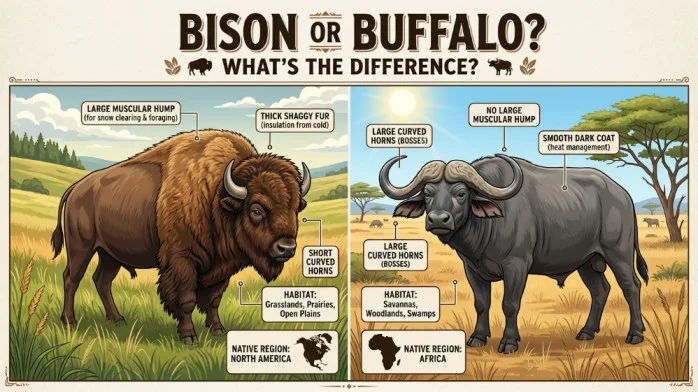
Bison and buffalo are not the same animal. A bison is native to North America and Europe, while a buffalo is found mainly in Africa and Asia. Bison have large shoulder humps and thick fur. Buffalo have longer horns, smoother coats, and no large hump. If you see an American “buffalo,” it is almost always a bison.
Quick Examples
| Animal | Example |
|---|---|
| Bison | American bison in Yellowstone National Park |
| Buffalo | African buffalo living on the African savanna |
| Buffalo | Water buffalo working on farms in Asia |
The Origin of Bison or Buffalo
The names bison and buffalo have different histories. Understanding where these words came from makes it easier to remember which animal is which.
The Origin of “Bison”
The word bison comes from the ancient Greek word bison and the Latin word bison. These words were used many centuries ago to describe large wild cattle living in Europe.
Today, the name bison refers to two living species:
- American bison
- European bison
Both animals have thick fur, short curved horns, and powerful shoulder muscles.
The Origin of “Buffalo”
The word buffalo comes from Portuguese and Italian words that described wild ox-like animals. European travelers later used the name for several large animals they found in Africa and Asia.
Today, the word buffalo mainly refers to:
- African buffalo
- Water buffalo
These animals look different from bison even though they belong to the same animal family.
Why Are the Names Confused?
Early European settlers in North America saw American bison for the first time. They believed the animals looked like buffalo they already knew from other parts of the world. Because of this, they started calling them buffalo.
The nickname became popular and is still used today.
For example:
- Buffalo Bill
- Buffalo nickel
- Buffalo burgers
- Buffalo herds
Even though these names remain common, the correct animal is actually the American bison.
British English vs American English Usage
Unlike many English words, bison and buffalo are spelled exactly the same in both British English and American English.
There are no spelling differences between the two forms of English.
The confusion comes from animal names, not from different spelling rules.
Comparison Table
| Feature | British English | American English |
|---|---|---|
| Correct spelling | Bison | Bison |
| Correct spelling | Buffalo | Buffalo |
| Different spelling? | No | No |
| Standard dictionaries | Use both names correctly | Use both names correctly |
| Main confusion | Animal identification | Animal identification |
Example Sentences
British English
- The zoo recently welcomed a young bison.
- African buffalo are known for their strength.
American English
- We saw several bison during our road trip.
- Water buffalo are common in many Asian countries.
Which Name Is More Common?
In North America, many people still say buffalo when talking about the American bison. This is part of history and culture.
However, scientists, wildlife experts, teachers, and nature guides usually use bison because it is the correct biological name.
If you are writing a school paper, article, report, or educational content, choosing bison for the North American animal is the best option.
Key Differences at a Glance
| Feature | Bison | Buffalo |
|---|---|---|
| Native to | North America and Europe | Africa and Asia |
| Shoulder hump | Large hump | No large hump |
| Fur | Thick and shaggy | Short and smooth |
| Horns | Short and curved | Long and wide |
| Beard | Usually present | Usually absent |
| Climate | Cold grasslands and forests | Warm grasslands, wetlands, and forests |
| Scientific grouping | Genus Bison | Several species in different genera |
How to Remember the Difference
A simple trick can help you remember.
Think of bison as the animal with a big hump and a thick winter coat.
Think of buffalo as the animal with long horns and a smooth body that often lives in warmer places.
If you remember hump equals bison, you will rarely mix them up again.
Why Is There Confusion Between “Bison” and “Buffalo”?
Many people use the words bison and buffalo as if they mean the same animal. This mistake has been around for hundreds of years. The confusion comes from history, popular culture, and everyday speech rather than spelling differences.
1. Early Explorers Used the Wrong Name
When European explorers reached North America, they saw the large, shaggy animal that we now call the American bison. It reminded them of the buffalo they had heard about in Africa and Asia.
Instead of using its proper name, they began calling it buffalo. The nickname spread quickly and became part of everyday language.
2. Movies and Television
Many Western movies, documentaries, and cartoons refer to American bison as buffalo.
Examples include:
- Buffalo hunters
- Buffalo trails
- Buffalo herds
These names became famous, even though the animals shown were actually bison.
3. Place Names
Many cities, roads, parks, and businesses use the word buffalo.
Examples include:
- Buffalo Gap
- Buffalo Creek
- Buffalo Mountain
- Buffalo Restaurant
Seeing these names makes many people think every large wild animal with horns is a buffalo.
4. Sports Teams and Mascots
Sports teams also help keep the confusion alive.
Names like “Buffalo” are popular because they sound strong and powerful. Even when a team logo shows an American bison, many people still call it a buffalo.
5. Similar Appearance
At first glance, both animals look alike.
Both have:
- Four legs
- Large bodies
- Horns
- Brown coloring
- Hooves
Because of these shared features, many people do not notice the important differences.
6. Internet Searches
People often type:
- bison or buffalo
- buffalo vs bison
- are buffalo and bison the same
- American buffalo
- what is the difference between buffalo and bison
These searches show that users want a quick explanation about the two animals rather than help with spelling.
Which Name Should You Use?
The best name depends on which animal you are talking about.
If You Mean the North American Animal
Use bison.
This is the correct scientific and educational term.
Examples:
- We watched a herd of bison crossing the grassland.
- The American bison is the national mammal of the United States.
If You Mean the African Animal
Use African buffalo.
Example:
- The African buffalo lives in grasslands and forests.
If You Mean the Asian Animal
Use water buffalo.
Example:
- Farmers use water buffalo to help work in rice fields.
For School and Professional Writing
Choose the correct animal name instead of using the words as if they mean the same thing.
This makes your writing more accurate and easier to understand.
In Everyday Conversation
Many people still say “buffalo” when talking about American bison.
Most listeners will understand what you mean, but bison is still the more accurate choice.
Common Mistakes with Bison or Buffalo
Here are some mistakes people often make.
Mistake 1: Calling Every Large Wild Animal a Buffalo
❌ We saw buffalo in Yellowstone National Park.
✅ We saw bison in Yellowstone National Park.
Explanation:
Yellowstone is home to American bison, not true buffalo.
Mistake 2: Thinking They Are the Same Species
❌ Bison and buffalo are exactly the same animal.
✅ Bison and buffalo are different animals in the same family.
Explanation:
They are closely related but belong to different groups.
Mistake 3: Using Buffalo in School Reports
❌ The buffalo is North America’s largest land mammal.
✅ The American bison is North America’s largest land mammal.
Explanation:
Educational writing should use the correct name.
Mistake 4: Confusing Their Homes
❌ Buffalo naturally live across North America.
✅ Bison naturally lived across much of North America.
Explanation:
True buffalo are native to Africa and Asia.
Mistake 5: Mixing Up Their Appearance
❌ Buffalo have large shoulder humps.
✅ Bison have large shoulder humps.
Explanation:
The hump is one of the easiest ways to identify a bison.
Bison or Buffalo in Everyday Examples
Knowing when to use each word helps you write more clearly.
In Emails
Correct:
We are planning a trip to see the bison in Yellowstone.
Correct:
The wildlife park recently added two African buffalo.
In News Articles
Correct:
Conservation groups continue to protect American bison populations.
Correct:
Rangers monitored a herd of African buffalo near the reserve.
On Social Media
Correct:
We finally saw wild bison today. They were amazing!
Correct:
Look at these beautiful water buffalo relaxing in the river.
In School Writing
Correct:
Bison once covered much of North America before hunting greatly reduced their numbers.
In Wildlife Guides
Correct:
Visitors should stay a safe distance from wild bison because they can move very quickly.
In Travel Blogs
Correct:
Watching a herd of bison cross the road was the highlight of our vacation.
Search Behavior and Usage Insights
People searching bison or buffalo usually want one simple answer:
Are they the same animal?
After finding that answer, many readers want to learn how to tell them apart.
Common searches include:
- bison vs buffalo
- buffalo or bison difference
- American buffalo
- what is a buffalo
- what is a bison
- pictures of bison and buffalo
- bison horns vs buffalo horns
- buffalo compared to bison
People also search after:
- Visiting a national park
- Watching wildlife documentaries
- Reading history books
- Seeing photos online
- Helping children with homework
Many readers expect a quick comparison first and then a more detailed explanation.
Comparison Table
| Feature | Bison | Buffalo |
|---|---|---|
| Correct animal name | Yes | Yes |
| Native region | North America and Europe | Africa and Asia |
| Thick shoulder hump | ✔ | ✘ |
| Thick shaggy coat | ✔ | ✘ |
| Long curved horns | Smaller | Usually much larger |
| Lives in cold climates | Often | Rarely |
| Lives in tropical climates | Rarely | Often |
| Common on farms | Sometimes | Frequently (water buffalo) |
| Seen in Yellowstone | ✔ | ✘ |
| Used for milk production | No | Water buffalo often are |
| Scientific accuracy for North American animal | ✔ | ✘ |
Quick Identification Guide
| If You See… | It Is Probably… |
|---|---|
| Huge shoulder hump | Bison |
| Thick winter fur | Bison |
| Very long wide horns | Buffalo |
| Animal working in Asian rice fields | Water buffalo |
| Large grazing animal in Yellowstone | American bison |
Frequently Asked Questions
1. Are bison and buffalo the same animal?
No. Bison and buffalo are different animals, although they belong to the same animal family. Bison are native to North America and Europe, while true buffalo live in Africa and Asia. They also have different body shapes, coats, and horns, making them easy to tell apart once you know what to look for.
2. Which is correct: bison or buffalo?
Both words are correct, but they describe different animals. Use bison when talking about the American or European species. Use buffalo when referring to the African buffalo or the Asian water buffalo. Choosing the correct name makes your writing more accurate.
3. Why do people confuse bison and buffalo?
The confusion began hundreds of years ago when early European explorers called the American bison a “buffalo.” The nickname became common in books, movies, songs, and everyday speech. Because of this long history, many people still use the two names interchangeably, even though they are different animals.
4. Is the American buffalo really a bison?
Yes. The animal often called the American buffalo is actually the American bison. While the nickname “buffalo” remains popular, wildlife experts, scientists, and educators use American bison because it is the correct biological name.
5. How can I quickly tell a bison from a buffalo?
Look at the shoulders and fur. A bison has a large shoulder hump, thick shaggy hair, and a noticeable beard. A buffalo has a smoother coat, no large hump, and much longer horns. These features make it easy to identify each animal.
6. Where do bison and buffalo live?
Bison naturally live in North America and parts of Europe. Buffalo are native to Africa and Asia. African buffalo are found in grasslands and forests, while water buffalo are common in wetlands and farming areas across many Asian countries.
7. Which word should I use in school or professional writing?
Use the correct name for the animal you mean. If you are writing about the large wild mammal found in places like Yellowstone National Park, write bison. If you are discussing African buffalo or water buffalo, use buffalo. Accurate wording makes your writing clearer and more trustworthy.
8. Why do many places and products use the word “buffalo”?
The word “buffalo” has become part of North American history and culture. It appears in place names, business names, books, and famous historical references. Even though many of these names refer to the American bison, they have remained unchanged because they are widely recognized.
Conclusion
Understanding the difference between bison or buffalo is easier than many people think. Although the two animals belong to the same family, they are not the same species. Bison are native to North America and Europe and are known for their large shoulder hump and thick coat. Buffalo live in Africa and Asia and have smoother bodies with longer horns. The confusion comes from history, not from modern English. When writing, studying, or talking about wildlife, use the correct name for the animal you mean. Doing so improves accuracy, avoids misunderstandings, and helps others learn the true difference between these remarkable animals.
Read More Related Articles:
Medical or Abbreviation | Meaning, Usage, Examples, and …
Tries or Trys | The Correct Spelling Explained Complete …