Getting a message, reading a joke, or hearing a phrase in conversation can make you stop and wonder if schooner or later is actually correct. You are not the only one. Thousands of people search for this phrase because it sounds similar to a common expression, making it easy to confuse the spelling, pronunciation, and meaning.
In this guide, you’ll discover whether schooner or later is the correct form, why so many people mix it up, and what makes the difference. We’ll explain the reason behind the confusion, provide clear examples, and share simple tips to help you avoid the same mistake in the future. Keep reading to learn the correct usage with confidence.
Quick Answer
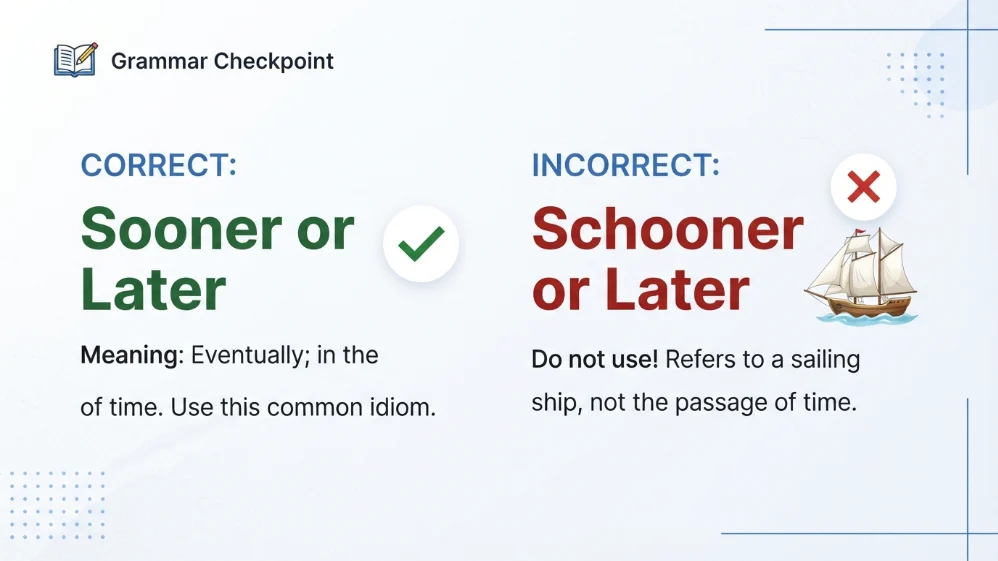
The correct English expression is “sooner or later.” It means something will happen eventually, even if it takes time.
“Schooner or later” is not a standard English phrase. It is usually a typo, a joke, or a playful pun because “schooner” is a type of sailing ship or, in some countries, a beer glass.
Examples
- ✅ Sooner or later, everyone learns from their mistakes.
- ✅ You’ll finish the project sooner or later.
- ❌ Schooner or later, you’ll understand.
The Origin of “Schooner or Later”
To understand why people search for schooner or later, it helps to know the history of the correct phrase.
The expression “sooner or later” has been used in English for centuries. It simply combines the words sooner and later to express that an event is certain to happen at some point in the future. The exact timing may be unknown, but the outcome is expected.
For example:
- Sooner or later, winter always arrives.
- Sooner or later, the truth comes out.
The word sooner is the comparative form of soon, meaning at an earlier time.
The word later means after some time.
Together, they create an idiom that means eventually.
Where Does “Schooner” Come From?
The word schooner has a completely different origin.
It refers to:
- A sailing ship with two or more masts.
- A large beer glass in countries such as Australia.
Because schooner sounds similar to sooner, people sometimes type or hear the wrong word. In many cases, writers intentionally use “schooner or later” as a humorous phrase related to boats or drinking.
So while schooner is a real English word, “schooner or later” is not a standard idiom.
British English vs American English Spelling
Unlike many English words, “sooner or later” has no spelling difference between British and American English.
People in both regions use exactly the same expression.
| Feature | British English | American English |
|---|---|---|
| Standard phrase | Sooner or later | Sooner or later |
| Correct spelling | ✅ Yes | ✅ Yes |
| Meaning | Eventually | Eventually |
| Formal writing | Preferred | Preferred |
| “Schooner or later” | Incorrect except as a joke | Incorrect except as a joke |
Examples
British English
- Sooner or later, the weather will improve.
- Sooner or later, you’ll find the answer.
American English
- Sooner or later, we’ll meet again.
- Sooner or later, every student learns this lesson.
No major English dictionary lists “schooner or later” as the standard version of the idiom.
Why Is There Confusion Between “Schooner or Later”?
Many people search for schooner or later because the two expressions sound almost identical when spoken quickly. Several factors make this mistake surprisingly common.
Similar Pronunciation
The words sooner and schooner share nearly the same ending. Fast speech can make them sound alike, especially for learners of English.
Typing Mistakes
While typing quickly, one extra group of letters can change sooner into schooner.
Examples:
- sooner → schooner
- sooner or later → schooner or later
Autocorrect Suggestions
Some keyboards recognize schooner because it is a real dictionary word. If a user accidentally types extra letters, the device may keep schooner instead of correcting it.
Social Media Humor
Many memes intentionally replace sooner with schooner to create jokes about:
- Boats
- Sailing
- Beer
- Ocean adventures
These humorous posts spread the phrase online, making people wonder whether it is actually correct.
Search Behavior
People often search:
- Is schooner or later correct?
- What does schooner or later mean?
- Should it be sooner or later?
Most of these searches come from people checking whether they have used the expression correctly.
Which Spelling Should You Use?
The answer depends on what you want to communicate.
For School and Academic Writing
Always use:
Sooner or later
Teachers, exams, dictionaries, and grammar guides recognize this as the correct idiom.
Example:
Sooner or later, every student understands the lesson.
For Business Writing
Professional emails, reports, and presentations should always use the standard phrase.
Correct:
- Sooner or later, the new policy will improve productivity.
Incorrect:
- Schooner or later, the new policy will improve productivity.
For Everyday Conversations
Use sooner or later in normal speech and writing.
People immediately understand that it means eventually.
For Jokes or Creative Writing
You may intentionally write “schooner or later” when talking about:
- Sailing
- Boats
- Pirates
- Beaches
- Beer culture
Example:
After another round at the harbor pub, everyone agreed that schooner or later they would head home.
Here, the phrase is clearly a humorous wordplay rather than correct English.
Quick Writing Advice
Use sooner or later when you want to say:
- Eventually
- At some point
- In time
- One day
Use schooner or later only when making a deliberate joke or pun.
Common Mistakes with “Schooner or Later”
Below are mistakes that writers commonly make and the correct versions.
Mistake 1: Treating “Schooner or Later” as the Standard Phrase
❌ Schooner or later, everything will be okay.
✅ Sooner or later, everything will be okay.
Why?
The English idiom uses sooner, not schooner.
Mistake 2: Assuming Both Are Acceptable
Some people believe both versions are equally correct.
This is not true.
Only sooner or later is accepted in standard English.
Mistake 3: Using the Joke in Formal Writing
Humorous expressions should stay out of professional documents.
Incorrect:
The company will schooner or later reach its goals.
Correct:
The company will sooner or later reach its goals.
Mistake 4: Confusing Meaning
Remember:
Sooner
- Means earlier.
Schooner
- Means a sailing vessel or, in some places, a type of beer glass.
They have completely different meanings even though they sound similar.
Mistake 5: Copying Memes Without Checking
Internet jokes often spread incorrect phrases for entertainment.
Before using an expression in an email, assignment, or article, check whether it is a recognized English idiom.
“Schooner or Later” in Everyday Examples
Understanding the difference is easier when you see it in real-life situations.
In Emails
✅ Correct
We will discuss the proposal sooner or later during the meeting.
❌ Incorrect
We will discuss the proposal schooner or later during the meeting.
In News Articles
✅ Correct
Experts believe the economy will recover sooner or later.
On Social Media
People sometimes write “schooner or later” as a joke.
Example:
Schooner or later, I’ll buy my dream sailboat!
Here, the writer is making a funny reference to a schooner (a sailing ship), not using the standard idiom.
In Formal Writing
Formal documents should always use the correct expression.
Example:
Sooner or later, technological advances influence every industry.
In Everyday Conversation
- Sooner or later, you’ll get used to your new job.
- Sooner or later, the rain will stop.
- Sooner or later, everyone finds their own path.
- Sooner or later, we’ll meet again.
- Sooner or later, practice brings improvement.
In Creative Writing
Writers sometimes use “schooner or later” intentionally for humor.
Example:
The old captain laughed, saying, “Schooner or later, every sailor returns to the sea.”
Because the story is about sailing, the wordplay fits the theme.
Google Trends & Usage Behavior
Many people search for schooner or later because they hear the phrase before they see it written. Since sooner and schooner sound similar, especially in fast speech, listeners may assume both spellings are correct.
Search behavior also shows that users often want quick answers to questions like:
- Is schooner or later correct?
- Should I write sooner or later?
- What does schooner or later mean?
- Is schooner or later a real phrase?
Another reason for these searches is online humor. Memes, sailing communities, and social media posts sometimes replace sooner with schooner to create a clever pun. While these jokes are entertaining, dictionaries and grammar references continue to recognize “sooner or later” as the only standard English idiom.
Comparison Table
| Phrase | Meaning | Correct or Incorrect | Context of Use |
|---|---|---|---|
| Sooner or later | Eventually; at some point in the future | ✅ Correct | Everyday English, school, business, books |
| Schooner or later | Humorous play on words using “schooner” | ⚠️ Not standard | Jokes, sailing themes, social media |
| Sooner than later | Preferably as early as possible | ✅ Acceptable in some contexts | Business and everyday conversation |
| Sooner or sooner | No clear idiomatic meaning | ❌ Incorrect | Avoid using |
| Schooner sooner | Random word combination | ❌ Incorrect | Not a recognized phrase |
Frequently Asked Questions
1. What is the correct spelling: schooner or later or sooner or later?
The correct English expression is “sooner or later.” It means eventually or at some point in the future. “Schooner or later” is not a standard idiom. It usually appears because of a typing mistake or as a humorous play on words.
2. Is “schooner or later” a real English phrase?
No. Standard English dictionaries do not recognize “schooner or later” as an official expression. It may appear in jokes, memes, or sailing-related humor, but it should not replace “sooner or later” in normal writing.
3. Why do people confuse sooner and schooner?
The confusion happens because both words sound very similar when spoken quickly. Typing mistakes, autocorrect, and humorous internet posts also contribute to the popularity of the incorrect phrase.
4. What does “sooner or later” mean?
Sooner or later means eventually or at some time in the future. It suggests that something is certain to happen, even if nobody knows exactly when it will happen.
5. Can I use “schooner or later” in professional writing?
No. Professional writing should always use “sooner or later.” The alternative phrase may confuse readers because it is not accepted as standard English.
6. Is “schooner” a real English word?
Yes. Schooner is a real English noun. It refers to a type of sailing ship and, in some countries, a large beer glass. However, that meaning has nothing to do with the idiom “sooner or later.”
7. Is “schooner or later” ever correct?
It can be appropriate when used intentionally as a joke or pun in stories, memes, or conversations about sailing or boats. Outside of those creative situations, it is considered incorrect.
8. How can I remember the correct phrase?
Think about the word soon. The phrase “sooner or later” comes from soon, making it easy to remember that it describes time. The word schooner refers to a ship, so it does not fit the meaning of the idiom.
Conclusion
The phrase “sooner or later” is the correct and widely accepted English idiom for expressing that something will happen eventually. Although “schooner or later” may appear online as a joke or because of a spelling mistake, it is not considered standard English. Understanding the difference helps you write more clearly in school assignments, professional documents, emails, and everyday conversations.
When your goal is accurate communication, always choose “sooner or later.” Reserve “schooner or later” only for intentional humor or creative wordplay involving boats or sailing. Remembering this simple distinction will help you avoid a common mistake and write with greater confidence.
Read More Related Articles:
Mercedes or BMW| Which Luxury Car Brand Is Better for …
What’s the Difference and Which Should You Use in 2026
The Correct Spelling Explained with Examples in 2026