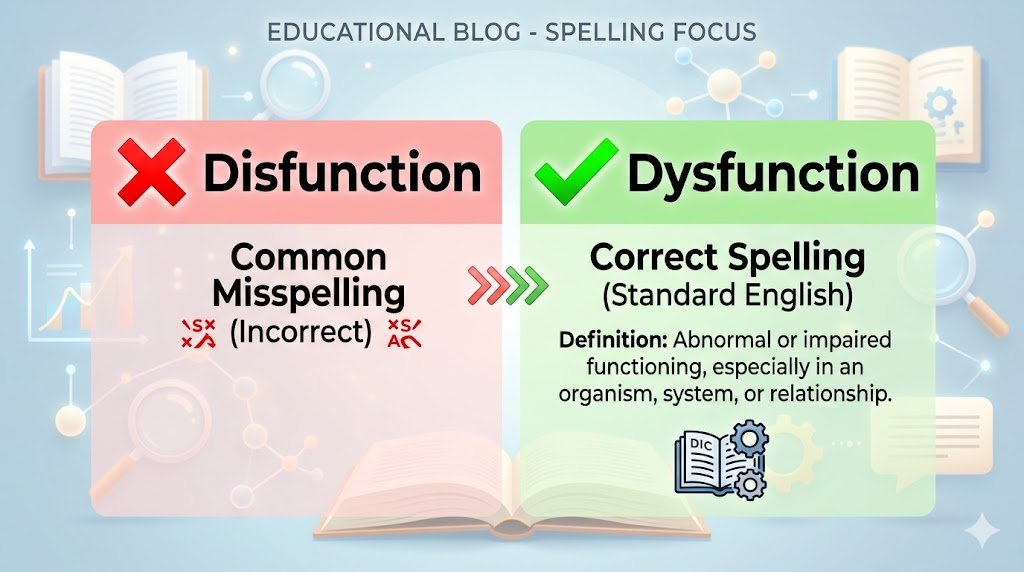
Have you ever typed disfunction and wondered whether it should actually be dysfunction? You are not alone. Thousands of people search for disfunction or dysfunction because the two words sound similar, yet only one is considered correct in standard English.
This spelling confusion appears in emails, academic writing, workplace documents, online searches, and everyday conversations. Many writers are unsure whether the prefix should be “dis-“ or “dys-“, especially because both prefixes exist in English and have different meanings.
Understanding the correct spelling matters because using the wrong form can make writing look unprofessional and may create confusion for readers. This guide explains the correct spelling, word origin, usage rules, common mistakes, and practical examples. By the end, you will know exactly when and why dysfunction is the correct choice and how to avoid this common spelling error in the future.
Quick Answer (Featured Snippet Optimized)
Dysfunction is the correct spelling in standard English. It refers to a condition, process, system, body part, or relationship that does not work properly.
Examples:
- The company suffered from organizational dysfunction.
- The patient was diagnosed with kidney dysfunction.
- Family dysfunction can affect children.
Disfunction is generally considered a misspelling of dysfunction and should be avoided in formal writing.
The Origin of Disfunction or Dysfunction
To understand why dysfunction is correct, it helps to look at the history of the word.
The word dysfunction comes from two parts:
The Prefix “Dys-“
The prefix dys- comes from Ancient Greek.
It means:
- Bad
- Difficult
- Impaired
- Abnormal
- Faulty
This prefix appears in many English words related to problems or abnormal conditions.
Examples include:
- Dyslexia
- Dysplasia
- Dyspepsia
- Dysphagia
- Dysfunction
In all these words, dys- suggests that something is not functioning normally.
The Root Word “Function”
The word function comes from Latin and refers to:
- Purpose
- Activity
- Operation
- Performance
When combined, dysfunction literally means:
“Impaired functioning” or “something that is not working correctly.”
Why Does “Disfunction” Appear?
Many people assume the word should begin with dis- because they are familiar with words such as:
- Disagree
- Disconnect
- Dislike
- Disapprove
The prefix dis- often means:
- Opposite of
- Not
- Apart
- Reverse
Because this prefix is very common, people naturally type disfunction even though English adopted the Greek-based form dysfunction instead.
This is one of the main reasons the confusion exists.
British English vs American English Spelling
One reason people search for spelling differences is because many English words have different forms in the United States and the United Kingdom.
For example:
| American English | British English |
|---|---|
| Color | Colour |
| Favor | Favour |
| Organize | Organise |
| Center | Centre |
However, dysfunction is not one of those words.
Both British English and American English use exactly the same spelling.
Comparison Table
| Language Version | Correct Spelling | Example |
|---|---|---|
| American English | Dysfunction | System dysfunction caused delays. |
| British English | Dysfunction | Family dysfunction affected communication. |
| Canadian English | Dysfunction | Kidney dysfunction requires treatment. |
| Australian English | Dysfunction | Organizational dysfunction reduced productivity. |
| New Zealand English | Dysfunction | Market dysfunction affected prices. |
Is “Disfunction” Accepted Anywhere?
No major English dictionary recognizes disfunction as the preferred spelling.
Writers in:
- United States
- United Kingdom
- Canada
- Australia
- New Zealand
all use dysfunction.
Therefore, there is no regional spelling difference between the two forms.
Why Is There Confusion Between “Disfunction” and “Dysfunction”?
The confusion between these spellings comes from several factors.
1. Similar Pronunciation
When spoken quickly, many people hear little difference between:
- Dysfunction
- Disfunction
Because of this, writers often spell the word based on sound rather than dictionary rules.
English contains many words that are not spelled exactly how they sound, making this mistake common.
2. The Familiar “Dis-” Prefix
Most English speakers encounter the prefix dis- frequently.
Examples include:
- Disappear
- Dislike
- Disconnect
- Disobey
- Disrespect
Because the prefix appears in thousands of words, people instinctively apply it to unfamiliar terms.
As a result, disfunction feels logical even though it is incorrect.
3. Typing Errors
Fast typing often creates spelling mistakes.
Someone may type:
- disfunction
- dysfuntion
- dysfuction
- disfuntion
without noticing the error.
This happens regularly in emails, reports, and social media posts.
4. Search Engine Behavior
Search engines are very good at understanding spelling mistakes.
When users search for:
- disfunction
- disfunction meaning
- disfunction vs dysfunction
search engines usually return results for dysfunction.
Because users still find the information they need, the incorrect spelling continues to circulate online.
5. Lack of Knowledge About Greek Prefixes
Many people know the meaning of dis- but are less familiar with dys-.
Words beginning with dys- are often medical or technical terms.
Examples include:
- Dyslexia
- Dysgraphia
- Dyspepsia
- Dysarthria
Since these words are less common in daily conversation, people may not recognize the correct spelling pattern.
Which Spelling Should You Use?
The answer is simple:
Always Use “Dysfunction”
Whether you are writing for:
- School
- University
- Business
- Healthcare
- Government
- Online publishing
the correct spelling is dysfunction.
For American Audiences
Use:
✅ Dysfunction
Example:
- Workplace dysfunction reduced team performance.
For British Audiences
Use:
✅ Dysfunction
Example:
- The report highlighted organizational dysfunction.
For International Audiences
Use:
✅ Dysfunction
Example:
- System dysfunction caused service interruptions.
In Formal Writing
Formal writing requires accuracy.
Examples include:
- Academic papers
- Research articles
- Legal documents
- Medical reports
- Business communications
In these situations, disfunction should never be used.
In Informal Writing
Even in:
- Text messages
- Social media
- Blog comments
it is still best to use dysfunction.
Using the correct spelling improves credibility and helps readers understand your message immediately.
Common Mistakes with Disfunction or Dysfunction
Many writers make the same errors repeatedly.
Understanding them can help you avoid future mistakes.
Mistake #1: Using Disfunction in Professional Writing
❌ The company experienced severe disfunction.
✅ The company experienced severe dysfunction.
Explanation:
Professional documents should always use the standard spelling.
Mistake #2: Assuming Disfunction Is British English
❌ Disfunction is the British version.
✅ Dysfunction is correct in both British and American English.
Explanation:
There is no regional spelling difference.
Mistake #3: Confusing the Prefixes
❌ Disfunction means poor functioning.
✅ Dysfunction means poor functioning.
Explanation:
The correct prefix is dys-, not dis-.
Mistake #4: Copying Incorrect Online Sources
Some websites contain spelling errors.
Always verify spelling using trusted dictionaries and language references.
Mistake #5: Relying Only on Pronunciation
❌ If it sounds like disfunction, it must be correct.
✅ English spelling often differs from pronunciation.
Explanation:
Correct spelling follows historical language rules, not just spoken sounds.
Dysfunction in Different Contexts
The word dysfunction appears in many fields.
Understanding these uses helps clarify its meaning.
Medical Dysfunction
In medicine, dysfunction describes an organ or body part that does not operate properly.
Examples:
- Liver dysfunction
- Kidney dysfunction
- Sexual dysfunction
- Cognitive dysfunction
Healthcare professionals use the term frequently because it clearly indicates impaired function.
Family Dysfunction
In psychology and family studies, dysfunction refers to unhealthy patterns within relationships.
Examples include:
- Poor communication
- Constant conflict
- Lack of emotional support
- Unhealthy behavior patterns
Family dysfunction can affect emotional and social development.
Organizational Dysfunction
Businesses often use the term when systems fail to operate efficiently.
Examples:
- Poor leadership
- Lack of communication
- Internal conflicts
- Ineffective processes
Organizational dysfunction can reduce productivity and employee satisfaction.
Social Dysfunction
Communities and social groups may experience dysfunction when systems fail to meet people’s needs.
Examples include:
- Institutional problems
- Public service failures
- Community conflict
The term helps describe situations where normal functioning has broken down.
Dysfunction in Everyday Examples
The word dysfunction appears in many areas of daily life. Learning how it is used can help you remember the correct spelling and understand its meaning more clearly.
In Emails
Professionals often use the word when discussing problems within systems, teams, or processes.
Examples:
- The recent dysfunction in our workflow caused project delays.
- Management is working to address communication dysfunction between departments.
- Technical dysfunction affected the software rollout.
These examples show how the word describes something that is not operating as intended.
In News Articles
Journalists frequently use dysfunction when reporting on organizations, governments, institutions, or social issues.
Examples:
- Political dysfunction delayed important legislation.
- The report identified dysfunction within the agency.
- Experts warned that market dysfunction could affect investors.
News writing often uses the term to describe failures in systems or operations.
On Social Media
Social media users may use the word casually when discussing personal experiences, workplaces, or public events.
Examples:
- Our group project is pure dysfunction right now.
- Office dysfunction is making everyone frustrated.
- The level of dysfunction in this situation is unbelievable.
Even in informal settings, the spelling remains dysfunction.
In Academic Writing
Researchers use the word when discussing psychological, medical, educational, or social topics.
Examples:
- Family dysfunction was associated with higher stress levels.
- Cognitive dysfunction affected learning outcomes.
- Organizational dysfunction reduced overall efficiency.
Academic writing requires precise language, making the correct spelling especially important.
In Medical Reports
Healthcare professionals frequently use the term.
Examples:
- The patient showed signs of kidney dysfunction.
- Hormonal dysfunction may contribute to symptoms.
- Early treatment can reduce dysfunction and improve outcomes.
In medicine, the word often refers to impaired operation of an organ or body system.
In Formal Business Writing
Businesses use the term when evaluating performance or internal processes.
Examples:
- Leadership dysfunction affected decision-making.
- The audit revealed operational dysfunction.
- Addressing dysfunction can improve productivity.
Because the term appears frequently in professional communication, using the correct spelling is essential.
Google Trends & Usage Behavior
People search for disfunction or dysfunction for several reasons.
Most users are not looking for a definition alone. Instead, they want confirmation of the correct spelling.
Common Search Intent
Users often search:
- Is disfunction correct?
- Dysfunction meaning
- Disfunction vs dysfunction
- How do you spell dysfunction?
- What is dysfunction?
These searches show that many people are unsure which version is accepted in standard English.
Typo-Based Searches
A large portion of searches containing disfunction come from spelling mistakes.
This happens because:
- The word sounds similar when spoken.
- The prefix “dis-” is more familiar.
- Users type quickly.
- Some people have never seen the word written before.
Search engines typically recognize this intent and guide users toward dysfunction.
Regional Search Patterns
The confusion appears in:
- United States
- United Kingdom
- Canada
- Australia
- South Africa
- New Zealand
Because both major English varieties use the same spelling, users worldwide ask the same question.
Why Search Engines Understand Both Terms
Modern search engines are designed to recognize:
- Misspellings
- Typographical errors
- Alternative spellings
- User intent
As a result, someone searching for disfunction will usually receive information about dysfunction.
What This Reveals About User Behavior
People often:
- Spell words based on pronunciation.
- Assume familiar prefixes are correct.
- Trust search engines to correct mistakes.
- Seek confirmation before using a word professionally.
This explains why searches for disfunction or dysfunction continue to appear despite the correct spelling being well established.
Comparison Table – Keyword Variations
| Variation | Meaning | Correct or Incorrect | Context of Use |
|---|---|---|---|
| Dysfunction | Impaired or abnormal functioning | Correct | Medical, academic, business, psychology, everyday writing |
| Disfunction | Common misspelling of dysfunction | Incorrect | Typing errors, spelling confusion |
| Organizational Dysfunction | Problems within a company or institution | Correct | Business and management |
| Family Dysfunction | Unhealthy family relationships | Correct | Psychology and social studies |
| Cognitive Dysfunction | Impaired mental functioning | Correct | Medicine and healthcare |
| System Dysfunction | Failure of a process or system | Correct | Technology, engineering, business |
Quick Comparison
| Word | Accepted English Word? | Recommended Usage |
|---|---|---|
| Dysfunction | Yes | Always use |
| Disfunction | No | Avoid |
Frequently Asked Questions
1. What is the correct spelling: disfunction or dysfunction?
The correct spelling is dysfunction. This is the form recognized by major dictionaries and used in professional, academic, medical, and everyday writing. The spelling disfunction is generally considered a mistake and should not be used in formal communication.
2. Is disfunction a real word?
Disfunction occasionally appears in writing, but it is not accepted as the standard English spelling. Most dictionaries list dysfunction as the correct form. When people use disfunction, it is usually the result of a spelling error or misunderstanding of the word’s origin.
3. Why do people confuse disfunction and dysfunction?
The confusion happens because the words sound similar. Many people are familiar with the prefix dis- from words like disagree and disconnect. Since the prefix dys- is less common in everyday language, writers often assume disfunction is correct.
4. Which spelling is correct in English?
The correct spelling in all major English varieties is dysfunction. This includes American English, British English, Canadian English, Australian English, and other forms of English used around the world.
5. Is disfunction a typo or a name?
Most of the time, disfunction is simply a typo for dysfunction. Unlike some spelling variations that are accepted regionally, disfunction is not considered a standard alternative spelling.
6. Why does dysfunction use “dys” instead of “dis”?
The prefix dys- comes from Greek and means impaired, difficult, abnormal, or faulty. Because the word refers to something functioning poorly, the Greek prefix is the correct choice. The prefix dis- has a different meaning and is not appropriate here.
7. Can I use disfunction in academic writing?
No. Academic writing requires standard spelling and precise language. Universities, journals, researchers, and educators use dysfunction. Using disfunction may be marked as an error or reduce the credibility of your work.
8. How can I remember the correct spelling?
A simple trick is to connect dysfunction with other words that begin with dys-, such as dyslexia and dyspepsia. These words all describe some form of difficulty or impairment. Remembering this pattern makes the correct spelling easier to recall.
Conclusion
The answer to disfunction or dysfunction is straightforward: dysfunction is the correct spelling in standard English. It is used worldwide in medical, psychological, academic, professional, and everyday contexts to describe something that is not functioning properly. The spelling disfunction usually appears because of pronunciation-based mistakes, typing errors, or confusion about English prefixes.
Understanding the word’s Greek origin makes the difference easier to remember. The prefix dys- means impaired or abnormal, which perfectly matches the meaning of the word. you are writing an email, a report, a social media post, or a research paper, always choose dysfunction. Using the correct spelling improves clarity, strengthens credibility, and helps ensure your message is understood by readers everywhere.