Have you ever stared at a word and wondered if you were spelling it right? You are not alone. Many people search for sulfur or sulphur because they see both versions and feel confused. One looks American. The other looks British. But which one is truly correct?
This is a common problem. Writers, students, and even scientists have argued about this spelling for years. The confusion happens because both spellings have a long history. Plus, different countries prefer different versions. The good news is that the answer is now clear.
This article will give you a simple and final answer. You will learn the difference between sulfur or sulphur. You will understand why both exist. And you will know exactly which one to use in any situation. By the end, you will feel confident and never second-guess this spelling again.
Quick Answer
Sulfur is the recommended spelling worldwide. Both spellings mean the same thing: a yellow chemical element with atomic number 16. Sulfur is preferred in American English and by the International Union of Pure and Applied Chemistry (IUPAC). Sulphur is the traditional British spelling. However, even British scientists now use sulfur in technical writing.
The Origin of Sulfur and Sulphur
The word has ancient roots. It comes from the Latin word sulpur, which meant “burning stone” or brimstone . The Latin pronunciation had a puff of air after the “p.” This puff was shown with an “h,” creating the spelling sulphur. Over time, people mistakenly thought the word came from Greek. In Greek, words with an “f” sound often used “ph.” This error made the “ph” spelling seem more educated .
In the 12th century, Anglo-French used sulfre. By the 14th century, the “ph” spelling appeared in Middle English as sulphre . By the 15th century, both sulfur and sulphur were common in English .
So, the confusion is not new. It has existed for hundreds of years. The “ph” spelling became the standard in Britain. The “f” spelling became the standard in the United States . This split continued until the late 20th century.
British English vs American English Spelling
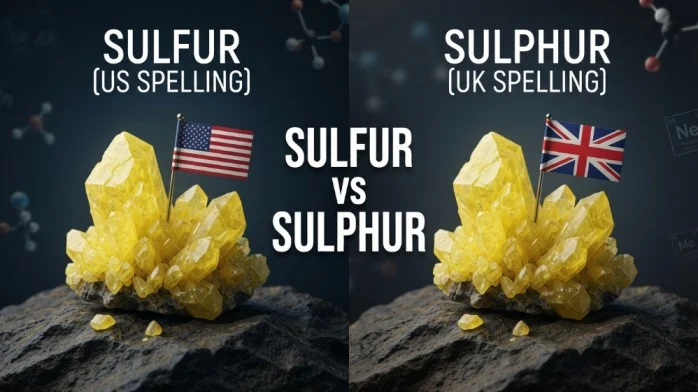
The main difference is regional. American English uses sulfur. British English traditionally uses sulphur. However, the rules have changed.
| English Variety | Spelling | Example |
|---|---|---|
| American English | sulfur | The sulfur smell was strong. |
| Traditional British English | sulphur | The sulphur dioxide caused acid rain. |
| Modern British Scientific | sulfur | IUPAC recommends sulfur. |
| Canadian English | both | Usage varies. |
| Australian English | sulphur | Traditional usage. |
Here are more examples of the spelling difference:
- American: sulfuric acid, sulfate, sulfide
- British: sulphuric acid, sulphate, sulphide
In 1990, IUPAC officially adopted the sulfur spelling . In 1992, the Royal Society of Chemistry followed . This means that in scientific and technical contexts, sulfur is now the standard spelling in British English too .
One writer noted that “sulfur is now universally accepted as the most common spelling in English” . Another said, “Even most British chemists now use sulfur” .
Why Is There Confusion Between “Sulfur” and “Sulphur”?
Several reasons explain why people mix up sulfur or sulphur.
Historical Spelling Split
For centuries, both spellings existed. Britain chose “ph.” America chose “f.” This created two standard versions .
Regional Habits
People often learn one spelling and think the other is wrong. A British person might call “sulfur” an Americanism. An American might call “sulphur” old-fashioned .
Pronunciation Similarity
Both spellings sound exactly the same. The “ph” is pronounced as “f.” So, you cannot hear the difference. This makes it easy to write either version without noticing.
Official Changes
In 1990, IUPAC chose “sulfur” as the international standard . But many people still use the old spelling. This creates ongoing confusion.
Resistance to Change
Some people prefer the traditional “sulphur.” They see the new “sulfur” as a change forced by Americans. One person called it “linguistic imperialism” . Another said, “Sulphur seems more correct” .
Which Spelling Should You Use?
The rule depends on your audience and context.
- For US audiences: Use sulfur. This is the standard American spelling .
- For UK or Commonwealth audiences: Use sulfur in scientific or technical writing. Use sulphur in everyday or traditional writing .
- For global audiences: Use sulfur. IUPAC recommends this spelling. It is the international standard .
- For academic or scientific contexts: Use sulfur. This is the official chemical name .
Practical writing advice:
- In formal scientific reports, use “sulfur.”
- In news articles for the UK, you may see “sulphur.” For example, The Guardian uses “sulphur” .
- In US publications, always use “sulfur.”
- In emails and social media, either is acceptable. But “sulfur” is more modern.
Some experts give simple advice: “Sulfur for technical writing as it’s internationally recognised and adopted. Sulphur for creative writing as it’s way more aesthetically agreeable” .
Common Mistakes with Sulfur and Sulphur
Here are the most frequent errors and how to fix them.
| Wrong Spelling | Correct Spelling | Explanation |
|---|---|---|
| sulfer | sulfur | Missing the “u.” |
| sulpher | sulfur or sulphur | Wrong vowel order. |
| sulfar | sulfur | Wrong vowel at the end. |
| sulphor | sulphur | Wrong vowel at the end. |
Example Mistakes
- ❌ “The sulfer smell filled the room.” → ✔ “The sulfur smell filled the room.”
- ❌ “I spilled sulphir on the table.” → ✔ “I spilled sulphur on the table.”
One common mistake is using “sulfer” with one “u.” Always keep the “u” after the “l.”
Another mistake is using “sulpher” with “ph” and an “e.” The correct British spelling is “sulphur.” The correct American spelling is “sulfur.”
Sulfur and Sulphur in Everyday Examples
- In Scientific Reports
“Sulfur is essential for plant growth.”
- In News Articles (UK)
- In News Articles (US)
“The EPA regulates sulfur dioxide emissions.”
- In Emails
“Please check the sulfur content in the sample.”
On Social Media
“This volcano is releasing so much sulfur!”
In School Textbooks
“Sulfur is a yellow nonmetal.”
Using the correct spelling makes your writing look professional and accurate.
Google Trends & Usage Behavior
Search data shows that people search for both sulfur and sulphur. The intent is usually to confirm which spelling is correct.
In the United States, sulfur is the dominant search term. In the United Kingdom, sulphur is still common, but searches for “sulfur” are increasing. This reflects the IUPAC change and the influence of American English.
In India, Australia, and New Zealand, sulphur remains popular . In the Philippines, sulfur is preferred .
Some people search for “sulphur” because they have seen it in older texts. Others search for “sulfur” because they are learning chemistry. Many users want a clear answer. This article provides that answer.
Comparison Table
| Term | Meaning | Correct/Incorrect | Context |
|---|---|---|---|
| sulfur | Chemical element (S) | Correct (US and IUPAC) | Scientific, American English |
| sulphur | Chemical element (S) | Correct (Traditional British) | British English, older texts |
| sulfate | Salt of sulfuric acid | Correct (US) | Chemistry |
| sulphate | Salt of sulfuric acid | Correct (British) | Chemistry |
| sulfide | Compound of sulfur | Correct (US) | Chemistry |
| sulphide | Compound of sulfur | Correct (British) | Chemistry |
| sulfuric | Relating to sulfur | Correct (US) | Chemistry |
| sulphuric | Relating to sulfur | Correct (British) | Chemistry |
FAQs
What is the correct spelling of sulfur or sulphur?
The correct spelling is sulfur according to IUPAC, the international chemistry authority. In 1990, IUPAC officially adopted “sulfur” as the standard spelling. This means it is the most correct version for scientific and global use .
Is sulphur a real word?
Yes, “sulphur” is a real word. It is the traditional British English spelling. It has been used for centuries. You will still see it in British publications, older texts, and everyday British writing .
Why do people confuse sulfur and sulphur?
People confuse them because both spellings have a long history. Britain used “sulphur,” while America used “sulfur.” Also, the official standard changed in 1990 to “sulfur.” This change created confusion between the old and new spellings .
Which spelling is correct in English?
Both are correct, but in different contexts. “Sulfur” is correct in American English and international science. “Sulphur” is correct in traditional British English. However, even British scientists now use “sulfur” in technical writing .
Is sulfur the American spelling?
Yes, “sulfur” is the American spelling. It has been the standard in the United States since the early 20th century. It is also the spelling adopted by IUPAC in 1990 .
Is sulphur the British spelling?
Yes, “sulphur” is the traditional British spelling. It was the standard in the UK for many years. However, after the IUPAC decision in 1990, British science and education have moved toward “sulfur” .
When did sulfur become the official spelling?
IUPAC adopted “sulfur” in 1990. The Royal Society of Chemistry followed in 1992. In 2000, UK schools began teaching “sulfur” as the standard spelling .
What are the derivatives of sulfur and sulphur?
For “sulfur,” the derivatives are sulfate, sulfide, and sulfuric. For “sulphur,” the derivatives are sulphate, sulphide, and sulphuric. The spelling matches the root word .
Conclusion
The answer is now clear. Sulfur is the recommended spelling worldwide, especially in science and technical writing. This is the spelling used by IUPAC, the Royal Society of Chemistry, and most modern publications . Sulphur is the traditional British spelling. It is still used in everyday British writing and older texts .
So, which one should you use? For American audiences, use sulfur. For British audiences, you can use either. But sulfur is safer for technical and global communication. It is the modern, international standard.
The confusion between sulfur or sulphur is understandable. Both have a long history. But the debate is now settled. Use “sulfur” with confidence. You are using the correct spelling. And you will look professional and up-to-date.
Read More Related Articles:
Tortoise or Turtle | What’s the Difference and Which Word …
Cringy or Cringey | Which Spelling Is Correct and When …