Writing an email, assignment, or social media post can quickly become frustrating when a single word makes you stop and wonder if it is correct. Many people hesitate between halve or half, unsure which one fits the sentence. You are not the only one facing this confusion, and that is exactly why thousands of people search for this keyword every month.
The mix-up often happens because these words look similar, sound related, and are connected in meaning. Whether the confusion comes from spelling, grammar, pronunciation, or word usage, choosing the wrong one can make your writing less accurate and less professional.
This guide will clear up the confusion around halve or half in a simple and practical way. You will learn the correct usage, understand why each word is used differently, see plenty of real-life examples, and discover easy tips to avoid making the same mistake again. Keep reading to master this common English confusion with confidence.
Quick Answer
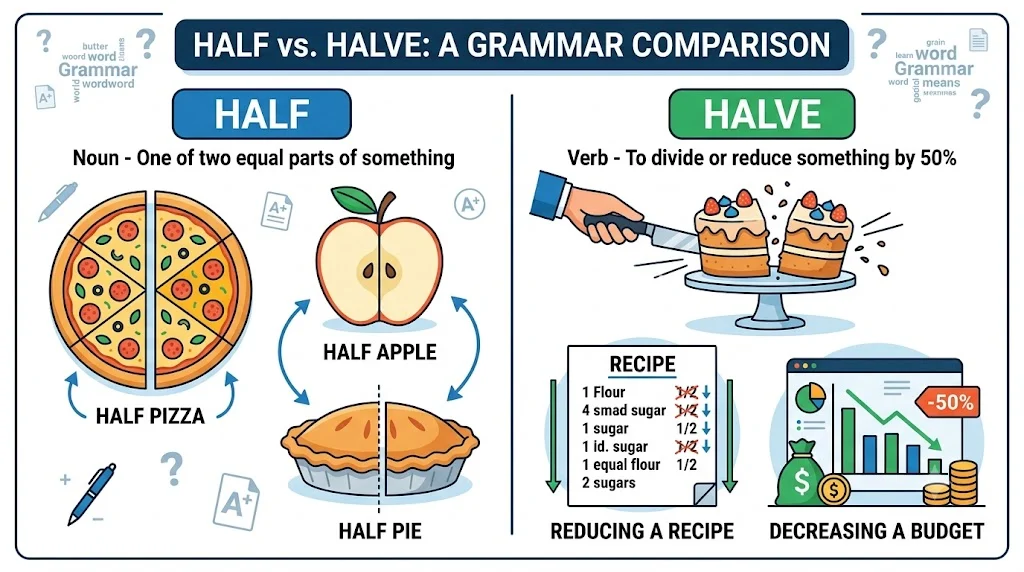
Half is usually a noun, adjective, or adverb that means one of two equal parts. Halve is a verb that means to divide something into two equal parts or reduce it by 50%.
Examples:
- I ate half of the pizza.
- Please halve the recipe.
- The company halved its expenses.
- She walked half a mile.
The easiest way to remember the difference is this: half names the part, while halve describes the action.
The Origin of Halve or Half
The words half and halve have a long history in the English language. Both come from the Old English word healf, meaning one of two equal parts. As English changed over hundreds of years, the language created a separate verb to describe the action of cutting or reducing something into halves.
This is why half and halve are closely related but have different jobs in a sentence.
Over time:
- Half remained the word for one of two equal parts.
- Halve developed as the action of making something into two equal parts.
- Modern English uses both words every day in speaking and writing.
Many people confuse them because they share the same root word and are pronounced similarly.
British English vs American English Usage
Unlike many English words, half and halve do not have different spellings in British and American English. Both forms are accepted on both sides of the Atlantic.
The only differences are in writing style, vocabulary choices, and sentence structure, not spelling.
| Feature | British English | American English |
|---|---|---|
| Spelling | Half | Half |
| Verb | Halve | Halve |
| Meaning | Same | Same |
| Formal Writing | Correct | Correct |
| Everyday Use | Very Common | Very Common |
Examples in British English
- Cut the sandwich in half.
- The council plans to halve traffic in the town centre.
- He drank half the bottle.
Examples in American English
- She finished half her homework.
- They hope to halve fuel costs.
- Cut the apple in half.
The spelling stays the same wherever English is used.
Why Is There Confusion Between “Halves” and “Halfs”?
Many people also search for halves or halfs, especially when writing quickly. The confusion happens because English has many plural rules, and learners often expect every word ending in f to simply add s.
The correct plural of half is halves, not halfs.
Several reasons cause this mistake.
Pronunciation
When people hear the word, they may not notice the change from f to v, so they write halfs instead.
Regular Plural Habit
Many English nouns form the plural by adding s, so writers naturally type halfs before checking.
Typing Quickly
Fast typing often leads to spelling mistakes, especially on phones or tablets.
Autocorrect Problems
Some devices may not correct the mistake immediately, making users think halfs is acceptable.
Learning English
People learning English often apply one grammar rule to every noun, even though English has many irregular plurals.
The Correct Rule
| Singular | Correct Plural | Incorrect Plural |
|---|---|---|
| Half | Halves | Halfs |
| Leaf | Leaves | Leafs (except proper names) |
| Knife | Knives | Knifes |
| Wolf | Wolves | Wolfs (except names) |
Remember this simple rule:
- If you mean more than one half, write halves.
- If you mean the action, use halve.
- If you mean one of two equal parts, use half.
Which Spelling Should You Use?
The correct choice depends on what you want to say, not where you live. Half and halve are both correct English words, but they have different jobs in a sentence.
Choose half when you are talking about one of two equal parts or describing a quantity.
Examples
- I ate half the cake.
- The glass is half full.
- We finished half the project.
Choose halve when you mean to divide something into two equal parts or reduce it by 50%.
Examples
- Please halve the oranges.
- We need to halve the budget.
- The doctor told him to halve the dose.
Quick Writing Tips
- Use half as a noun, adjective, or adverb.
- Use halve only as a verb.
- If you can replace the word with divide into two or reduce by half, halve is the correct choice.
- If you are describing an amount, use half.
Whether you write for readers in the United States, the United Kingdom, Canada, Australia, or anywhere else, these rules stay the same.
Common Mistakes with Halve or Half
Even experienced writers sometimes mix these words. Here are the most common mistakes and the correct forms.
Mistake 1: Using half as a verb
❌ Please half the watermelon.
✅ Please halve the watermelon.
Why?
The sentence needs an action, so the verb halve is correct.
Mistake 2: Using halve as a noun
❌ I ate halve of the sandwich.
✅ I ate half of the sandwich.
Why?
You are talking about an amount, so half is the correct word.
Mistake 3: Writing halfs
❌ Two halfs make a whole.
✅ Two halves make a whole.
Why?
The plural of half is halves.
Mistake 4: Confusing the meanings
❌ The company halfed its expenses.
✅ The company halved its expenses.
Why?
The past tense of halve is halved, not halfed.
Mistake 5: Using the wrong word in instructions
❌ Half the tomatoes before cooking.
✅ Halve the tomatoes before cooking.
Why?
The sentence gives a command, so it needs the verb halve.
Halve or Half in Everyday Examples
Understanding grammar is easier when you see real-life examples. Here is how these words appear in everyday writing.
Emails
- Please halve the number of printed copies for tomorrow’s meeting.
- I completed half of the report before lunch.
- We have already used half of this month’s budget.
News Writing
- The city hopes to halve road accidents over the next five years.
- Rainfall reached only half of the usual level this season.
- The factory halved its energy use after upgrading its equipment.
Social Media
- I only watched half the movie before falling asleep.
- Time to halve my screen time this week.
- Finished half my workout and still feel great.
School Writing
- Cut the paper in half.
- The teacher asked students to halve each rectangle.
- One half equals fifty percent.
Business Writing
- We plan to halve delivery times next year.
- Sales reached half of last month’s total.
- The company successfully halved production costs.
Daily Conversations
- Can you cut this apple in half?
- Let’s halve the pizza so everyone gets the same amount.
- I only need half a cup of milk.
These examples show a simple pattern. If the word describes an amount, use half. If it describes an action, use halve.
Google Trends and Search Behavior
Many people search for halve or half because they are unsure which word fits their sentence. The confusion is common among students, English learners, office workers, and anyone writing quickly.
People often search using phrases such as:
- halve or half
- half vs halve
- when to use halve
- difference between half and halve
- halve meaning
- half meaning
- halves or halfs
- is halve a real word
- half grammar
- halve examples
Searches for these words usually increase during school terms, writing assignments, grammar lessons, and professional editing tasks. Many users arrive after a spell checker highlights a word or after they notice different versions in books or online articles.
Because both words are correct but have different meanings, users are usually looking for a quick explanation with simple examples rather than long grammar rules.
Comparison Table – Halve vs Half
| Feature | Half | Halve |
|---|---|---|
| Part of Speech | Noun, adjective, adverb | Verb |
| Meaning | One of two equal parts | To divide into two equal parts or reduce by 50% |
| Correct Word | ✅ Yes | ✅ Yes |
| Used as an Action | ❌ No | ✅ Yes |
| Used as an Amount | ✅ Yes | ❌ No |
| Example | Half the cake is gone. | Please halve the cake. |
| Common Mistake | Using it as a verb | Using it as a noun |
Understanding this table makes it easy to choose the correct word in almost every sentence.
FAQs
What is the difference between halve and half?
Half refers to one of two equal parts of something. It can be a noun, adjective, or adverb. Halve is a verb that means to divide something into two equal parts or reduce it by 50%. Although the words are related, they have different grammatical roles.
Is halve a real English word?
Yes. Halve is a standard English verb used in both British and American English. It appears in dictionaries and is commonly used in cooking, mathematics, business, science, and everyday conversation when describing the action of cutting or reducing something by half.
Which is correct: half or halve?
Both words are correct, but they are used differently. Choose half when talking about an amount or one of two equal parts. Choose halve when describing the action of dividing something into two equal parts or reducing it by half.
Is halfs correct?
No. The correct plural of half is halves. English changes the f to v before adding es in this word. Writing halfs is considered a spelling mistake in standard English.
Can half be used as a verb?
In standard English, half is not normally used as a verb. If you mean to cut or divide something into two equal parts, the correct verb is halve.
Is there a spelling difference between British and American English?
No. Both British English and American English use the same spellings: half, halve, and halves. The meanings and grammar rules are also the same, so there is no regional spelling difference for these words.
Why do people confuse halve and half?
The confusion happens because the words share the same origin, look almost identical, and sound similar when spoken. Many people also forget that one is a noun while the other is a verb, leading to mistakes in writing.
How can I remember the difference easily?
A simple trick is to remember that half is the thing, while halve is the action. If you can replace the word with divide into two or reduce by half, use halve. If you are talking about an amount or portion, use half.
Conclusion
The difference between halve and half is simple once you know their roles. Half refers to one of two equal parts, while halve means to divide something into two equal parts or reduce it by fifty percent. They are both correct words, but they cannot replace each other because each has a different grammatical purpose. Remember that the plural of half is halves, not halfs. By keeping these rules in mind and using the examples in this guide, you can avoid common mistakes and write with confidence in school, at work, and in everyday communication.
Read More Related Articles:
Fazed or Phased | The Correct Word, Meaning, Examples, and …
Parent or Guardian | Everything You Need to Know Before Filling …