Have you ever stopped while writing because you weren’t sure whether to use do or dye? It is a common confusion because both words are short, easy to pronounce, and sound somewhat alike in fast speech. A simple typing mistake or autocorrect can also lead to using the wrong word.
The truth is that do or dye are both real English words, but they have completely different meanings. One relates to performing an action, while the other refers to changing the color of something, usually hair or fabric. Knowing the difference helps you write clearly and avoid embarrassing mistakes.
This guide explains the meaning of each word, where the confusion comes from, when to use each spelling, and practical examples you can follow with confidence.
Quick Answer
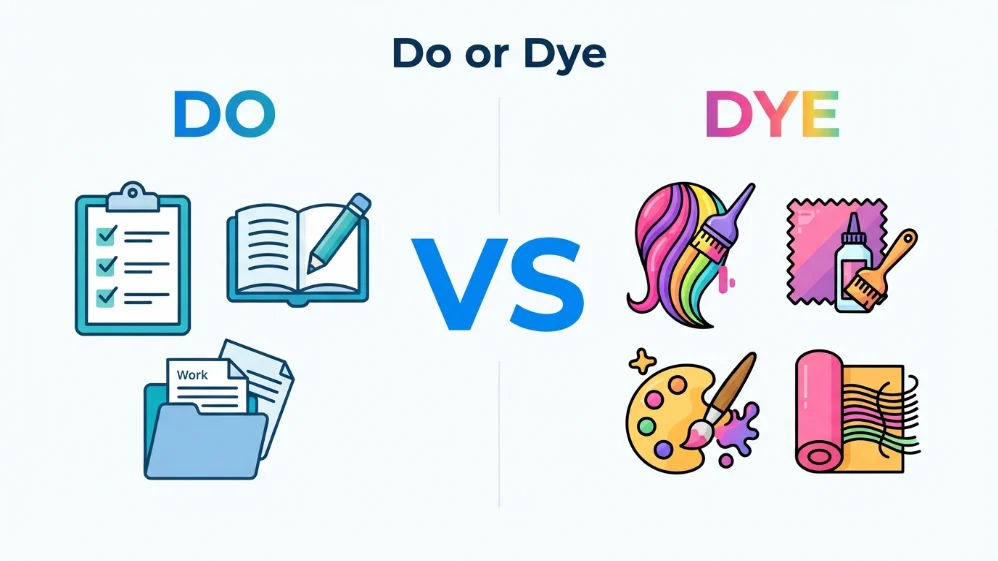
Do means to perform, complete, or carry out an action. It is one of the most common verbs in English.
Dye means to color something, such as hair, clothes, or fabric, using a coloring substance.
Examples:
- I need to do my homework before dinner.
- She wants to dye her hair brown this weekend.
- Please do your best.
- They used natural plants to dye the cloth blue.
If you are talking about an action, use do. If you are talking about adding color, use dye.
The Origin of Do or Dye
Understanding where these words came from makes it easier to remember their meanings.
The Origin of Do
The word do comes from the Old English word dōn, meaning to perform, make, complete, or carry out. It has been part of English for over a thousand years and is one of the language’s most frequently used verbs.
Today, do appears in everyday conversations, questions, commands, schoolwork, business writing, and formal documents.
Examples include:
- Do your work.
- What are you doing?
- They did an amazing job.
- I will do it tomorrow.
The Origin of Dye
The word dye entered English through the Old English word deagian, meaning to color or stain. Over time, it became associated with changing the color of cloth, leather, yarn, and later human hair.
Today, dye is commonly used in fashion, beauty, art, and textile industries.
Examples include:
- She dyed her hair black.
- They dye cotton using natural colors.
- This fabric is easy to dye.
Why These Words Get Mixed Up
The confusion happens because:
- Both words are very short.
- They are often typed quickly.
- Autocorrect sometimes replaces one with the other.
- Fast pronunciation can make them sound similar.
- Many learners remember the sound but forget the meaning.
The key difference is simple:
- Do = perform an action
- Dye = change the color of something
British English vs American English Spelling
Unlike many English words, do and dye have the same spelling in both British and American English. There is no regional spelling difference.
The meanings also remain identical across English-speaking countries.
| Feature | British English | American English |
|---|---|---|
| Action verb | Do | Do |
| Coloring hair | Dye | Dye |
| Coloring fabric | Dye | Dye |
| Daily writing | Do | Do |
| Formal writing | Do | Do |
| Beauty industry | Dye | Dye |
| Correct spelling | Do / Dye | Do / Dye |
British English Examples
- Please do your homework before dinner.
- She decided to dye her hair red.
- We must do our best.
- The artist used flowers to dye the fabric.
American English Examples
- I have a lot of work to do today.
- He wants to dye his beard.
- They always do a great job.
- This company uses safe chemicals to dye clothing.
No matter where you live, the correct spellings remain exactly the same.
Why Is There Confusion Between “Do or Dye”?
Many people search do or dye because they know one spelling is correct but cannot remember which word fits their sentence. The confusion usually comes from writing quickly rather than not knowing English.
Here are the most common reasons.
Similar Pronunciation
When spoken quickly, the two words may sound closer than they appear in writing. Learners who hear the words more often than they read them can accidentally choose the wrong spelling.
Fast Typing
People often type without checking each word. Since both are valid English words, spell check may not flag the mistake.
Example:
- I need to dye my homework. ❌
- I need to do my homework. ✅
Autocorrect Changes
Some phones and computers automatically replace words based on previous typing habits. This can create mistakes even when the writer knows the correct word.
Both Words Are Correct
Unlike many spelling mistakes, do and dye both exist in English. The problem is not spelling but using the correct meaning.
English Learners
Students learning English often focus on pronunciation first. Because these words are short and common, they sometimes remember the sound but mix up the meanings.
Reading Too Quickly
While reading, the brain often recognizes the first and last letters instead of every letter. That makes it easier to overlook the difference between do and dye.
An Easy Memory Trick
Remember this simple tip:
- Do = Action
- Dye = Color
If your sentence talks about working, making, completing, helping, or performing, choose do.
If your sentence talks about hair, clothes, fabric, paint, or color, choose dye.
This one rule will help you avoid almost every mistake related to these two words.
Part 2 will include:
- Which Spelling Should You Use?
- Common Mistakes with Do or Dye
- Do or Dye in Everyday Examples
- Google Trends & Usage Behavior
- Comparison Table
- 8 Detailed FAQs
- Conclusion
- 20-word Meta Description
- 16:9 Featured Image Prompt
2
Which Spelling Should You Use?
The correct choice depends entirely on what you want to say. Although do and dye are both correct English words, they cannot replace each other because their meanings are completely different.
Choose do when talking about completing a task, performing an action, finishing work, or helping someone.
Examples:
- I have homework to do.
- Please do your best.
- They always do great work.
- What should we do next?
Choose dye when talking about changing the color of something.
Examples:
- She wants to dye her hair blonde.
- They dye cotton using natural colors.
- We will dye the fabric blue tomorrow.
- He learned how to dye leather.
For American English
Use do for actions and dye for coloring. Both spellings are standard across the United States.
For British English
The same rule applies. British English also uses do for actions and dye for coloring.
For International English
Whether you write for school, work, business, blogs, or social media, the meanings never change.
A quick way to remember is:
- Do = Complete an action
- Dye = Add color
When you think about the meaning first, choosing the correct word becomes easy.
Common Mistakes with Do or Dye
Many mistakes happen because both words are valid. The spelling is not wrong, but the meaning is.
Mistake 1: Using dye for an action
❌ I need to dye my homework.
✅ I need to do my homework.
Homework is an activity, not something you color.
Mistake 2: Using do for coloring
❌ She wants to do her hair blue.
✅ She wants to dye her hair blue.
Hair color requires dye, not do.
Mistake 3: Mixing the words in instructions
❌ First, do the fabric red.
✅ First, dye the fabric red.
Fabric receives color, so dye is correct.
Mistake 4: Choosing words by sound
Some writers pick the word that sounds right instead of checking the meaning.
Always ask yourself:
Am I talking about an action or a color?
If it is an action, use do.
If it is about color, use dye.
Mistake 5: Trusting Autocorrect
Autocorrect cannot understand every sentence. Since both words are correct English words, it may leave the wrong one unchanged.
Always read your sentence before publishing or sending it.
Do or Dye in Everyday Examples
Here are examples showing how these words appear in real life.
- In Emails
- Please do the report before Friday.
- We need to do a final review today.
- In School
- Students should do their assignments on time.
- Did you do the science project?
- In the Workplace
- Our team will do the presentation tomorrow.
- Everyone should do their part.
- In Beauty and Fashion
- She plans to dye her hair purple.
- The stylist will dye your hair safely.
- In Clothing
- They dye cotton using natural ingredients.
- This company dyes fabric in many colors.
On Social Media
- I finally dyed my hair and love the new look.
- Time to do something exciting today.
In News Writing
- Volunteers did an excellent job after the storm.
- Scientists created a safer method to dye fabrics.
In Daily Conversation
- What should we do this weekend?
- I want to dye my old T-shirt green.
These examples show that the correct choice depends entirely on the meaning of your sentence.
Google Trends and Usage Behavior
Many people search for do or dye because they want to confirm which word fits their sentence. In most cases, the search comes from uncertainty rather than spelling.
Common reasons people look up this pair include:
- Writing school assignments.
- Checking grammar before sending an email.
- Learning English as a second language.
- Correcting social media captions.
- Understanding the difference between action words and coloring words.
Searches also increase when people are looking for hair coloring tips. In those cases, users may already know the word dye but want to make sure they are using it correctly in a sentence.
Another common search pattern appears after typing mistakes. Since both words exist in English, search engines often show comparison guides to help users choose the correct meaning.
This tells us that people are not asking which word is real. Instead, they want to know which word matches their sentence.
Comparison Table – Keyword Variations
| Word | Meaning | Correct Usage | Incorrect Usage | Common Context |
|---|---|---|---|---|
| Do | To perform or complete an action | ✅ Yes | ❌ When talking about coloring | Homework, work, tasks, activities |
| Dye | To change the color of something | ✅ Yes | ❌ When talking about actions | Hair, clothes, fabric, leather |
Quick Comparison
| Situation | Correct Word |
|---|---|
| Finish homework | Do |
| Complete work | Do |
| Color your hair | Dye |
| Color fabric | Dye |
| Perform a task | Do |
| Change clothing color | Dye |
FAQs
What is the correct spelling: do or dye?
Both spellings are correct because they have different meanings. Do means to perform an action or complete a task. Dye means to change the color of hair, fabric, clothing, or other materials. The correct choice depends on the meaning of your sentence.
Is dye a real English word?
Yes. Dye is a standard English word used as both a noun and a verb. It refers to a coloring substance or the act of adding color to something such as hair, cloth, leather, or other materials.
Why do people confuse do and dye?
People confuse them because they are short, familiar words that may sound similar in fast speech. Typing quickly, relying on autocorrect, or focusing on pronunciation instead of meaning also causes many mistakes.
Which spelling is correct in English?
Both are correct English words. Use do when referring to an action and dye when referring to coloring something. Neither spelling replaces the other because each has a separate meaning.
Is do ever used for hair color?
No. Do is never the correct word when talking about changing hair color. The correct verb is dye.
Correct example:
- She wants to dye her hair black.
Is dye only used for hair?
No. Dye is used for many materials, including fabric, leather, paper, wood, and yarn. Hair coloring is simply one of its most common uses.
Can spell check detect this mistake?
Not always. Since do and dye are both correct English words, spell check may not notice that the wrong one was used. Reading the sentence carefully is the safest way to catch the mistake.
How can I remember the difference?
Think about the meaning before writing.
- Do means perform an action.
- Dye means change a color.
If your sentence involves work, tasks, or activities, choose do. If it involves hair, fabric, or color, choose dye.
Conclusion
The difference between do and dye is simple once you focus on meaning instead of spelling. Do is the everyday verb used for completing tasks, performing actions, and getting things done. Dye is the word used when changing the color of hair, fabric, clothing, or other materials. Since both words are correct English words, confusion usually happens because of fast typing, pronunciation, or autocorrect rather than poor spelling. Before writing, pause for a moment and ask whether your sentence is about an action or a color. That one question will help you choose the correct word every time and write with greater confidence.
Read More Related Articles:
Crain or Crane | Which Spelling Is Correct? Meaning, Usage …
Bride or Die| What Does It Mean and Is It the Correct Phrase