Have you ever typed personalise or personalize and stopped to wonder which spelling looks right? You are not alone. This is a common English spelling difference, especially when writing for an international audience. Both forms are correct, but the right choice depends mainly on the variety of English you are using.
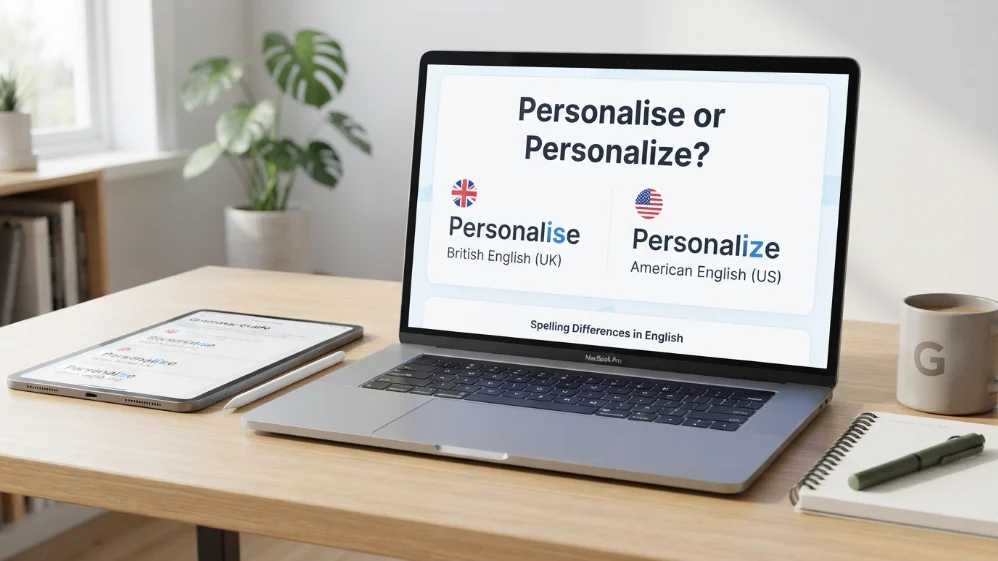
The confusion usually comes from the letters s and z. British English generally uses personalise, while American English usually uses personalize. The meaning is exactly the same: to make something personal or suited to a particular person. Knowing this small spelling difference can help you write clearer emails, articles, school assignments, business content, and social media posts without second-guessing yourself.
Quick Answer
Both personalise and personalize are correct spellings. Personalise is preferred in British English, while personalize is standard in American English. Both mean to make something more personal or suitable for a particular person. For example, British English uses “personalise your profile,” while American English uses “personalize your profile.”
The Origin of Personalise or Personalize
The words personalise and personalize come from the adjective personal, which comes from the Latin word personalis, meaning “of a person.”
English later developed the verb personalize/personalise by adding a suffix that turns the adjective into an action.
The basic idea is simple:
personal → personalise/personalize
The verb means to make something personal, individual, or better suited to a particular person.
The difference between -ise and -ize developed through different spelling traditions in English. American English strongly favors -ize in many words, while British English commonly uses -ise.
This is why you may see pairs such as:
| British English | American English |
|---|---|
| personalise | personalize |
| organise | organize |
| recognise | recognize |
| realise | realize |
| apologise | apologize |
There is an important point here: the difference is usually about regional spelling preference, not meaning.
So, if you see personalise in a British newspaper and personalize on an American website, neither writer has necessarily made a spelling mistake.
British English vs American English Spelling
The clearest difference is the ending.
In British English, personalise is widely accepted and commonly preferred.
In American English, personalize is the standard form.
Here is a quick comparison:
| Feature | British English | American English |
|---|---|---|
| Preferred spelling | personalise | personalize |
| Meaning | Make something personal | Make something personal |
| Verb ending | -ise | -ize |
| Example | Personalise your account. | Personalize your account. |
| Correct? | Yes | Yes |
| Best for | UK and many Commonwealth contexts | US English |
Examples
British English:
You can personalise your account settings.
American English:
You can personalize your account settings.
The meaning does not change.
If your readers are mainly in the United States, personalize is the safer choice. If your audience follows British English, personalise will usually feel more natural.
Why Is There Confusion Between Personalise and Personalize?
The confusion happens because both spellings appear in reliable English writing.
A person may learn British English at school but later read American websites. Another person may use an American app while living in a country where British English is more common.
This creates a simple spelling problem: Which version should I use?
There are several reasons people search for the difference.
The s and z sound similar
In normal speech, the difference between personalise and personalize is not always obvious. Both words are pronounced almost the same in many varieties of English.
Because the pronunciation gives little help, writers often check the spelling before publishing.
Different countries use different spelling systems
English does not have one universal spelling system.
Words such as colour/color, favourite/favorite, and organise/organize show how British and American English can differ.
Personalise/personalize follows the same general pattern.
Autocorrect can create doubt
Modern keyboards and writing apps may automatically change a word based on language settings.
For example, a British English keyboard may prefer personalise, while an American English setting may suggest personalize.
This can make writers wonder whether one version is wrong.
Online content uses mixed English
The internet brings different English varieties together.
A reader in the UK may visit an American website and see personalize. A reader in the US may visit a British website and see personalise.
Seeing both forms repeatedly can make the difference seem like a spelling error when it is actually a regional variation.
Search behavior adds to the confusion
People often search both versions because they want confirmation before using the word in an important piece of writing.
They may be writing:
- A school assignment
- A business email
- A website
- A product description
- A cover letter
- A social media post
- A report
- A customer message
The real question behind the search is often not “Which word exists?” but “Which spelling is right for my audience?”
Which Spelling Should You Use?
The best spelling depends on where your readers are and which style of English you follow.
If you write American English
Use personalize.
Examples:
- Personalize your homepage.
- You can personalize the settings.
- The service lets users personalize their experience.
This is the normal choice for American readers.
If you write British English
Use personalise.
Examples:
- Personalise your homepage.
- You can personalise the settings.
- The service lets users personalise their experience.
This spelling fits British English writing.
If you write for Commonwealth audiences
Many Commonwealth countries use spelling conventions influenced by British English. In those contexts, personalise is often a natural choice.
However, local style guides can differ. If you are writing professionally, follow the style guide used by your organization or publication.
If you write for a global audience
Consistency matters more than choosing one version as universally “correct.”
If your website uses British English throughout, use personalise consistently.
If your website uses American English throughout, use personalize consistently.
Do not switch between the two without a reason.
Common Mistakes with Personalise or Personalize
The biggest mistake is assuming that one spelling is always wrong.
That is not the case.
Mistake: Calling personalise incorrect
Incorrect claim:
Personalise is wrong because personalize is the correct spelling.
Better understanding:
Personalise is a standard British English spelling, while personalize is standard American English.
Mistake: Calling personalize incorrect
The opposite mistake is also common.
Some writers learn British English first and assume personalize is a spelling error.
It is not.
Personalize is the standard American form.
Mistake: Mixing spelling styles
Consider this sentence:
We will personalise your account and organize your preferences.
The sentence mixes British personalise with American organize.
This is not always grammatically wrong, but it can make your writing look inconsistent.
A British-style version would be:
We will personalise your account and organise your preferences.
An American-style version would be:
We will personalize your account and organize your preferences.
Mistake: Changing the meaning
Neither spelling means something different.
Personalise does not mean one thing while personalize means another.
Both verbs mean to make something personal, individual, customized, or suited to a particular person.
Mistake: Assuming pronunciation decides the spelling
Pronunciation is not a reliable way to choose between these forms.
The better approach is to identify your English variety and follow it consistently.
Personalise or Personalize in Everyday Examples
The word appears in many everyday situations, especially when talking about products, services, profiles, settings, and experiences.
In an email
British English:
You can personalise your account before completing the registration.
American English:
You can personalize your account before completing the registration.
In a business message
British English:
Our team can personalise the service to meet your needs.
American English:
Our team can personalize the service to meet your needs.
In a website instruction
British English:
Personalise your dashboard to see the information you use most.
American English:
Personalize your dashboard to see the information you use most.
In an app
British English:
Personalise your notifications in the settings menu.
American English:
Personalize your notifications in the settings menu.
In social media content
British English:
Personalise your profile and make it feel like you.
American English:
Personalize your profile and make it feel like you.
In formal writing
British English:
The company allows customers to personalise their subscription plans.
American English:
The company allows customers to personalize their subscription plans.
In each example, the meaning remains unchanged.
Google Trends & Usage Behavior
People searching for personalise or personalize usually have a spelling or regional-English question.
The search intent can be divided into several groups.
Spelling intent: The user wants to know which form is correct.
Regional intent: The user wants to know whether British or American English uses a particular spelling.
Writing intent: The user has already written the word and wants to check it before publishing.
Grammar intent: The user may want to understand whether the two forms have different meanings.
Business intent: Website owners and marketers may want to choose the spelling that matches their target readers.
Search behavior around this type of query is especially interesting because both forms are legitimate. The user is not simply looking for a misspelling correction. They are often trying to understand language variation.
This makes a direct answer especially useful: explain the regional difference first, then show examples.
A helpful rule is simple:
British English → personalise
American English → personalize
For content aimed at international readers, consistency throughout the page is usually the most practical approach.
Comparison Table – Personalise vs Personalize
| Variation | Meaning | Correct/Incorrect | Context |
|---|---|---|---|
| personalise | To make something personal | Correct | British English |
| personalize | To make something personal | Correct | American English |
| personalyse | Intended to mean make personal | Incorrect | Common spelling mistake |
| personelise | Intended to mean make personal | Incorrect | Typing or spelling error |
| personilize | Intended to mean make personal | Incorrect | Misspelling |
| personalised | Made personal | Correct | British English |
| personalized | Made personal | Correct | American English |
The key difference is not the meaning. It is the spelling convention.
Is Personalise More Correct Than Personalize?
No. Neither spelling is universally more correct.
Personalise is correct in British English, while personalize is correct in American English.
The choice depends on your audience and your chosen style of English.
For example, a British publication may write:
Customers can personalise their accounts.
An American publication may write:
Customers can personalize their accounts.
Both sentences are correct.
The important thing is to avoid switching between British and American spelling without a clear reason.
If your article uses British spelling elsewhere, personalise will usually fit better. If your writing follows American conventions, choose personalize.
Is Personalise Used in the UK?
Yes. Personalise is widely used in British English.
It follows a spelling pattern commonly seen in British writing, where many verbs ending in this sound are written with -ise.
Examples include:
- personalise
- organise
- recognise
- realise
- apologise
However, British English can contain -ize spellings too, depending on the word and the style guide being followed. Therefore, it is better to treat personalise as the common British preference rather than claim that every British writer must use it.
For everyday British writing, personalise is a natural and widely understood choice.
Is Personalize Used in the United States?
Yes. Personalize is the standard American spelling.
American English commonly uses -ize in words of this type.
For example:
Personalize your experience.
You can personalize the page.
Customers can personalize their profiles.
If your target readers are American, personalize is the clearest choice.
This spelling is also common across American websites, software interfaces, business writing, advertising, and digital products.
Do Personalise and Personalize Mean the Same Thing?
Yes.
Both words mean to make something personal or suited to a particular person.
For example:
You can personalise your profile.
and
You can personalize your profile.
Both sentences tell the reader that they can adjust the profile to suit their own preferences.
The difference is spelling, not meaning.
This is an important point because many spelling questions involve words that actually have different meanings. That is not what happens here.
Personalise and personalize are regional spelling variants of the same verb.
Personalised or Personalized: Which One Is Correct?
Both are correct.
Personalised is the common British English spelling.
Personalized is the common American English spelling.
Examples:
British:
The website offers a personalised experience.
American:
The website offers a personalized experience.
The same pattern appears with the base verbs:
personalise → personalised
personalize → personalized
If you are writing in one variety of English, keep the spelling consistent from the verb to its related forms.
Personalisation or Personalization: Which One Should You Use?
Again, both forms are correct, but the preferred spelling depends on regional English.
Personalisation is commonly used in British English.
Personalization is standard in American English.
Examples:
The personalisation of online services is becoming more common.
The personalization of online services is becoming more common.
Both sentences communicate the same idea.
This pattern is useful to remember because once you know the regional difference, you can recognize related words more easily.
How Do You Remember the Difference?
A simple memory trick can help.
Think:
British → S → personalise
American → Z → personalize
You do not need to memorize the meaning because the meaning is the same.
Instead, remember the audience.
If the text is for readers in the United States, choose personalize.
If the text follows British English, choose personalise.
The same idea can help with other spelling pairs such as organise/organize and recognise/recognize.
FAQs
What is the correct spelling: personalise or personalize?
Both personalise and personalize are correct spellings. Personalise is commonly preferred in British English, while personalize is standard in American English. Both words mean to make something personal or suited to an individual. Your choice should depend on the English variety used by your audience.
Is personalise a real word?
Yes, personalise is a real and standard English word. It is widely used in British English and means to make something personal or suitable for a particular person. For example, “You can personalise your profile” is a correct sentence in British English. It is not simply a spelling mistake.
Is personalize a real word?
Yes, personalize is a standard English word, especially in American English. It means to make something personal, customized, or appropriate for a particular individual. For example, “You can personalize your profile” is completely correct in American English. The spelling differs from British personalise, but the meaning remains the same.
Why do people confuse personalise and personalize?
People confuse these spellings because both forms are correct and appear frequently online. British English commonly uses personalise, while American English uses personalize. Since the two words have the same meaning and very similar pronunciation, writers may not know which regional spelling fits their audience.
Which spelling is correct in English?
Both spellings are correct in English. Personalise is commonly associated with British English, while personalize is the usual American English form. There is no need to label either one as universally wrong. The best spelling is the one that matches the English variety and style used throughout your writing.
Should I use personalise or personalize in a formal email?
Use the spelling that matches your chosen variety of English. For a British English email, write personalise. For an American English email, write personalize. Both are suitable for formal communication. The most important thing is consistency, especially when the email contains other words with British or American spelling differences.
Is personalize American or British English?
Personalize is primarily the standard American English spelling. British English commonly prefers personalise, although British spelling practices can vary by style guide. If you are writing specifically for an American audience, personalize is the natural choice. If your audience follows British English, personalise will usually be preferred.
Do personalise and personalize have different meanings?
No. Personalise and personalize have the same basic meaning: to make something personal, individual, or suitable for a particular person. The difference is mainly regional spelling. British English commonly uses personalise, whereas American English generally uses personalize. You can use either form correctly when it matches your chosen English style.
Conclusion
The choice between personalise or personalize is easier once you know that both spellings are correct. Personalise is commonly used in British English, while personalize is the standard American form. Neither spelling changes the meaning of the word, and neither should automatically be treated as a mistake.
The best choice depends on your readers. Use personalise when following British English conventions and personalize when writing in American English. Most importantly, stay consistent throughout your content. Once you understand the simple S versus Z difference, you can confidently use the word in emails, articles, websites, business writing, and everyday communication without worrying about which spelling is “wrong.”
Read More Related Articles:
Crain or Crane | Which Spelling Is Correct? Meaning, Usage …
Bride or Die| What Does It Mean and Is It the Correct Phrase