When you want to talk about dividing something into two equal parts, choosing between half or halve can be confusing. Both words are correct, but they do not work in the same way. One is usually a noun, adjective, or adverb, while the other is a verb. This small spelling difference can change the meaning of a sentence completely.
People often search for half or halve because the words sound very similar, are closely related in meaning, and can be easy to mix up when writing quickly. The confusion becomes even stronger in phrases such as halve the cake and half the cake. This guide explains the difference in simple English, shows where each word belongs, and gives clear examples so you can choose the right word with confidence.
Quick Answer
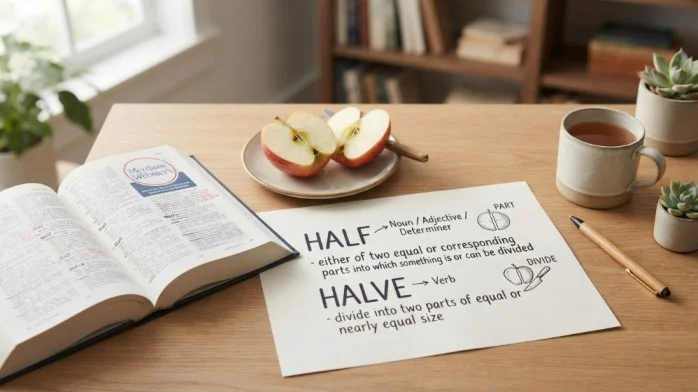
Half means one of two equal parts of something, while halve means to divide something into two equal parts. For example, I ate half the cake means I ate one part of the cake. We need to halve the cake means we need to cut or divide it into two equal parts.
The Origin of Half or Halve
The words half and halve are closely related. Both come from the same old Germanic word family connected with the idea of dividing something into two parts.
Half has been used in English for many centuries. It developed from Old English half, meaning a part of two equal parts. The word has kept its basic meaning over time.
Halve developed from the same family but took on a different grammatical role. It means to make something half its original size, amount, or value or to divide something into two equal parts.
This relationship explains why the words look so similar. The extra v in halve is not random. It helps form the verb from the related noun and adjective half.
The pronunciation can also make the difference less obvious. In normal speech, half and halve can sound very close, especially when spoken quickly. Their meanings and grammatical roles, however, are different.
A useful way to remember them is simple:
Half = one of two parts.
Halve = divide into two parts.
British English vs American English Spelling
There is no major British-versus-American spelling difference between half and halve. Both forms are standard in British English and American English.
The important difference is not the country. It is the function of the word in a sentence.
| Word | British English | American English | Meaning | Example |
|---|---|---|---|---|
| Half | Correct | Correct | One of two equal parts | I ate half the sandwich. |
| Halve | Correct | Correct | Divide into two equal parts | Halve the sandwich before serving. |
| Halfs | Usually incorrect as plural | Usually incorrect as plural | Incorrect plural form of half | Write halves instead. |
| Halves | Correct | Correct | More than one half | The two halves were equal. |
The spelling half stays the same in both major varieties of English. The plural changes to halves, not halfs.
Likewise, halve remains halve in both British and American English.
Why Is There Confusion Between Halves or Halfs?
The confusion between halves and halfs comes mainly from a common English spelling pattern.
Many English words form their plural by adding s. For example:
book → books
chair → chairs
apple → apples
Because of this pattern, some writers naturally assume that half → halfs. However, half follows a different plural rule.
When half becomes plural, the f changes to v, producing:
half → halves
This is similar to other English words that change their final sound or spelling when forming a plural.
The pronunciation can add to the problem. Halves and halfs may seem close when someone is thinking about the word rather than carefully writing it.
Typing mistakes are another reason. Someone writing quickly may automatically add s without remembering the spelling change. Autocorrect can also fail to fix unusual or context-dependent mistakes.
Search behavior plays a role too. People who see halfs in a message, document, or online post may search for both forms to check which one is accepted.
Which Spelling Should You Use?
Use the word based on what you want to say.
Choose half when you mean one of two equal parts or an amount equal to 50 percent.
Examples:
- I drank half the water.
- Half of the students arrived early.
- She spent half the day reading.
Choose halve when you mean divide something into two equal parts or reduce something by half.
Examples:
- Halve the apple before serving it.
- We need to halve the recipe.
- The company plans to halve its costs.
For formal writing, the same rule applies. There is no need to choose a different spelling for American or British readers.
For global readers, the easiest rule is:
If it describes a part, use half. If it describes an action, use halve.
Common Mistakes with Half or Halve
One common mistake is using half when the sentence needs an action.
Incorrect: Please half the orange.
Correct: Please halve the orange.
Here, the writer is asking someone to divide the orange, so halve is the correct verb.
Another mistake happens when writers use halves as the plural.
Incorrect: The two halfs were the same size.
Correct: The two halves were the same size.
The plural form changes f to v.
Another common error is writing halves when the sentence needs halve.
Incorrect: Halves the amount of sugar.
Correct: Halve the amount of sugar.
The first sentence needs a verb in its base form, so halve is required.
A quick memory trick can help:
half = part
halves = parts
halve = action
Once you connect each form with its job, the difference becomes much easier to remember.
Half or Halve in Everyday Examples
These words appear in everyday writing more often than you may realize.
In Emails
Please halve the number of printed copies before the meeting.
Here, halve means reduce the number by 50 percent.
I have completed half of the report.
Here, half describes the amount completed.
In News Writing
The new plan could halve the cost of transportation.
The word halve describes a reduction.
Half of the residents supported the proposal.
The word half describes a portion of a group.
On Social Media
I ate half the pizza before anyone noticed.
Halve the recipe if you are cooking for two.
Both sentences are natural, but the words have different jobs.
In Formal Writing
The treatment reduced the time required by half.
Researchers divided the sample into two halves.
These examples show how naturally the forms can appear in academic, professional, and everyday English.
Google Trends & Usage Behavior
People who search for half or halve usually have a clear language problem: they know the general idea but are unsure which form fits their sentence.
Search intent often falls into a few groups. Some users want to know whether half or halve is the correct spelling. Others search for the difference between the two words. Many are specifically checking whether halfs is a correct plural.
The query halves or halfs is especially useful because it shows a spelling-check intent. A person may have written halfs and want to confirm whether the word is acceptable.
Regional search behavior does not create a major difference here because half, halves, and halve are standard forms in both British and American English.
The strongest way to understand the query is through sentence purpose. People are usually asking one of three things:
Do I mean a part? Use half.
Do I mean more than one part? Use halves.
Do I mean the action of dividing? Use halve.
This intent-based approach is more useful than memorizing isolated spellings.
Comparison Table – Keyword Variations
| Word | Meaning | Correct or Incorrect | Context of Use |
|---|---|---|---|
| Half | One of two equal parts | Correct | I ate half the cake. |
| Halve | Divide into two equal parts | Correct | Halve the cake carefully. |
| Halves | Two or more parts, each equal to half | Correct | The halves were equal. |
| Halfs | Intended plural of half | Incorrect | Use halves instead. |
| Halfed | Incorrect past form of halve | Incorrect | Use halved. |
| Halved | Divided into two equal parts | Correct | She halved the apple. |
Notice that halved is also important. Since halve is a verb, its past tense is halved.
For example:
We halved the recipe yesterday.
Not:
We halfed the recipe yesterday.
FAQs
What is the difference between half and halve?
Half refers to one of two equal parts or an amount equal to 50 percent. Halve is a verb meaning to divide something into two equal parts or reduce it by 50 percent. For example, eat half the cake, but halve the cake.
Is half a noun or an adjective?
Half can work as a noun, adjective, determiner, or adverb depending on the sentence. In half the cake, it identifies an amount. In I ate half, it acts as a noun. Its grammatical role changes, but the core idea remains 50 percent.
Is halve a correct English word?
Yes, halve is a standard English word. It is a verb meaning to divide something into two equal parts or reduce something by half. For example, halve the amount of sugar means reduce the amount to 50 percent.
Is halfs the correct plural of half?
No, halfs is not the standard plural form of half. The correct plural is halves. The spelling changes from f to v before the plural ending. For example, The two halves fit together perfectly.
Why does half become halves?
English has several older plural patterns that do not simply add s. In half, the final f changes to v, creating halves. This spelling developed through historical changes in English pronunciation and grammar over many centuries.
Is halve used in British and American English?
Yes. Halve is correct in both British and American English. There is no regional spelling choice between halve and another standard form. Writers in both varieties use halve when they mean to divide something into two equal parts.
What is the past tense of halve?
The past tense of halve is halved. For example, They halved the amount of sugar in the recipe. Do not write halfed. The verb keeps its final v and adds -ed, producing halved.
How can I remember half, halves, and halve?
Think of the three forms as different jobs. Half means one part, halves means two or more parts, and halve means the action of dividing. Remembering part, parts, action makes the spelling much easier to choose correctly.
Conclusion
The difference between half or halve becomes simple once you focus on meaning instead of spelling alone. Half refers to one of two equal parts or 50 percent. Halve means to divide something into two equal parts or reduce it by half. When you need the plural of half, use halves, not halfs.
The same forms are correct in both British and American English, so the real issue is how the word functions in your sentence. If you are describing a portion, choose half. If you are describing the act of dividing, choose halve. Keep that simple rule in mind, and this common English confusion becomes easy to avoid.
Read More Related Articles:
Santorini or Mykonos| Which Greek Island Is Better for Your …
Narita or Haneda| Which Tokyo Airport Should You …
Naxos or Paros| Which Greek Island Is Better for Your …