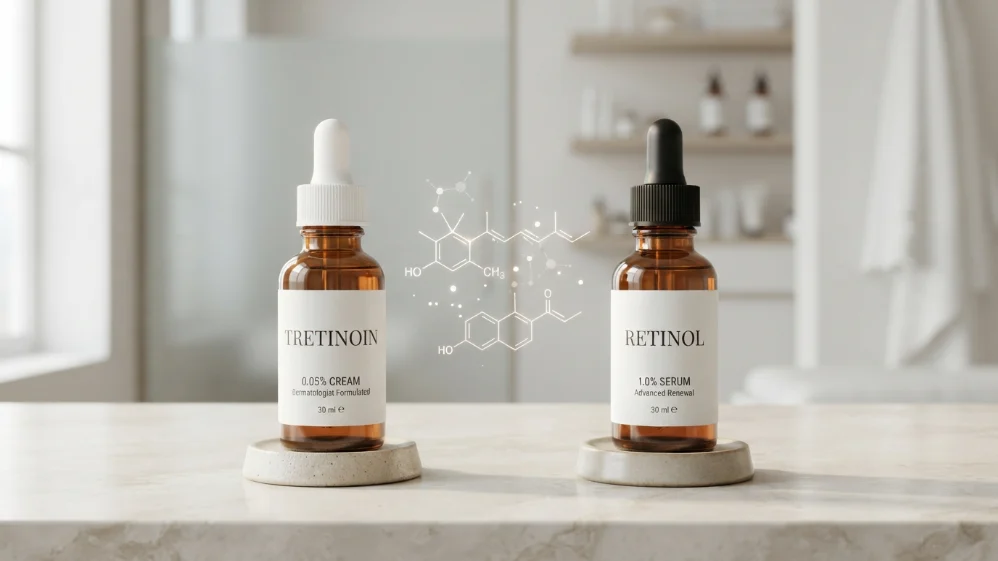
If you have ever stood in front of a skincare shelf wondering whether tretinoin or retinol is the better choice, you are not alone. Both are forms of vitamin A, and both are widely used for acne, fine lines, uneven skin tone, and smoother-looking skin. The confusion usually starts because their names sound similar and their benefits overlap, yet they are not exactly the same.
One is a prescription-strength retinoid, while the other is commonly available in over-the-counter skincare products. Choosing the wrong option can also lead to unnecessary dryness, irritation, or disappointment. This guide breaks down the difference between tretinoin and retinol in simple language, explains how each works, and shows which option may make more sense for different skincare goals.
Quick Answer
Tretinoin and retinol are both vitamin A derivatives, but tretinoin is stronger and works directly on skin receptors, while retinol must first be converted by the skin. Tretinoin is commonly prescribed for acne and signs of aging. Retinol is usually gentler and easier to find in non-prescription skincare products.
The Origin of Tretinoin and Retinol
The names tretinoin and retinol come from the chemistry of vitamin A and its related compounds.
Retinol is a form of vitamin A. The word is linked to retina, because vitamin A plays an important role in vision. Retinol is also used in skincare because the body can convert it into other active vitamin A compounds.
Tretinoin is a specific retinoid related to vitamin A. Its chemical name is all-trans retinoic acid, and it is sometimes called retinoic acid.
This explains an important difference. Retinol is not simply a weaker spelling of tretinoin. They are different compounds that belong to the same broader vitamin A family.
People often group them together because both can help improve acne, skin texture, and visible signs of aging. However, they behave differently after being applied to the skin.
Tretinoin vs Retinol: What Is the Difference?
The biggest difference is how directly each ingredient acts on the skin.
Tretinoin is already in the active retinoic acid form. It can interact directly with retinoid receptors in skin cells.
Retinol needs to go through additional conversion steps before becoming retinoic acid. Because of this, retinol products are generally considered less potent than prescription tretinoin.
| Feature | Tretinoin | Retinol |
|---|---|---|
| Vitamin A family | Yes | Yes |
| Form | Retinoic acid | Vitamin A alcohol |
| Prescription | Usually prescription | Usually available without prescription |
| Strength | Generally stronger | Generally milder |
| Acne treatment | Commonly prescribed | May help mild acne |
| Fine lines | Can improve appearance | Can improve appearance |
| Irritation risk | Higher | Usually lower |
| Conversion needed | No | Yes |
| Best for | Stronger treatment under medical guidance | Beginners and maintenance |
The important point is that stronger does not automatically mean better for everyone. Skin type, goals, tolerance, and medical advice all matter.
Why Is There Confusion Between Tretinoin and Retinol?
The confusion comes from several sources.
First, both names appear frequently in skincare discussions. People may see retinol, retinal, retinoid, and tretinoin mentioned in the same article and assume they are interchangeable.
Second, both ingredients belong to the vitamin A family. They can address some of the same skin concerns, including acne, uneven texture, and visible signs of aging.
Third, skincare marketing can make the differences harder to understand. Products may use words such as retinoid or vitamin A without clearly explaining the exact ingredient.
Search behavior adds another layer of confusion. Someone may begin by searching for retinol and then discover tretinoin while researching stronger acne or anti-aging treatments.
The names are related, but they should not be treated as identical ingredients.
Which One Should You Use?
The right choice depends on your skin goals and how much treatment your skin can tolerate.
For someone new to vitamin A skincare: Retinol may be easier to start with because many products are designed for gradual use and lower irritation.
For persistent acne: Tretinoin may be considered when a stronger treatment is appropriate. A healthcare professional can determine whether it is suitable.
For visible signs of aging: Both can improve the appearance of fine lines, texture, and uneven skin over time. Tretinoin is generally the stronger option, while retinol may be easier for people who want a gentler routine.
For sensitive skin: Starting slowly is important. Even retinol can cause dryness or irritation.
For formal medical treatment: Tretinoin should be used according to professional instructions, especially when it has been prescribed for a specific skin condition.
Regardless of the choice, using too much does not make results appear overnight. Consistency and patience are important.
Common Mistakes With Tretinoin and Retinol
A common mistake is assuming that tretinoin and retinol are exactly the same. They are related, but they are different compounds.
Another mistake is starting with a large amount. More product does not necessarily produce faster results. It can simply increase irritation.
Some people also apply vitamin A products too frequently at first. The skin may need time to adjust.
Another frequent mistake is ignoring daytime sun protection. A well-planned skincare routine should include appropriate sun protection because ultraviolet exposure can contribute to premature skin aging.
People may also combine several potentially irritating products at once. For example, adding multiple strong exfoliating products to a new retinoid routine can make dryness and irritation more likely.
Simple routines are often easier to maintain and evaluate.
Tretinoin and Retinol in Everyday Examples
Here are natural examples of how the terms may appear in different types of writing.
In an email:
I am considering adding retinol to my nighttime skincare routine and would like advice on how to begin.
In a skincare article:
Tretinoin is a prescription retinoid commonly used to treat acne and improve the appearance of photoaged skin.
On social media:
I started using retinol slowly because I wanted to give my skin time to adjust.
In formal writing:
Retinoids are vitamin A derivatives used in dermatology for several skin concerns.
In everyday conversation:
Is retinol the same thing as tretinoin?
These examples show that the words have distinct meanings even though they are closely related.
How People Search for Tretinoin or Retinol
People searching for this phrase usually have one of several goals.
Some want to know which ingredient is stronger. Others want to compare results for acne, wrinkles, dark spots, or skin texture.
Another common search intent is finding out whether a person can replace one ingredient with the other. This question is understandable because both belong to the same vitamin A family.
Searches may also come from people who have already purchased a product and want to understand what it actually does.
Regional access can influence search behavior too. Retinol products are widely sold in skincare markets, while tretinoin is often associated with prescription treatment.
The most useful comparison is therefore not simply which ingredient is better. The better question is which ingredient fits the person’s skin goals, tolerance, and treatment needs?
Comparison Table – Tretinoin vs Retinol
| Variation | Meaning | Correct Usage | Typical Context |
|---|---|---|---|
| Tretinoin | A prescription retinoic acid used in dermatology | Correct | Acne and professional skincare treatment |
| Retinol | A vitamin A derivative used in skincare | Correct | Over-the-counter skincare and anti-aging routines |
| Retinoid | A broad term for vitamin A-related compounds | Correct | Medical and skincare discussions |
| Retinal | Another vitamin A derivative | Correct | Skincare products and cosmetic routines |
| Tretinoin cream | A topical form of tretinoin | Correct | Prescription skincare |
| Retinol serum | A cosmetic product containing retinol | Correct | Home skincare routines |
The terms should not be used as if they describe the exact same product.
Tretinoin or Retinol for Acne?
Both may be discussed in acne care, but they are not equally strong.
Tretinoin has a long history of dermatological use and is commonly prescribed for acne. It can help keep pores from becoming clogged and can support normal skin-cell turnover.
Retinol may also be useful in cosmetic skincare, particularly for people who want a gentler vitamin A option. However, the concentration, formulation, and individual skin response can vary greatly between products.
If acne is persistent, painful, severe, or leaving scars, professional medical advice is more appropriate than simply switching between cosmetic products.
Tretinoin or Retinol for Wrinkles?
Both ingredients can be used to improve the appearance of aging skin.
Tretinoin is often chosen when a stronger retinoid treatment is appropriate. It has been studied extensively for photoaging and can help improve the appearance of fine lines and skin texture.
Retinol can also support smoother-looking skin. Because it is generally less potent, some people find it easier to include in a long-term cosmetic routine.
Results take time with either option. Skincare products cannot erase every sign of aging, and daily sun protection remains an important part of protecting the skin.
Can You Use Tretinoin and Retinol Together?
Using both at the same time is not automatically better.
Since both are vitamin A-related ingredients, combining them may increase the chance of dryness, peeling, redness, or irritation. Someone using prescription tretinoin generally does not need to add retinol simply because it appears in another skincare product.
If you are thinking about combining products, especially prescription treatments with cosmetic actives, it is sensible to ask a dermatologist or other qualified healthcare professional.
A simple routine can be more useful than a crowded routine filled with multiple active ingredients.
FAQs
Is tretinoin the same as retinol?
No. Tretinoin and retinol are related vitamin A compounds, but they are chemically different. Tretinoin is retinoic acid and acts directly on retinoid receptors. Retinol must first undergo conversion in the skin before becoming retinoic acid.
Which is stronger, tretinoin or retinol?
Tretinoin is generally considered stronger than retinol because it is already in the active retinoic acid form. Retinol requires conversion before producing its active effect. The stronger option is not always the best choice for every person’s skin.
Is retinol safer than tretinoin?
Retinol is often easier for beginners to tolerate because it is generally less potent. However, it can still cause dryness, redness, or irritation. Tretinoin can also be used safely when prescribed and introduced according to professional guidance.
Can retinol replace tretinoin?
Retinol may be an alternative for someone who wants a gentler cosmetic vitamin A product, but it is not an identical replacement for tretinoin. Their strength, formulation, and intended uses differ. A healthcare professional can advise on appropriate treatment choices.
Is tretinoin better for acne?
Tretinoin is a well-established topical treatment for acne and is commonly prescribed for this purpose. Whether it is appropriate depends on the person’s skin and acne severity. Persistent or severe acne should be assessed by a qualified healthcare professional.
Is retinol better for beginners?
Retinol is often a more approachable starting point for people who are new to vitamin A skincare. Many cosmetic products are designed for gradual introduction. Beginners should still follow product directions and stop or seek advice if significant irritation develops.
Can tretinoin and retinol cause dry skin?
Yes. Both can cause dryness, peeling, redness, or irritation, particularly when first introduced. These effects may become more noticeable when too much product is used or when several irritating skincare ingredients are combined.
Which should I choose for anti-aging?
Both tretinoin and retinol can support smoother-looking skin and improve the appearance of fine lines over time. Tretinoin is generally more potent, while retinol may be easier to tolerate. Your skin type, goals, and professional advice should guide the choice.
Conclusion
Tretinoin and retinol are closely related, but they are not the same ingredient. it is an active form of retinoic acid and is commonly used as a prescription treatment, while retinol is a vitamin A derivative widely found in cosmetic skincare products. Tretinoin is generally stronger, whereas retinol may offer a gentler starting point for many people.
The best choice depends on your skin concerns, tolerance, routine, and treatment goals. Avoid assuming that more strength always means better results. Introduce vitamin A products carefully, follow product or professional instructions, and give your skin time to adjust. Understanding the difference makes it much easier to choose skincare based on facts rather than confusing product claims.
Read More Related Articles:
Santorini or Mykonos| Which Greek Island Is Better for Your …
Narita or Haneda| Which Tokyo Airport Should You …
Naxos or Paros| Which Greek Island Is Better for Your …