Have you ever typed sweeped or swept and wondered which one is correct? You are not alone. Many English learners, students, and even native speakers search for this question because the two words look similar. Since many regular verbs simply add -ed, it is easy to think that sweeped follows the same rule.
The truth is much simpler. Knowing the correct form can help you write better emails, school assignments, articles, and everyday messages without making a common grammar mistake. In this guide, you will quickly learn the correct spelling, why people get confused, and how to use the right word with confidence.
Quick Answer
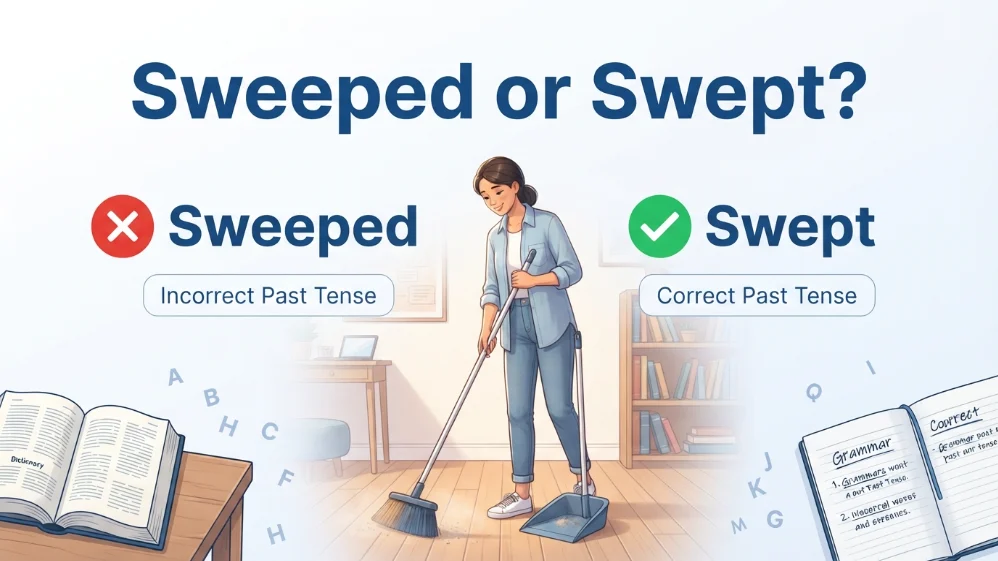
Swept is the correct past tense and past participle of the verb sweep. Sweeped is not accepted in standard English.
Examples:
- She swept the kitchen before dinner.
- The wind swept through the streets.
- They swept the floor every morning.
If you are choosing between sweeped or swept, always use swept.
The Origin of “Sweeped or Swept”
The verb sweep comes from Old English swāpan, which meant to move across, brush away, or clean with long strokes. It has been part of the English language for hundreds of years.
English has two main groups of verbs:
- Regular verbs, which form the past tense by adding -ed.
- Irregular verbs, which change their spelling in different ways.
The verb sweep belongs to the irregular group. Instead of becoming sweeped, it changes to swept.
Here are similar examples:
| Present | Past |
|---|---|
| Keep | Kept |
| Sleep | Slept |
| Sweep | Swept |
| Weep | Wept |
Notice the pattern. Several English verbs ending in -eep change to -ept in the past tense. That is why swept is correct while sweeped is not.
This spelling has remained the standard form for centuries and is used in books, newspapers, schools, and professional writing around the world.
British English vs American English Spelling
Good news! There is no difference between British English and American English for this verb.
Both varieties use swept as the correct past tense.
| Feature | British English | American English |
|---|---|---|
| Present tense | Sweep | Sweep |
| Past tense | Swept | Swept |
| Past participle | Swept | Swept |
| Is “Sweeped” correct? | No | No |
British Examples
- He swept the path before the guests arrived.
- The leaves were swept into a pile.
American Examples
- She swept the garage yesterday.
- The storm swept across the state.
Whether you write for readers in the United Kingdom, the United States, Canada, Australia, or New Zealand, swept is always the correct choice.
Why Is There Confusion Between “Sweeped or Swept”?
Many people accidentally write sweeped because English often teaches a simple rule: add -ed to make the past tense.
That rule works for many verbs.
Examples include:
- Walk → Walked
- Clean → Cleaned
- Wash → Washed
Because of these examples, learners naturally expect sweep to become sweeped.
However, sweep is an irregular verb, so it follows a different pattern.
Other reasons for the confusion include:
Typing Habits
People type quickly and automatically add -ed without checking whether the verb is irregular.
Pronunciation
The word swept is shorter and sounds different from sweep, making it less obvious to learners.
Autocorrect and Spell Check
Some writing tools may not explain why a word is wrong. They simply replace sweeped with swept, leaving users unsure about the grammar rule.
Learning English
People learning English often memorize the regular verb rule before learning irregular verbs. As a result, sweeped seems logical even though it is incorrect.
Search Behavior
Many users search sweeped or swept because they want a quick answer before submitting homework, writing an email, or publishing content online.
Fortunately, the answer is easy to remember:
Sweep → Swept
Never Sweep → Sweeped.
Which Spelling Should You Use?
The correct spelling is always swept.
No major English dictionary accepts sweeped as the standard past tense of sweep.
If You Write for an American Audience
Use swept in all situations.
Example:
- The janitor swept the hallway before school started.
If You Write for a British Audience
The correct form is still swept.
Example:
- She swept the garden path every afternoon.
If You Write for an International Audience
Choose swept because it is understood and accepted everywhere English is spoken.
Formal Writing
Use swept in:
- Business emails
- School essays
- Reports
- News articles
- Books
- Academic writing
Informal Writing
Use swept in:
- Text messages
- Social media posts
- Personal emails
- Online comments
- Daily conversations
No matter where or why you are writing, swept is the only correct past tense.
Common Mistakes with “Sweeped or Swept”
Many writers make small mistakes when using the past tense of sweep. Most happen because they treat sweep like a regular verb. Learning these common errors will help you avoid them.
| Incorrect | Correct | Why? |
|---|---|---|
| I sweeped the floor yesterday. | I swept the floor yesterday. | Swept is the correct past tense. |
| She has sweeped the room. | She has swept the room. | The past participle is swept. |
| They were sweepinged the street. | They were sweeping the street. | Use sweeping for the continuous tense. |
| The wind sweeped away the leaves. | The wind swept away the leaves. | Swept is the correct form. |
| We have sweeped every room. | We have swept every room. | Always use swept after have or has. |
Easy Rule to Remember
Think about these irregular verbs:
- Keep → Kept
- Sleep → Slept
- Sweep → Swept
- Weep → Wept
If you can remember kept and slept, remembering swept becomes much easier.
“Sweeped or Swept” in Everyday Examples
Here are real-life examples showing how swept is used in different situations.
- In an Email
I swept the meeting room before everyone arrived.
- In a School Assignment
The student swept the classroom as part of the cleaning activity.
- In a News Story
Strong winds swept across the coast during the night.
On Social Media
Finally swept my room. It looks so much better now!
- In a Business Report
Staff members swept the warehouse before the inspection.
- In Daily Conversation
Dad swept the driveway this morning.
- In a Story
The old woman swept the porch while the children played outside.
- In Nature Writing
A cool breeze swept through the forest.
These examples show that swept works naturally in both formal and informal writing.
Google Trends and Usage Behavior
People often search sweeped or swept because they are unsure whether sweep follows the regular -ed rule or an irregular verb pattern.
Many searches come from:
- Students doing homework.
- English learners studying verb forms.
- Writers checking grammar before publishing.
- People writing emails or reports.
- Users double-checking spellings after autocorrect changes a word.
Searches for sweeped usually reflect uncertainty rather than correct usage. People often type the word because it sounds like it should follow the same pattern as walked or cleaned.
Across English-speaking countries, dictionaries, schools, style guides, and professional writers consistently use swept as the correct form.
Comparison Table
| Word | Meaning | Correct or Incorrect | Context |
|---|---|---|---|
| Sweep | Present tense of the verb | ✅ Correct | I sweep the floor every day. |
| Swept | Past tense and past participle | ✅ Correct | She swept the kitchen yesterday. |
| Sweeped | Incorrect past tense | ❌ Incorrect | Avoid using it in standard English. |
| Sweeping | Present participle | ✅ Correct | He is sweeping the driveway. |
Frequently Asked Questions
What is the correct spelling: sweeped or swept?
The correct spelling is swept. It is the accepted past tense and past participle of sweep. Sweeped is not considered correct in standard English and should be avoided in school, work, and everyday writing.
Is sweeped a real word?
Sweeped sometimes appears in informal writing or by mistake, but it is not accepted as the standard past tense of sweep. Modern dictionaries and grammar guides recognize swept as the correct form.
Why do people confuse sweeped and swept?
People often learn that adding -ed makes the past tense of a verb. Since many verbs follow this pattern, they assume sweep becomes sweeped. However, sweep is an irregular verb, so the correct form is swept.
Which spelling is correct in English?
The correct spelling in all major forms of English is swept. British English, American English, Canadian English, Australian English, and other varieties all use swept.
Is sweeped a typo?
Most of the time, yes. Sweeped is usually a typing mistake or a misunderstanding of irregular verbs. Replacing it with swept will make your writing grammatically correct.
Is swept the past participle of sweep?
Yes. Swept is both the past tense and the past participle of sweep.
Examples:
- She swept the floor.
- She has swept the floor.
Can I use sweeped in formal writing?
No. Formal writing should always use swept. Using sweeped may make your writing look incorrect and reduce its credibility.
How can I remember the correct word?
A simple trick is to group similar irregular verbs together:
- Keep → Kept
- Sleep → Slept
- Sweep → Swept
- Weep → Wept
This pattern makes the correct spelling much easier to remember.
Conclusion
If you have ever wondered whether sweeped or swept is correct, the answer is simple. Swept is the only correct past tense and past participle of sweep. The word sweeped is a common mistake caused by applying the regular -ed rule to an irregular verb. No matter whether you are writing an email, completing schoolwork, preparing a report, or posting on social media, choosing swept will make your writing clear and correct.
Read More Related Articles:
The Correct Spelling Explained with Examples in 2026
Lawyer or Attorney| What’s the Difference and Which Word …
Breech or Breach| What’s the Difference? Meaning, …