Have you ever typed plane or plain and stopped because you were not sure which word fits the sentence? You are not alone. These two words sound almost the same, but they have very different meanings. One can describe an aircraft, while the other can mean simple, flat, or clear. That small difference can change the meaning of an entire sentence.
People often search for this phrase because of spelling confusion, similar pronunciation, fast typing, or uncertainty about which word belongs in a sentence. The good news is that the difference is easy to understand once you know what each word means. This guide explains plane or plain in simple English, with clear examples, common mistakes, and practical tips to help you choose the right word every time.
Quick Answer:
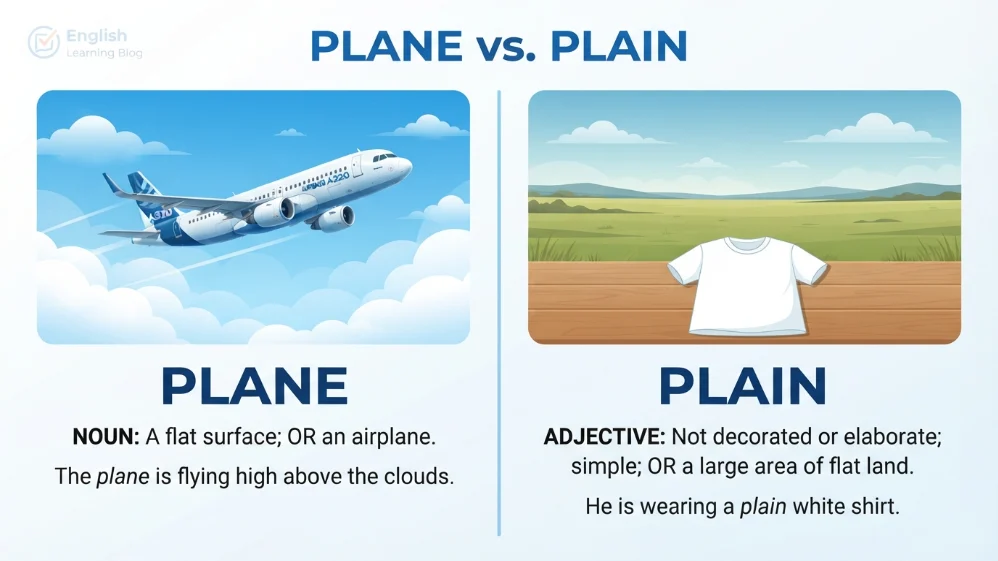
Plane and plain are both correct English words, but they have different meanings. Plane commonly means an aircraft or a flat surface. Plain can mean simple, clear, ordinary, or a large area of flat land. For example, “The plane landed safely” and “She wore a plain dress” are both correct.
The Origin of Plane and Plain
The words plane and plain have different histories, even though they look and sound very similar.
Plane comes from Latin planus, meaning flat or level. Over time, the word developed several meanings. It can describe something flat or level, such as a geometric surface. It also became associated with a tool used to make wood smooth. Later, plane became widely used as a short form of airplane.
Plain also has roots connected to the idea of something flat or open. It comes through Old French from Latin planus. In English, it developed meanings such as flat land, simple appearance, and something that is easy to understand.
Because both words have related historical roots and similar pronunciation, it is easy to see why learners mix them up. However, their modern meanings are different.
British English vs American English Spelling
Unlike some British and American spelling differences, plane and plain do not change according to regional spelling rules.
Both British English and American English use plane and plain in the same way.
| Word | British English | American English | Example |
|---|---|---|---|
| Plane | Correct | Correct | The plane arrived early. |
| Plain | Correct | Correct | She chose a plain shirt. |
| Airplane | Correct | Correct | The airplane took off. |
| Plain | Correct | Correct | They crossed the open plain. |
So, whether you are writing for readers in the United Kingdom, the United States, Canada, Australia, or another English-speaking region, the spelling does not change.
The important thing is not choosing a British or American spelling. It is choosing the word that matches your meaning.
Why Is There Confusion Between Plane and Plain?
The main reason for the confusion is pronunciation. In most common varieties of English, plane and plain sound the same. They are homophones, which means they have different spellings and meanings but the same pronunciation.
Typing can also cause mistakes. When people write quickly, they may choose the wrong word without noticing. Autocorrect and predictive text can make this worse if the wrong word is accepted as a valid English word.
Search behavior also plays a role. Someone who remembers the sound of a word but not its spelling may search for both versions. This is especially common among English learners and people writing quickly on phones.
The easiest solution is to focus on meaning, not sound.
If you mean an aircraft, use plane.
If you mean simple, ordinary, flat, or clear, plain may be the word you need.
Which Spelling Should You Use?
The correct word depends on what you are trying to say.
Use plane when you are talking about an aircraft.
For example:
We boarded the plane at noon.
Use plane when referring to a flat surface in geometry or mathematics.
For example:
The points lie on the same plane.
Use plain when something is simple or not decorated.
For example:
He wore a plain white shirt.
Use plain when something is easy to understand.
For example:
Please explain it in plain English.
Use plain when talking about a large area of flat land.
For example:
The farmers worked across the wide plain.
For formal writing, emails, schoolwork, and professional documents, always choose the word based on its meaning. Do not choose between them based on pronunciation.
Common Mistakes with Plane and Plain
One common mistake is writing plain when talking about an aircraft.
Incorrect:
The plain landed at 8 p.m.
Correct:
The plane landed at 8 p.m.
Another common mistake is using plane when describing something simple or undecorated.
Incorrect:
She bought a plane black dress.
Correct:
She bought a plain black dress.
People also confuse the phrase plain English with plane English.
Correct:
Please explain the rules in plain English.
Here, plain means simple and easy to understand.
Another useful expression is plain to see, which means something is obvious.
For example:
It was plain to see that he was tired.
You should also remember that plane can be used beyond aviation.
For example:
The carpenter used a plane to smooth the wood.
So, plane does not always mean an aircraft.
Plane or Plain in Everyday Examples
Seeing both words in real sentences makes the difference much easier to remember.
Emails
I will take the morning plane to Chicago.
Could you explain this in plain language?
The first sentence is about travel. The second is about simple language.
News Articles
The passenger plane landed safely after a long flight.
Heavy rain flooded parts of the coastal plain.
News writing can use both words often because they describe common events, places, and ideas.
Social Media
Finally on the plane and ready for vacation!
I like the plain design better because it looks clean.
On social media, both words may appear in short, informal sentences.
Formal Writing
The aircraft crossed the mountain range before landing.
The report should be written in plain language for general readers.
In formal writing, choosing the right word helps readers understand your meaning without confusion.
Plane or Plain: Easy Memory Trick
A simple memory trick can help you remember the difference.
Think of plane with pilot.
Plane = aircraft
The plane is ready for takeoff.
Think of plain with simple.
Plain = simple
She prefers plain clothes.
You can also remember:
Plane flies. Plain describes.
This is not true in every grammatical use, because plane has other meanings, but it is a useful shortcut for everyday writing.
When you are unsure, replace the word with its meaning.
If aircraft makes sense, choose plane.
If simple, ordinary, clear, or flat land makes sense, choose plain.
Comparison Table: Plane vs Plain
| Word | Meaning | Correct or Incorrect? | Context of Use |
|---|---|---|---|
| Plane | Aircraft | Correct | Travel and aviation |
| Plane | Flat surface | Correct | Geometry and mathematics |
| Plane | Tool for smoothing wood | Correct | Carpentry |
| Plain | Simple or ordinary | Correct | Clothing, design, appearance |
| Plain | Easy to understand | Correct | Language and explanations |
| Plain | Flat area of land | Correct | Geography |
| Plain | Aircraft | Incorrect | Use plane instead |
| Plane | Simple or undecorated | Usually incorrect | Use plain instead |
The key difference is meaning. Neither spelling is simply the “right” version of the other.
Google Trends and Usage Behavior
People searching for plane or plain usually have one of several intentions. Some want to know which spelling is correct. Others know the meaning but are unsure about the spelling. Some may have heard the word in conversation and are trying to identify it in written English.
Because the two words are pronounced alike, searches can come from spelling mistakes rather than a lack of vocabulary. Mobile typing, autocorrect, voice search, and fast writing can also contribute to these searches.
Regional spelling is not the main issue here because British and American English use the same spellings. The real challenge is understanding context.
For content creators, teachers, students, and English learners, explaining the meaning with short examples is more useful than simply saying one spelling is correct.
FAQs
What is the correct spelling, plane or plain?
Both plane and plain are correct spellings. They are different words with different meanings. Plane can mean an aircraft, a flat surface, or a woodworking tool. Plain can mean simple, clear, ordinary, or a flat area of land. The correct choice depends on the sentence.
Is plain a real word?
Yes, plain is a common English word. It can describe something simple or not decorated, such as a plain shirt. It can also mean clear or easy to understand, as in plain language. In geography, a plain is a broad area of mostly flat land.
Is plane a real word?
Yes, plane is a very common English word. Most people know it as a short form of airplane or aeroplane. However, it has other meanings too. A plane can refer to a flat surface or a woodworking tool used to make wood smooth.
Why do people confuse plane and plain?
People often confuse these words because they usually have the same pronunciation. They are homophones, so hearing the word does not reveal its spelling. Fast typing, autocorrect, and uncertainty about meaning can also cause mistakes. Looking at the context is the easiest way to choose correctly.
Which spelling is correct in English?
There is no single correct spelling between plane and plain because both words are correct. The correct spelling depends on meaning. Use plane for an aircraft or flat surface. Use plain for something simple, clear, ordinary, or a flat area of land.
Does plane always mean an aircraft?
No. Although plane commonly means an aircraft, it has other meanings. In mathematics, a plane is a flat two-dimensional surface. In woodworking, a plane is a tool used to smooth wood. The surrounding words usually make the intended meaning clear.
Does plain mean boring?
Not always. Plain can mean simple or without decoration, but that does not automatically mean boring. For example, someone may choose a plain design because they like a clean and simple style. The word can also mean clear, obvious, or related to flat land.
How can I remember plane and plain?
Use the simple memory trick plane flies, plain is simple. If you are talking about an aircraft, choose plane. If you are describing something simple or undecorated, choose plain. For other meanings, such as flat land or a mathematical surface, check the context before choosing.
Conclusion
Understanding plane or plain becomes easy once you focus on meaning instead of sound. Plane commonly refers to an aircraft, but it can also describe a flat surface or a woodworking tool. Plain can mean simple, clear, ordinary, or a large area of flat land. Both words are correct, and neither is a British or American spelling variation of the other. The confusion mainly comes from their similar pronunciation. When writing, pause and ask what you mean. If you mean an aircraft, choose plane. If you mean simple or clear, choose plain. With these simple rules, you can avoid this common spelling mistake confidently.
Read More Related Articles:
Fazed or Phased | The Correct Word, Meaning, Examples, and …
Parent or Guardian | Everything You Need to Know Before Filling …
Crain or Crane | Which Spelling Is Correct? Meaning, Usage …