Picture yourself walking through a forest and spotting a huge deer-like animal with long legs and impressive antlers. You might call it an elk. Someone else might say moose. So, which one is right?
The confusion around elk or moose is common because both animals belong to the deer family and can look similar at first glance. They are also large, wild animals with antlers, which makes it easy to mix up their names. However, elk and moose are not the same animal. They have clear differences in size, body shape, antlers, habitat, and behavior. This guide explains those differences in simple terms so you can identify each animal correctly and use elk or moose with confidence in everyday writing, conversation, schoolwork, travel content, and nature articles.
Quick Answer:
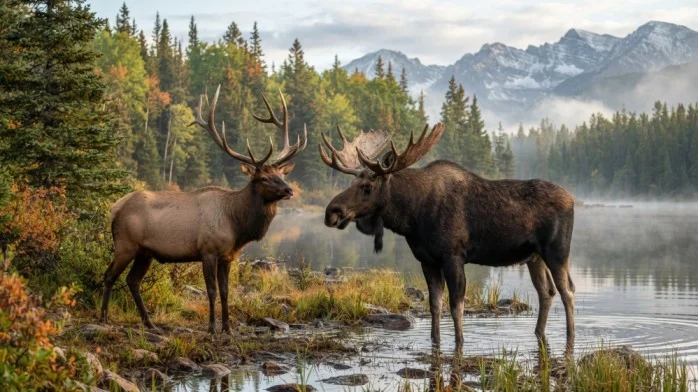
An elk and a moose are two different members of the deer family. A moose is generally larger, with a broad, long face and wide, flat antlers. An elk is smaller and more deer-like, with tall, branching antlers. In American English, both elk and moose are correct words, but they describe different animals.
The Origin of Elk and Moose
The words elk and moose have very different histories.
The word elk comes from an old Germanic word related to names used for large deer. In Old English, a similar word was used for a large deer-like animal. Over time, the word developed into the modern English elk.
The word moose has a different story. It comes from an Indigenous North American language. Early European settlers adopted the word after encountering the animal in North America. The name is often linked to an Algonquian language word referring to the animal and its habit of stripping bark from trees.
There is an important language detail here. The word elk can refer to different animals depending on the country.
In North America, elk usually means a large deer species scientifically known as Cervus canadensis. It is also called wapiti.
In British English, however, elk can refer to what Americans call a moose. This difference can create confusion when people from different English-speaking countries discuss wildlife.
That means the word is not always wrong simply because someone uses it differently. Context and region matter.
British English vs American English Usage
The biggest language problem is not really spelling. It is meaning.
In American English, elk and moose are separate animals. In traditional British usage, elk may refer to the animal Americans call a moose.
| Term | American English | British English | Example |
|---|---|---|---|
| Elk | A large deer species, also called wapiti | Can mean a moose in some usage | We saw an elk in Yellowstone. |
| Moose | The large North American deer | Commonly understood as the North American animal | A moose crossed the road. |
| Wapiti | Another name for North American elk | Less common in everyday speech | The wapiti has large branching antlers. |
For modern readers, especially online, moose and elk are usually understood as separate animals when the context is North American wildlife.
Why Is There Confusion Between Elk and Moose?
Several things make these two words easy to confuse.
They belong to the same family. Both are members of the deer family, known as Cervidae. This means they share several physical features.
Both can have antlers. Male elk and male moose grow antlers. Because people often associate large antlers with both animals, they may use the names interchangeably.
Both are large animals. An elk is much bigger than many familiar deer, while a moose is even larger. If someone has only seen pictures, the difference may not be obvious.
Regional English creates confusion. In North American English, the animals have different names. In British usage, the word elk can sometimes refer to a moose.
Search behavior adds another layer. People may type elk or moose when they are trying to identify an animal from a photograph, understand a wildlife documentary, or learn which animal they saw during a trip.
The confusion is therefore about both animal identification and language.
Which Word Should You Use?
The best word depends on what animal you mean and where your readers are.
If you are writing for an American audience, use elk for the North American elk and moose for the larger animal with broad, flat antlers.
If you are writing for a British or Commonwealth audience, remember that elk can have a different meaning. clarity matters, especially in international writing, use a more specific phrase such as North American elk or moose.
For formal writing, school assignments, wildlife guides, and educational articles, accuracy is more important than choosing the shorter word.
For casual conversation, the meaning may be clear from context. Still, using the correct animal name helps avoid confusion.
A useful memory trick is simple:
Elk = branching antlers and a more deer-like shape.
Moose = huge body, long face, and broad, flat antlers.
Common Mistakes with Elk and Moose
One common mistake is treating elk and moose as two spellings for the same animal. They are not the same in standard North American English.
Incorrect: The moose had tall, branching antlers like an elk.
Better: The elk had tall, branching antlers.
Another mistake is assuming that the largest deer-like animal must be an elk. In North America, the moose is generally much larger than an elk.
Incorrect: We saw a huge elk with a wide, flat palm-shaped rack.
Better: We saw a huge moose with wide, flat antlers.
Writers may also forget the British English meaning of elk. This can cause confusion when translating or writing for international readers.
Incorrect for a North American audience: An elk stood beside a lake, and it had a very broad face and flat antlers.
Clearer: A moose stood beside the lake.
Another mistake is using elks as the plural of elk. In standard English, elk is normally used for both singular and plural.
Correct: We saw one elk.
Correct: We saw several elk.
For moose, the plural is also moose.
Correct: One moose crossed the road.
Correct: Three moose crossed the road.
Elk or Moose in Everyday Examples
The difference becomes easier to understand when you see the words in real sentences.
In an email:
We spotted a moose during our camping trip and kept a safe distance.
In a school assignment:
The elk is a large member of the deer family found in parts of North America and Asia.
In a news article:
Drivers were warned after a moose was seen near a busy road.
On social media:
I finally saw an elk in the wild!
In travel writing:
Visitors to the Rocky Mountains may have a chance to see elk in open valleys.
In wildlife writing:
A male moose can develop enormous antlers during the warmer months.
In casual conversation:
Was that an elk or a moose?
In formal writing:
The two species differ in body size, antler shape, habitat, and feeding behavior.
These examples show why choosing the right word matters. The words may sound simple, but they identify different animals.
Elk vs Moose: The Main Differences
The easiest way to tell an elk from a moose is to look at the animal’s overall shape.
| Feature | Elk | Moose |
|---|---|---|
| Overall size | Large | Very large |
| Body shape | More deer-like | Tall, heavy, and powerful |
| Face | Narrower | Long and broad |
| Antlers | Tall and branching | Wide and often shovel-shaped |
| Neck | More defined | Shorter-looking and heavier |
| Shoulder area | Less bulky | Very high and strong |
| Common habitat | Forests, mountains, grasslands | Forests, wetlands, lakes, and northern regions |
| North American name | Elk or wapiti | Moose |
Antlers are often the quickest clue. Elk antlers usually grow upward in branching points, while moose antlers spread outward and can look broad and flattened.
Body size is another strong clue. A moose is usually much larger and heavier than an elk.
Google Trends and Usage Behavior
People searching elk or moose may have different goals. Some want to identify an animal. Others want to understand the difference between the two species, learn their names, or settle an argument about which word is correct.
Searches can also come from travelers who have seen wildlife in North America. A person may remember the animal but not its name, leading them to search phrases such as elk vs moose, moose or elk, elk and moose difference, or elk compared with moose.
Regional language can also influence searches. Someone using British English may encounter a different meaning for elk, while an American reader normally expects elk and moose to describe separate animals.
This makes the topic useful for both language learners and wildlife readers.
Comparison Table – Elk or Moose Variations
| Term | Meaning | Correct or Incorrect? | Context |
|---|---|---|---|
| Elk | A large deer species in North America | Correct | Wildlife, travel, education |
| Moose | A very large deer species | Correct | Wildlife, travel, education |
| Elk vs moose | A comparison of two different animals | Correct | Questions and searches |
| Moose vs elk | The same comparison in reverse order | Correct | Questions and searches |
| Elk animal | Refers to the animal called elk | Correct | General descriptions |
| Moose animal | Refers to the animal called moose | Correct | General descriptions |
| Elk meaning in British English | May refer to a moose | Correct in certain usage | British English |
| Elks | Often used as the plural | Usually incorrect | Standard modern usage |
| Mooses | Incorrect plural form | Incorrect | Avoid in standard English |
FAQs
What is the difference between an elk and a moose?
An elk and a moose are different animals in North American English. A moose is generally much larger and has a long face, heavy body, and broad, flat antlers. An elk is smaller and has tall, branching antlers. Both belong to the deer family, but they are separate species.
Is an elk the same as a moose?
No, an elk is not the same as a moose in North American English. They are two different deer species. Elk are generally smaller and have branching antlers, while moose are much larger and usually have broad, flattened antlers. British English can sometimes use elk to mean moose.
Which is bigger, an elk or a moose?
A moose is generally bigger than an elk. Moose are among the largest members of the deer family and have very large bodies, long legs, and heavy shoulders. Elk are also large animals, but they have a slimmer and more deer-like appearance compared with a moose.
Do elk and moose have antlers?
Yes, male elk and male moose grow antlers. However, their antlers look quite different. Elk usually have tall antlers with several branching points, while moose often have broad, flattened antlers. Looking at the antlers is one of the easiest ways to tell the two animals apart.
Why do people confuse elk and moose?
People confuse elk and moose because both are large members of the deer family and both have antlers. Regional English also contributes to the confusion. In North America, elk and moose are different animals, while British English has traditionally used the word elk for what Americans call a moose.
Is elk a correct word for moose?
It can be, depending on the variety of English being used. In North American English, elk and moose normally describe different animals. In British English, elk can refer to a moose. For international readers, using moose for the North American animal is often the clearest choice.
What is the plural of elk?
The plural of elk is normally elk, not elks. For example, you can say, “We saw one elk,” or “We saw several elk.” The same pattern applies to moose: one moose and several moose. These unchanged plural forms are common in English animal names.
How can I quickly tell an elk from a moose?
Look at the animal’s size, face, and antlers. A moose is usually much larger, with a long face and broad, flattened antlers. An elk is smaller, with a more deer-like body and tall, branching antlers. If the antlers look wide and palm-shaped, you are likely seeing a moose.
Conclusion
The words elk and moose do not usually mean the same animal. In North American English, an elk is a large deer with tall, branching antlers, while a moose is much larger and has broad, flattened antlers. Their shared place in the deer family is one reason people confuse them. Regional English adds another layer because elk can mean moose in some British usage. When writing for a general or international audience, be specific about which animal you mean. Remember the simple rule: elk are large and branch-antlered, while moose are huge and broad-antlered. With that difference in mind, you can use both words accurately and confidently.
Read More Related Articles:
Fazed or Phased | The Correct Word, Meaning, Examples, and …
Parent or Guardian | Everything You Need to Know Before Filling …
Crain or Crane | Which Spelling Is Correct? Meaning, Usage …