Have you ever seen EKG on one medical report and ECG on another and wondered if they mean the same test? You are not alone. People often search for ekg or ecg because both terms appear in hospitals, health reports, medical forms, and online articles. The different letters can make it seem like these are two separate heart tests.
The good news is that the confusion is much simpler than it looks. EKG and ECG refer to the same heart test, but the terms come from different language roots. Knowing why both names exist can help you understand medical records and communicate more clearly with doctors. This guide explains the difference, where each term comes from, when it is used, and which form you are most likely to see in different parts of the world.
Quick Answer:
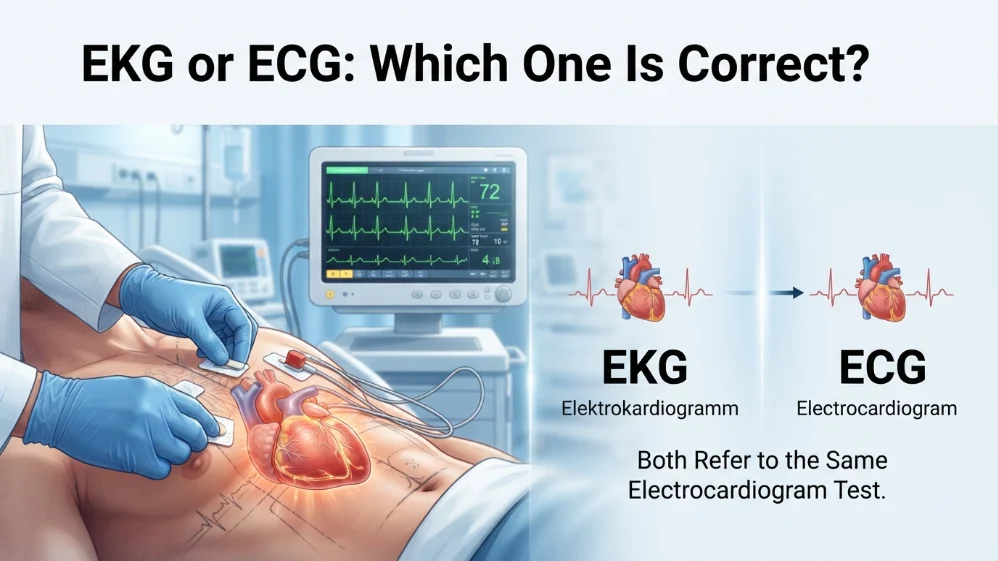
EKG and ECG are two names for the same medical test: an electrocardiogram. Both record the heart’s electrical activity and can help doctors check heart rate and rhythm. ECG comes from the English name, while EKG comes from the German word Elektrokardiogramm. Neither term means a different test.
The Origin of EKG and ECG
The difference between EKG and ECG comes from language, not medicine.
ECG is based on the English term electrocardiogram. The word combines parts that relate to electricity, the heart, and recording or measurement.
EKG has a different history. It comes from the German word Elektrokardiogramm. In German, the word for electricity begins with E, and the word for heart is Kardiogramm. This gives the abbreviation EKG.
The letter K is useful because it helps preserve the German spelling of the heart-related word. Without this background, seeing ECG and EKG can easily make them look like separate medical terms.
However, they describe the same basic examination. During the test, small electrodes are placed on the skin. The machine records the electrical signals produced by the heart.
So, the difference is mainly historical and linguistic, rather than a difference in the test itself.
British English vs American English Spelling
Unlike many British and American spelling differences, EKG and ECG are not simply two regional spellings of one word.
The main difference comes from the language behind the abbreviation.
| Term | Common Usage | Origin | Meaning | Correct? |
|---|---|---|---|---|
| ECG | Common in British English and many other countries | English | Electrocardiogram | Yes |
| EKG | Common in the United States and also used elsewhere | German | Electrocardiogram | Yes |
| Electrocardiogram | Full medical term | English | Test of heart electrical activity | Yes |
| Electrocardiograph | Name for the recording instrument | English | Device used to record heart activity | Yes |
In the UK, doctors and medical websites commonly use ECG. In the United States, EKG is also very common, although ECG is understood and used as well.
This means you should not treat one as a misspelling of the other.
Why Is There Confusion Between EKG or ECG?
The confusion usually happens because people expect one medical test to have only one abbreviation.
When someone sees ECG on one website and EKG on a hospital document, it is natural to wonder whether the tests are different. Search engines also show both terms, which can increase the uncertainty.
Another reason is pronunciation. People may hear a doctor say one abbreviation without seeing it written down. Later, they may remember the sound but not the exact letters.
Typing habits can also play a role. A person who normally sees ECG may type EKG, or the other way around. Autocorrect and search suggestions can make this even more confusing.
Most importantly, the two abbreviations have different linguistic histories. Once that is understood, the apparent spelling problem becomes much easier to remember.
Which Spelling Should You Use?
The best choice depends on your audience.
If you are writing for a British audience, ECG is usually the most natural choice.
For a United States audience, EKG is very common and may be the term readers recognize fastest.
For a global audience, either term can be correct. If your article is educational, you can introduce both forms together, such as electrocardiogram (ECG or EKG). After that, use one abbreviation consistently.
For formal medical writing, always follow the terminology used by the hospital, medical organization, publication, or style guide you are writing for.
The key point is simple: you do not need to correct EKG to ECG or ECG to EKG simply because the other form looks more familiar. Both are accepted abbreviations for the same test.
Common Mistakes with EKG or ECG
Several mistakes appear when people are unfamiliar with the two abbreviations.
Mistake: Thinking EKG and ECG are different tests
Correct: Both refer to an electrocardiogram.
Mistake: Calling EKG a spelling error
Correct: EKG is a valid abbreviation with German roots.
Mistake: Assuming ECG is only British
Correct: ECG is used in many countries, not just the UK.
Mistake: Assuming EKG is only American
Correct: EKG is strongly associated with American medical usage, but it can also appear elsewhere.
Mistake: Using both forms randomly in one article
Correct: Choose one abbreviation and use it consistently after explaining the difference.
Mistake: Confusing the test with the machine
Correct: An electrocardiogram is the recording or test, while an electrocardiograph can refer to the instrument that produces the recording.
EKG or ECG in Everyday Examples
You may encounter both abbreviations in many everyday situations.
Medical appointment:
My doctor recommended an ECG to check my heart rhythm.
American medical setting:
The nurse performed an EKG before the examination.
Medical report:
The ECG showed a regular heart rhythm.
News article:
Doctors used an EKG to monitor the patient’s heart activity.
Educational writing:
An ECG, also called an EKG, records the heart’s electrical signals.
Email:
The doctor asked me to bring my previous ECG report.
Social media:
I had an EKG today as part of my routine checkup.
These examples show why understanding both terms is useful. You may encounter either abbreviation even when the medical test is exactly the same.
Usage Insight – Search and Language Behavior
People who search ekg or ecg are usually trying to solve a terminology problem rather than learn about two separate tests.
Some users may have seen ECG on a medical website and EKG on a report. Others may be checking whether one abbreviation is a typo. Some simply want to know which term they should use when speaking or writing.
Regional language habits also influence search behavior. ECG is widely recognized internationally, while EKG has especially strong recognition in American medical contexts.
This creates a useful search pattern: people may search both abbreviations together because they want confirmation that the terms are equivalent.
Understanding this intent is important because a short answer can solve the main question immediately: EKG and ECG refer to the same heart test.
Comparison Table – EKG and ECG Variations
| Term | Meaning | Correct or Incorrect? | Main Context |
|---|---|---|---|
| ECG | Electrocardiogram | Correct | British, international, and medical usage |
| EKG | Electrocardiogram | Correct | Especially common in American medical usage |
| Electrocardiogram | Test that records heart electrical activity | Correct | Formal medical writing |
| EKG test | An electrocardiogram test | Correct | Everyday medical language |
| ECG test | An electrocardiogram test | Correct | Everyday and formal medical language |
| EGC | Common letter reversal | Usually incorrect for this test | Typing or memory error |
| ECGG | Extra-letter error | Incorrect | Typing mistake |
FAQs
What is the correct spelling of EKG or ECG?
Both EKG and ECG are correct. They are abbreviations for the same medical test, an electrocardiogram. ECG comes from the English term, while EKG reflects the German word Elektrokardiogramm. The choice usually depends on regional or institutional usage.
Is EKG a real medical term?
Yes, EKG is a real and widely accepted medical abbreviation. It refers to an electrocardiogram, which records the heart’s electrical activity. The abbreviation comes from the German term Elektrokardiogramm. It is particularly familiar in American medical settings.
Is ECG different from EKG?
No. ECG and EKG describe the same heart test. Both involve recording the electrical activity of the heart through electrodes placed on the skin. The different abbreviations come from different language traditions, not from differences in the medical procedure.
Why do doctors use EKG instead of ECG?
Doctors may use EKG because it comes from the German word Elektrokardiogramm. The K helps distinguish the abbreviation from other medical terms and reflects the German spelling of the word for heart. EKG is especially familiar in the United States.
Why is ECG common in Britain?
ECG is widely used in Britain because it follows the English term electrocardiogram. It is also common across many countries and international medical resources. British medical writing generally uses ECG, although healthcare professionals will understand EKG as well.
Which term should I use in America?
In the United States, EKG is a very common choice, especially in everyday medical communication. However, ECG is also understood. If you are writing for an American audience, EKG may feel more familiar, while a global audience may recognize ECG quickly.
Which term is better for formal writing?
There is no universal winner. Use the abbreviation preferred by your audience, organization, or publication. For international writing, introducing both forms can prevent confusion: electrocardiogram (ECG or EKG). Then choose one abbreviation and use it consistently throughout your text.
Is EKG a typo for ECG?
No. EKG is not a typo for ECG. Both are accepted abbreviations for an electrocardiogram. Their different letters come from English and German language traditions. Therefore, seeing EKG on one document and ECG on another does not mean one is wrong.
Conclusion
The confusion between EKG or ECG is understandable because the two abbreviations look different while referring to the same medical test. The main difference is their linguistic origin: ECG comes from the English term electrocardiogram, while EKG comes from the German Elektrokardiogramm.
Both forms are correct, and neither represents a different heart examination. ECG is especially common in Britain and international medical writing, while EKG is particularly familiar in the United States. When writing for a specific audience, use the form that readers are most likely to recognize. For a global audience, introducing both terms once can remove confusion immediately.
Read More Related Articles:
Fazed or Phased | The Correct Word, Meaning, Examples, and …
Parent or Guardian | Everything You Need to Know Before Filling …
Crain or Crane | Which Spelling Is Correct? Meaning, Usage …