Have you ever typed a sentence and suddenly stopped at oversite or oversight? You are not alone. This word can be confusing because both spellings look possible at first glance, especially when you hear the word rather than see it written. The confusion often appears in emails, school assignments, reports, and everyday writing when someone wants to describe a mistake, a missed detail, or the act of supervising something.
One small spelling change, however, can make your sentence look incorrect or change what readers understand. If you are unsure whether to write oversite or oversight, this guide will clear it up. You will learn the correct spelling, what the word means, where it comes from, how it is used in British and American English, and how to avoid this common mistake.
Quick Answer
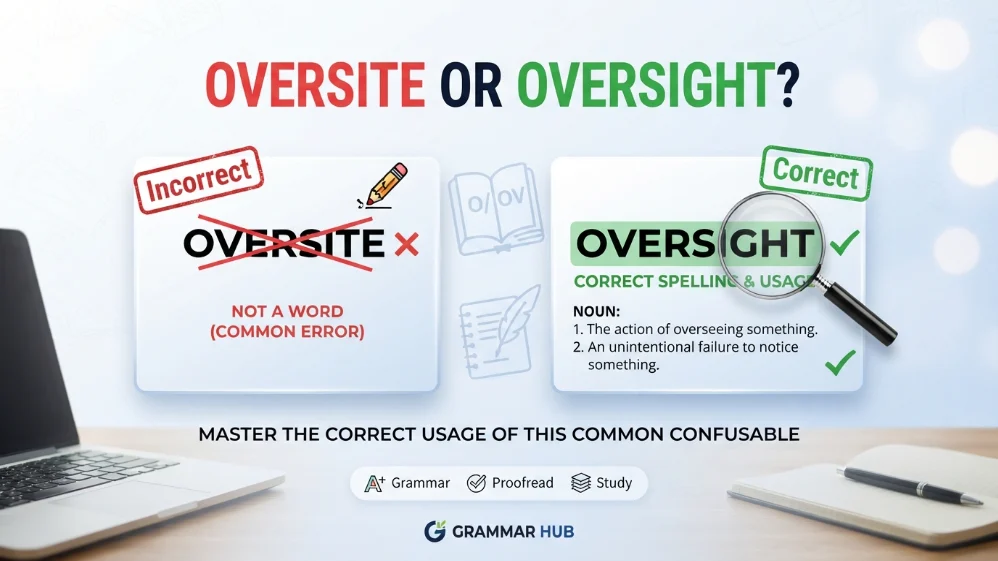
The correct spelling for the common English word is oversight. It can mean an unintentional mistake caused by failing to notice or do something, or it can mean supervision and control of an activity. Oversite is generally not the correct spelling when you mean these everyday meanings. For example: “Leaving her name off the list was an oversight.”
The Origin of Oversite or Oversight
The word oversight has a long history in English. It comes from the combination of over and sight. Historical sources trace the noun to Middle English, with early uses connected to the idea of supervision or watching over something. Later, the word also developed the meaning of failing to notice something.
This history helps explain why oversight has two meanings that may seem almost opposite.
One meaning is supervision. If a manager has oversight of a project, the manager watches, guides, or controls the work.
The other meaning is an accidental mistake or omission. If you forget to include an important name in a document, you can call that an oversight.
For example:
- The committee has oversight of the new policy.
- Forgetting to attach the file was an oversight.
- The project needs better financial oversight.
- Leaving out that important detail was an unfortunate oversight.
The spelling oversight remains the standard form for both meanings.
British English vs American English Spelling
There is no major spelling difference between British and American English in this word. Both varieties use oversight.
The pronunciation can sound slightly different because British and American speakers often pronounce vowels differently, but the written form stays the same.
| Variety | Correct Spelling | Example | Correct? |
|---|---|---|---|
| British English | oversight | It was an unfortunate oversight. | Yes |
| American English | oversight | It was an unfortunate oversight. | Yes |
| British English | oversite | It was an unfortunate oversite. | No |
| American English | oversite | It was an unfortunate oversite. | No |
So, whether you are writing for readers in the UK, the US, Canada, Australia, or another English-speaking region, oversight is the safe standard choice when you mean the common word.
Cambridge and Oxford both list oversight as the noun used for both a mistake caused by failing to notice something and responsibility for supervising an activity.
Why Is There Confusion Between Oversite and Oversight?
The main reason for the confusion is simple: oversite looks like a logical spelling.
English has many words ending in -site, such as:
- website
- campsite
- worksite
- firesite
Because of these familiar words, some writers may naturally type oversite when they hear the word.
Another reason is pronunciation. In normal speech, the final sound in oversight may be heard quickly. Someone who has learned the word mainly through conversation may not immediately know whether it ends in -site or -sight.
Typing also plays a role. A person may remember the sound correctly but choose the wrong letters while writing. Autocorrect can sometimes make this worse if the typed form is treated as a possible word.
Search behavior can add another layer of confusion. When people are unsure about a spelling, they often search both versions. This is why queries such as oversite or oversight appear when users are trying to confirm which form belongs in their sentence.
The important point is that the common noun is spelled oversight.
Which Spelling Should You Use?
If you are writing a normal English sentence and mean a mistake, omission, supervision, or monitoring, use oversight.
For formal writing, oversight is especially important because spelling mistakes can make a report, email, application, or academic assignment look less polished.
Use:
- The error was an oversight.
- The board provides oversight of the project.
- We apologize for the oversight.
- The department needs stronger oversight.
Avoid writing:
- The error was an oversite.
- The board provides oversite of the project.
- We apologize for the oversite.
For global English users, oversight is the best choice because it works naturally across major varieties of English.
One useful trick is to connect the word with sight. An oversight can involve something you failed to see, notice, or monitor. This mental connection can help you remember the correct spelling.
Common Mistakes with Oversite or Oversight
Here are some common mistakes and their corrections.
Mistake: The missing signature was an oversite.
Correct: The missing signature was an oversight.
The word refers to something that was accidentally missed.
Mistake: The manager has oversite of the department.
Correct: The manager has oversight of the department.
Here, oversight means supervision or responsibility.
Mistake: Sorry for the oversite in the report.
Correct: Sorry for the oversight in the report.
Again, the writer is talking about a missed detail.
Mistake: It happened because of a small oversite.
Correct: It happened because of a small oversight.
Remember that oversight is the standard spelling for these meanings.
Another common mistake is confusing oversight with oversee.
Oversight is usually a noun.
Oversee is a verb.
For example:
- The director will oversee the project.
- The director has oversight of the project.
The two words are related, but they do not serve the same grammatical role.
Oversite or Oversight in Everyday Examples
Seeing the word in real sentences makes the difference easier to remember.
In an email:
“Please accept my apology for the oversight. I have attached the missing document.”
In a workplace report:
“The team introduced new checks to reduce the chance of human oversight.”
In a news article:
“The committee called for stronger oversight of public spending.”
In formal writing:
“The agency is responsible for regulatory oversight.”
In everyday conversation:
“Leaving the keys at home was a complete oversight.”
In social media:
“Sorry, I forgot to tag you. That was an oversight!”
Notice that the meaning changes with context. In one sentence, oversight means a mistake. In another, it means supervision. The spelling does not change.
This is one of the interesting features of the word: the same spelling can carry two different meanings. Context tells the reader which meaning is intended.
Search Intent and Usage Behavior
People searching oversite or oversight are usually looking for a quick spelling check. They may have seen the word in a sentence, heard it in conversation, or typed it and wondered whether it looked right.
The search can also come from several different situations:
- Someone checking an email before sending it
- A student checking an assignment
- A professional writing a report
- A writer editing an article
- An English learner checking vocabulary
- Someone unsure about the difference between -site and -sight
The strongest search intent is usually simple: Which spelling is correct?
The answer is oversight when you mean the standard English noun for a missed detail, accidental omission, or supervision.
The spelling confusion does not appear to come from a British-versus-American difference. Major dictionaries use oversight in both varieties. What changes more noticeably is pronunciation, not spelling.
This makes oversite best understood as a spelling error when the intended word is the common noun oversight.
Comparison Table – Keyword Variations
| Variation | Meaning | Correct/Incorrect | Context of Use |
|---|---|---|---|
| oversight | An accidental mistake or missed detail | Correct | Everyday and formal English |
| oversight | Supervision or monitoring | Correct | Business, government, management |
| oversite | Usually intended as the word oversight | Incorrect for these meanings | Common spelling mistake |
| oversee | To supervise or manage something | Correct | Verb |
| oversaw | Past tense of oversee | Correct | Past actions |
| overseen | Past participle of oversee | Correct | Perfect/passive constructions |
The key distinction is that oversight is a noun, while oversee is a verb.
For example:
“The manager will oversee the work.”
“The manager has oversight of the work.”
That small grammar difference can make your writing much clearer.
FAQs
What is the correct spelling of oversite or oversight?
The correct spelling is oversight when you mean a missed detail, accidental mistake, supervision, or monitoring. Oversite is not the standard spelling for these meanings. For example, you can say, “Forgetting the appointment was an oversight.”
Is oversite a real word?
For normal English writing, oversite should not be used as a replacement for oversight. If you mean an accidental omission or supervision, write oversight. The spelling oversite is most often the result of a spelling mistake or confusion with other words.
Why do people confuse oversite and oversight?
People often confuse these spellings because they sound similar when spoken. The ending -site also appears in familiar words such as website and worksite. As a result, writers may choose oversite even though the standard spelling is oversight.
Which spelling is correct in English?
Oversight is the correct spelling for the common English noun. It can describe something accidentally missed or the supervision of an activity. Both British and American English use oversight, so you do not need to change the spelling based on your audience.
Is oversite a typo or a name?
When someone writes oversite while intending to mean a mistake, omission, or supervision, it is normally a spelling error for oversight. A word or name can have a special use in a particular context, but that does not make it the standard spelling here.
Does oversight mean a mistake?
Yes. Oversight can mean a mistake caused by failing to notice or do something. For example, “Leaving the payment off the report was an oversight.” It can also mean supervision, so the surrounding words help determine which meaning is intended.
Can oversight also mean supervision?
Yes. Oversight can mean responsibility for watching, managing, or checking an activity. For example, “The committee has oversight of the program.” This meaning is common in business, government, law, management, and other formal contexts.
What is an easy way to remember oversight?
Connect oversight with the word sight. If something is missed because you failed to notice it, think about what you did not see. This can help you remember that the standard spelling ends in -sight, not -site.
Conclusion
When choosing between oversite or oversight, the correct spelling for the common English word is oversight. Use it when talking about an accidental mistake, a missed detail, supervision, or responsibility for monitoring something. The spelling does not change between British and American English. Although oversite may look natural because of words such as website and worksite, it is not the standard form for these meanings. Remember the sight in oversight, and you will have an easy way to avoid the mistake. Whether you are writing an email, school assignment, business report, or social post, choosing oversight will keep your sentence clear, correct, and natural.
Read More Related Articles:
Fazed or Phased | The Correct Word, Meaning, Examples, and …
Parent or Guardian | Everything You Need to Know Before Filling …
Crain or Crane | Which Spelling Is Correct? Meaning, Usage …