Choosing the right spelling can make a big difference, especially when writing an email, filling out a form, or searching for a name online. Many people pause when they see lily or lilly, unsure which version is correct and whether the extra letter changes the meaning. That is why thousands of people search for this spelling every month, hoping to avoid embarrassing mistakes.
This guide will clear up the lily or lilly confusion in simple, easy to follow language. You’ll learn why the two spellings are often mixed up, when each one is used, see real examples, and discover practical tips to remember the correct form. By the end, you’ll feel more confident using the right spelling without second-guessing yourself. Keep reading to get the full explanation.
Quick Answer
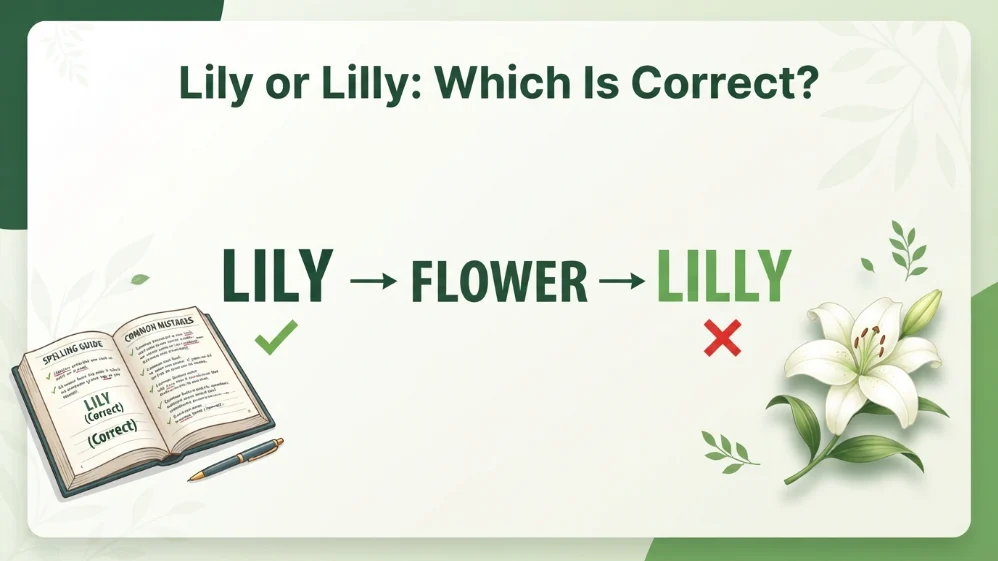
The correct spelling for the flower is lily. Lilly is not a standard spelling for the flower and is generally considered a misspelling.
However, Lilly is commonly used as a personal name, brand name, or in some proper nouns.
Examples
She planted a white lily in her garden. (Flower)
Lilly received a bouquet of lilies for her birthday. (Name)
If you’re writing about the flower, always use lily. For personal names, follow the individual’s preferred spelling.
The Origin of Lily or Lilly
The word lily has a long and interesting history that explains why the spelling matters. The flower name comes from the Latin word “lilium,” which was used by ancient Romans to describe this beautiful blooming plant. The Latin form passed through Old English as “lilie” before becoming the modern “lily” we use today.
The spelling with a single L comes directly from these ancient roots. The word entered English through Germanic languages, maintaining the single L that appeared in its Latin origin. This historical consistency makes lily the standard spelling for the flower across all English-speaking countries.
The double L spelling appears much later in English history. The variant Lilly emerged as a surname and given name, often derived from the flower’s symbolism but spelled differently for personal identification. Families adopted the Lilly spelling to distinguish themselves from others or to create unique name forms.
Today, this historical split explains why both spellings exist. Lily belongs to the natural world and botanical language. Lilly belongs to the world of people’s names and brand identities. Understanding this origin helps clarify when to use each spelling correctly.
British English vs American English Spelling
Unlike many words that differ between British and American English, lily does not vary across regions. Both varieties of English spell the flower with a single L. The same rule applies in Canada, Australia, New Zealand, and all other English-speaking countries.
Here is how the spellings compare:
| Aspect | British English | American English |
|---|---|---|
| Flower Spelling | Lily | Lily |
| Name Spelling | Lilly (personal choice) | Lilly (personal choice) |
| Botanical Standard | Lily | Lily |
| Dictionary Entry | Lily | Lily |
| Common Misspelling | Lilly | Lilly |
| Brand Usage | Varies by company | Varies by company |
| Formal Writing | Lily | Lily |
| School Teaching | Lily | Lily |
The table clearly shows that the standard spelling never changes. The only variation comes from personal naming conventions and branding choices. Lily consistently appears with one L in all botanical, horticultural, and general writing contexts.
Why Is There Confusion Between “Lily or Lilly”?
The confusion between these two spellings exists because both forms appear in everyday life. Unlike many spelling questions where one form is wrong, lily and lilly both have valid uses in different contexts. This overlap creates uncertainty for many writers.
Here are the biggest reasons people get confused.
Different Uses in Writing
Lily describes the flower. Lilly appears as a person’s name. Since both appear frequently in books, social media, and websites, readers see both spellings regularly and wonder which one is correct for their situation.
Example
Lily is my favorite flower.
Lilly is my best friend’s name.
Name Popularity
Many parents name their children Lilly with a double L. This spelling choice has become very popular in recent decades. When people see the name frequently, they start thinking the double L spelling might also work for the flower.
Social Media Usernames
People create usernames with both spellings. Some choose lily for its simplicity. Others pick lilly because the single L version is already taken. This online mixing confuses people who see both forms in their feeds.
Brand and Product Names
Companies sometimes use Lilly as part of their brand identity. Famous examples include Lilly Pulitzer and Eli Lilly and Company. These well-known brands reinforce the double L spelling in public consciousness.
Autocorrect and Spell Checkers
Writing tools handle these spellings differently. Some autocorrect systems change lilly to lily automatically. Others accept both forms as valid. This inconsistency makes users doubt which spelling is correct.
Which Spelling Should You Use?
The best choice depends on what you are writing rather than strict grammar rules.
If You Write About Flowers
Choose lily because it is the only correct spelling for the plant and its blossoms.
Example
The garden was filled with pink lilies and white roses.
If You Write a Person’s Name
Choose the spelling that person uses for themselves. If they spell it Lilly, use Lilly. If they spell it Lily, use Lily.
Example
Lilly invited me to her birthday party.
Lily baked cookies for the school event.
For International Writing
Use lily for the flower because it is the standard spelling worldwide. English speakers everywhere recognize this as the correct botanical form.
For Formal Writing
Always use lily when referring to the flower. This applies to academic papers, professional documents, news articles, and business communications. The double L spelling is not acceptable in formal flower references.
For Brand Names
Follow the company’s official spelling. Companies that use Lilly have the right to spell their name that way. Always check the official brand spelling before writing.
For Creative Writing
Use the correct spelling based on your subject matter. If your character is named Lilly, spell it that way. If you describe flowers, spell it lily.
For Social Media
Use the spelling that matches your meaning. Flower posts need lily. Personal posts about someone named Lilly need the double L spelling.
Common Mistakes with Lily or Lilly
Even careful writers sometimes make mistakes with these spellings. Here are common errors and how to avoid them.
Mistake 1: Using Lilly for the Flower
Incorrect: She received a bouquet of lillies.
Correct: She received a bouquet of lilies.
The flower always uses a single L.
Mistake 2: Changing a Person’s Name Spelling
Incorrect: Lily sent me a text. (When the person spells it Lilly)
Correct: Lilly sent me a text. (When the person spells it Lilly)
Always respect the individual’s preferred spelling.
Mistake 3: Mixing Spellings in One Document
Incorrect: The lily garden featured white flowers. Lilly is a beautiful flower.
Correct: The lily garden featured white flowers. The lily is a beautiful flower.
Stay consistent with the flower spelling.
Mistake 4: Pluralizing Incorrectly
Incorrect: We planted three lillys in the yard.
Correct: We planted three lilies in the yard.
The plural of lily is lilies, not lillys or lillies.
Mistake 5: Assuming Both Work for Flowers
Incorrect: The florist sold lillies and roses.
Correct: The florist sold lilies and roses.
Only the single L spelling is acceptable for the flower.
Mistake 6: Using Lily as a Brand Name
Incorrect: I love Lily Pulitzer dresses.
Correct: I love Lilly Pulitzer dresses.
Always follow the brand’s official spelling.
Lily or Lilly in Everyday Examples
Seeing both spellings in real situations makes the difference much easier to understand.
In an Email
My garden is full of beautiful white lilies this spring. I also planted pink lilies along the fence. Would you like some lily bulbs for your own yard?
In News Writing
The new variety of lily blooms earlier than traditional species. Gardeners love this lily for its strong fragrance. The flower show featured award-winning lilies from across the region.
On Social Media
Just posted my first lily photos of the season! These white lilies smell incredible. Drop a like if you love lilies too! 🌸
In Formal Writing
The botanical garden showcased rare lily species from around the world. Each lily received careful attention from the horticultural staff. Visitors admired the pink and white lilies throughout the exhibit.
In Everyday Conversation
I love seeing lilies bloom in the garden.
Lilly is coming over for dinner tonight.
The white lily symbolizes purity and peace.
Did you know that water lilies float on ponds?
In Academic Writing
The researchers studied the reproductive cycle of the garden lily. Temperature changes affect the lily’s bloom time significantly. This lily species adapts well to various climate conditions.
In Naming Examples
Lilly graduated with honors from the university.
Lily announced her engagement last week.
The name Lilly has increased in popularity recently.
Lily has been a common flower name for centuries.
Google Trends and Usage Behavior
Search interest in lily or lilly stays steady because people regularly encounter both spellings in different contexts. The search pattern reveals genuine confusion rather than simple curiosity. Users typically fall into several categories.
The Flower Gardener: Someone looking up planting information who wants correct spelling for articles, labels, or garden notes. They need confirmation that lily is the proper botanical spelling.
The Gift Giver: Someone writing a note or card who wants to describe flowers correctly. They might be ordering flowers or writing a thank you message and want to avoid embarrassing spelling errors.
The Name Researcher: Parents deciding on baby names who want to understand spelling variations and popularity. They search to compare Lily versus Lilly as name options.
The Social Media User: Someone creating posts or usernames and needing to decide which spelling to use. They want to know which version is correct for their specific content.
The Professional Writer: Editors, bloggers, and content creators who want definitive answers for their writing. They need authoritative guidance on standard spelling.
Common related searches include:
is lily spelled with one L
lily flower spelling
lilly or lily name
correct spelling of lily
lily spelling name
lily plural spelling
lilies or lillies
lily vs lilly grammar
Comparison Table
| Feature | Lily | Lilly |
|---|---|---|
| Meaning | Flower, also a given name | Given name, brand name, surname |
| Correct? | Yes, for flower and some names | Yes, for names and brands only |
| Main Usage | Botanical contexts worldwide | Personal names, company names |
| Botanical Standard | Yes | No |
| Dictionaries | Listed as standard | Listed as name variant |
| International Use | Universal | Personal choice only |
| Plural Form | Lilies | Lillies (for names) |
| Used In Schools | Yes, as flower spelling | No, not for flower |
| Best For | Flower references | People named Lilly, brand names |
This table shows that lily has broader, universal usage while lilly serves specific naming purposes.
FAQs
1. What is the correct spelling of lily?
The correct spelling for the flower is lily with one L. This spelling applies to all English-speaking countries and all varieties of English. The word comes from Latin “lilium” and has always been spelled with a single L in English.
2. Is Lilly a real word?
Yes, Lilly is a real word but it is a proper noun, not a common noun. It appears as a given name, surname, and brand name. However, Lilly is not a recognized spelling for the flower and should never be used in that context.
3. Why do people confuse lily and lilly?
People confuse these spellings because both appear frequently in daily life. The flower lily appears in gardens and decorations. The name Lilly appears in social circles and media. Seeing both forms regularly makes it hard to remember which one is correct for each situation.
4. Is lilly a typo or name?
Lilly is a name when used for a person or brand. It becomes a typo when used to describe the flower. Always check your context. If you mean the flowering plant, lily is correct. If you mean a person, Lilly may be correct.
5. Can I use Lilly as a flower spelling?
No, you should never use Lilly to describe the flower. The standard botanical spelling is lily with one L. Using the double L spelling for flowers is considered an error in all English-speaking countries and all types of writing.
6. What is the plural of lily?
The plural of lily is lilies. You change the Y to I and add ES. This follows the standard rule for words ending in consonant plus Y. The plural is spelled L-I-L-I-E-S, with a single L and I before the final ES.
Conclusion
Choosing between lily or lilly becomes simple when you understand their different purposes. The flower always uses a single L spelling in all English varieties worldwide. This standard never changes regardless of region or writing style. Lilly with a double L belongs to the world of personal names, brand identities, and specific proper nouns.
Remember the simple rule: for flowers, use lily; for people and companies, use their preferred spelling. Most grammar confusion disappears when you apply this basic principle. If you describe a beautiful blooming plant, one L works every time. If you address a person or brand, follow their chosen spelling.
By matching your spelling to your meaning and maintaining consistency throughout your writing, you can communicate clearly and confidently. Your readers will appreciate your attention to detail, and you will never worry about making a spelling mistake again. The beauty of the lily deserves a spelling that matches its elegance and simplicity.
Read More Related Articles:
Schooner or Later| Meaning, Correct Phrase, and Why …
AC or DC | What’s the Difference? Meaning, Uses, and …
Fazed or Phased | The Correct Word, Meaning, Examples, and …