Many people pause while writing an email, school assignment, or social media post because one spelling suddenly looks right and the other looks familiar. That is exactly why judgmental or judgemental is searched by thousands of English learners, students, and professionals every month. A single extra letter can create uncertainty and make even confident writers second-guess themselves.
The confusion comes from differences in spelling rules, regional English, and common writing habits. Since both versions appear online, it is easy to wonder which one is correct and when each should be used. That is why this topic continues to confuse writers around the world.
In this guide, you will discover the correct usage, understand the reason behind the spelling, see clear examples, and learn simple tips to avoid making the same mistake again. Keep reading to write with confidence every time.
Quick Answer
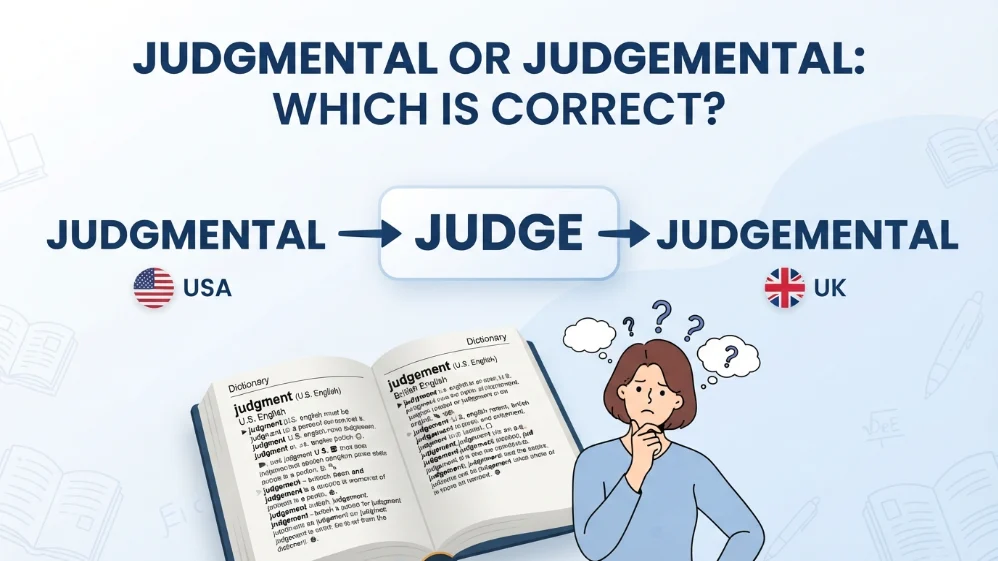
Both judgmental and judgemental are correct spellings of the same word. Judgmental is the preferred spelling in American English. Judgemental is the preferred spelling in British English and many other English-speaking countries.
Examples:
She gave me a judgmental look. (American English)
She gave me a judgemental look. (British English)
If you’re writing for an international audience, judgmental is usually the safest choice because it is widely accepted worldwide.
The Origin of Judgmental or Judgemental
The word judgmental comes from the noun judgment, which itself comes from the verb judge. The spelling confusion started because the base word judge ends with an “e” that drops when adding suffixes.
Originally, the standard spelling was judgement in British English and judgment in American English. This difference came from how each region treated the silent “e” before adding a suffix. British writers kept the “e” to preserve the connection to the root word judge. American writers dropped the “e” to simplify the spelling and match pronunciation.
When adding the suffix “al” to create the adjective, both regions followed their existing patterns:
- American English: judgment + al = judgmental
- British English: judgement + al = judgemental
Over time, both spellings became established and accepted in their respective regions. Today, dictionaries recognize both forms, making this one of the few words with two accepted spelling variations.
British English vs American English Spelling
Although this is a spelling difference rather than a grammar difference, regional preference plays a major role. Here is how the two forms compare:
| Aspect | British English | American English |
|---|---|---|
| Preferred Spelling | Judgemental | Judgmental |
| Also Accepted | Judgmental (less common) | Judgemental (less common) |
| Used in Schools | Mostly Judgemental | Mostly Judgmental |
| Newspapers | Usually Judgemental | Usually Judgmental |
| Formal Writing | Judgemental | Judgmental or Judgemental |
Examples:
British English
The teacher gave a judgemental response to the student’s question.
American English
The teacher gave a judgmental response to the student’s question.
Both versions are correct, but matching your audience makes your writing feel more natural.
Why Is There Confusion Between “Judgmental or Judgemental”?
The confusion exists because both spellings are correct. Unlike many spelling questions where one form is wrong, judgmental and judgemental are both accepted. Their usage mainly depends on regional English.
Here are the biggest reasons people get confused.
Different English Varieties
American English commonly uses judgmental, while British English prefers judgemental. Since people read content from around the world, they often see both forms.
Example:
US: Her comment was very judgmental.
UK: Her comment was very judgemental.
School Spelling Rules
Students often learn only one version in school.
- American textbooks usually teach judgmental.
- British textbooks usually teach judgemental.
When learners later encounter the other form, they think it must be incorrect.
Internet Content
Search engines display articles from many countries. One website may use judgmental, while another uses judgemental, making both appear equally common.
Pronunciation
Both words are pronounced exactly the same way. Since neither sounds different when spoken, many speakers never realize that spelling preference exists.
Autocorrect and Grammar Checkers
Writing tools sometimes recommend one form based on the language setting.
For example:
- English (US) often suggests judgmental.
- English (UK) often suggests judgemental.
This can make writers think the other version is wrong when it is actually acceptable.
Search Intent
People searching judgmental or judgemental usually want to know:
- Which spelling is correct?
- Which one is more common?
- Which should I use in school writing?
- Which form appears in exams?
- Is one American and the other British?
Understanding these questions helps explain why this spelling topic remains popular.
Which Form Should You Use?
The best choice depends on your audience rather than strict spelling rules.
If You Write for American Readers
Choose judgmental because it is the form most Americans naturally expect.
Example:
He made a judgmental comment about her outfit.
If You Write for British Readers
Choose judgemental because it follows standard British spelling.
Example:
The reviewer was overly judgemental about the film.
For International Writing
If your audience comes from different countries, judgmental is often the safest option because it is widely accepted across American and global English.
Academic Writing
Check your institution’s preferred style guide.
- American universities usually accept judgmental.
- British universities generally recommend judgemental.
Consistency matters more than choosing one particular form.
Business Writing
Use whichever form matches your company’s language style.
- If your documents use American English, stay with judgmental.
- If they follow British English, use judgemental throughout.
Common Mistakes with Judgmental or Judgemental
Even though both forms are correct, writers sometimes make mistakes by mixing spellings or using the wrong base word.
Mistake 1: Mixing Regional Styles
Incorrect: The article was judgemental and harsh. (American document using US spelling elsewhere.)
Correct: The article was judgmental and harsh.
Remain consistent throughout your writing.
Mistake 2: Using the Wrong Base Noun
Many people confuse the spelling of the noun judgment with the adjective.
Incorrect: The judge’s judgement was final.
Correct: The judge’s judgment was final. (American English)
Correct: The judge’s judgement was final. (British English)
Mistake 3: Changing Forms Mid-Article
Incorrect: Her judgmental attitude was obvious. Later, she made another judgemental comment.
While not technically incorrect, switching spellings in one piece of writing feels inconsistent.
Choose one spelling and keep it throughout.
Mistake 4: Thinking One Is Always Wrong
Many learners believe only one answer exists.
The truth:
Judgmental ✔ Correct
Judgemental ✔ Correct
The better choice depends on your audience.
Mistake 5: Adding Extra Letters
Incorrect: Judgemental is sometimes misspelled as judgeamental.
Correct: Judgemental has a clear spelling pattern.
Judgmental or Judgemental in Everyday Examples
Seeing both spellings in real situations makes the difference much easier to understand.
In an Email
American English:
Please try not to be judgmental about the new employee’s mistakes.
British English:
Please try not to be judgemental about the new employee’s mistakes.
In News Writing
The politician faced judgmental scrutiny from the media.
The critic gave a judgemental review of the restaurant.
On Social Media
I hate it when people get so judgmental online.
Why is everyone so judgemental today?
In Formal Writing
The researcher avoided judgmental language when analyzing participant responses.
In Everyday Conversation
She gave me a judgmental glance.
His tone was very judgemental.
Both spellings look natural, depending on the writer’s English variety.
Google Trends and Usage Behavior
Search interest in judgmental or judgemental stays steady because learners regularly encounter both spellings in books, classrooms, websites, and media.
Common reasons people search this topic include:
- Checking the correct spelling of judgmental
- Understanding American and British English spelling differences
- Preparing for exams
- Improving spelling for school assignments
- Writing professional documents
- Editing books, blogs, or articles
- Confirming dictionary usage
- Learning natural English expressions
People also search related phrases such as:
- how to spell judgmental
- judgmental or judgemental
- judgemental meaning
- judgmental definition
- correct spelling of judgmental
- British vs American spelling
- judgmental person
- judgemental attitude
Because both spellings are accepted, readers often look for practical guidance rather than a simple right-or-wrong answer. This explains why the topic remains popular year after year.
Comparison Table
| Feature | Judgmental | Judgemental |
|---|---|---|
| Meaning | Inclined to judge critically | Inclined to judge critically |
| Correct? | Yes | Yes |
| Main Usage | American English | British English and Commonwealth English |
| Formal Writing | Accepted in US | Widely accepted internationally |
| School Usage | Common in US | Common in UK |
| Etymology | Judgment + al | Judgement + al |
| Best For | American audiences | British and global audiences |
FAQs
1. What is the correct spelling of judgmental?
Both judgmental and judgemental are correct spellings. Judgmental is the preferred spelling in American English. Judgemental is the preferred spelling in British English. The best choice depends on your audience and the variety of English you are using.
2. Is judgmental grammatically correct?
Yes. Judgmental is grammatically correct and widely accepted in American English. It has been used for many years in books, newspapers, and everyday writing. Although it is less common in British English, it is still recognized by major dictionaries.
3. Is judgemental grammatically correct?
Yes. Judgemental is the standard spelling in British English, Australia, New Zealand, and other Commonwealth countries. It follows the British pattern of keeping the silent “e” from the noun judgement. It is also accepted in American English.
4. Should I use judgmental or judgemental in formal writing?
Use the spelling that matches your audience. If you are writing for an American audience, judgmental is a natural choice. For British or international readers, judgemental is usually preferred. The most important rule is to stay consistent throughout your writing.
5. Why do people confuse judgmental and judgemental?
People become confused because both spellings are correct and appear in dictionaries, books, and online articles. Regional English differences, school lessons, spelling tools, and international websites all contribute to the confusion, making it difficult to know which spelling to choose.
6. Is judgemental the same as judgmental?
Yes. Both words have exactly the same meaning. They describe someone who is quick to form opinions or judgments about others. The only difference between them is the spelling, which depends on whether you are using American or British English.
7. What is the noun form of judgmental?
The noun form is judgment in American English and judgement in British English. Both nouns mean the ability to make considered decisions or the act of forming an opinion. The spelling of the noun matches the adjective form you choose.
Conclusion
Choosing between judgmental or judgemental is easier once you understand that both spellings are correct. The real difference lies in regional preference rather than correctness. Judgmental is the standard spelling in American English, while judgemental remains the preferred form in British English and many other parts of the world. For international writing, judgmental is often the safest option, but either spelling is acceptable when used consistently. By matching your choice to your audience and maintaining the same style throughout your writing, you can communicate clearly and confidently without worrying about making a spelling mistake.
Read More Related Articles:
Schooner or Later| Meaning, Correct Phrase, and Why …
AC or DC | What’s the Difference? Meaning, Uses, and …
Fazed or Phased | The Correct Word, Meaning, Examples, and …