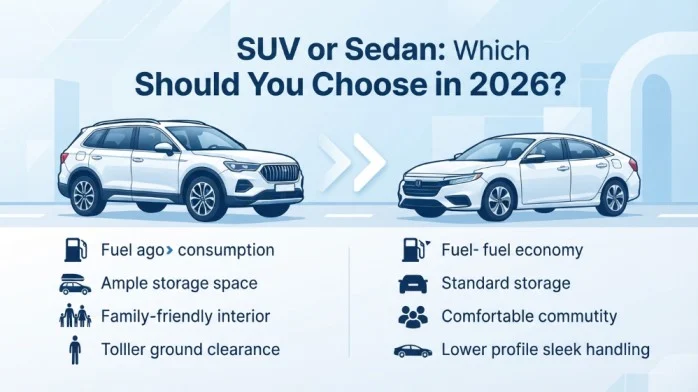
Choosing between SUV or sedan can feel like a big decision, especially when you are buying a new car, leasing a vehicle, or helping a family member find the right ride. Many drivers pause before making this choice because both options offer unique benefits that suit different lifestyles. This common dilemma comes from differences in fuel economy, cargo space, driving experience, and the way people use their vehicles every day.
If you have searched for SUV or sedan, you are far from alone. Thousands of people look up this comparison every month to figure out which vehicle type fits their needs best. In this guide, you will learn the key differences between SUVs and sedans, understand why both vehicle types exist, discover where each one works best, and see clear examples that help you avoid choosing the wrong vehicle. Keep reading to choose the right car with complete confidence.
Quick Answer
SUVs offer more cargo space, higher seating positions, and better off-road capability. Sedans provide better fuel economy, easier parking, and smoother handling on paved roads. SUVs suit active families, outdoor enthusiasts, and drivers who need extra space. Sedans fit city commuters, budget-conscious buyers, and people who prioritize fuel savings. Your choice depends on your lifestyle, family size, driving habits, and budget priorities.
Examples
She bought an SUV for her growing family and weekend camping trips. (Family needs)
He chose a sedan for his daily commute and city parking. (City driving)
If you are buying for an international lifestyle or uncertain needs, a sedan is often the safer choice because it works well in most situations.
The Origin of SUVs and Sedans
The vehicle categories we know today developed over more than a century of automotive history. Sedans appeared first as closed-body cars that could carry passengers in comfort and protection from weather. The word sedan comes from an Italian word meaning chair with a roof, which described how early carriages protected riders inside. These vehicles became popular because they offered shelter from rain, wind, and dust while traveling.
SUVs, or sport utility vehicles, began as rugged work vehicles designed for farms, military use, and off-road exploration. The Jeep and Land Rover pioneered this category in the 1940s and 1950s. These early SUVs were simple, strong, and built for tough terrain rather than passenger comfort. They could carry heavy loads and drive through mud, snow, and rough paths that stopped ordinary cars.
During the 1990s, SUVs changed dramatically. Automakers started building them with car-like frames instead of truck chassis. This shift made SUVs more comfortable and fuel-efficient while keeping their tall appearance and spacious interiors. Today, SUVs have become the most popular vehicle type in America and many other countries.
British English vs American English Usage
The terms SUV and sedan are understood in all English-speaking countries, but some regional differences exist in vocabulary.
| Feature | British English | American English |
|---|---|---|
| Preferred Term | 4×4 or Off-Roader | SUV |
| Also Called | Chelsea Tractor (informal) | Sport Utility Vehicle |
| Sedan Term | Saloon | Sedan |
| Common Usage | SUV increasingly common | SUV used widely |
| Formal Writing | 4×4 or SUV | SUV |
| Everyday Speech | 4×4 or four-by-four | SUV |
| Example Sentence | She bought a new 4×4. | She bought a new SUV. |
| Fuel Comparison | 4×4 vs Saloon | SUV vs Sedan |
The table shows that Americans use SUV almost exclusively while Brits have multiple terms. Sedan in America becomes saloon in Britain, which can confuse international readers. Understanding these differences helps when reading reviews or comparing vehicles from different countries.
Why Is There Confusion Between SUV or Sedan?
The confusion between SUVs and sedans comes from several factors that make the choice difficult for modern buyers.
Blurred Vehicle Categories
The lines between vehicle types have blurred significantly. Automakers now produce crossovers that combine sedan handling with SUV space. These in-between vehicles make the old categories less useful for decision-making.
Marketing Language
Marketing language confuses buyers. Companies use terms like sport activity vehicle, crossover, and utility sedan to make their products sound unique. This flood of new names makes it hard to understand what each vehicle actually offers.
Improved Fuel Economy
Fuel economy has improved dramatically in SUVs. Older SUVs were gas guzzlers, but modern models often achieve similar mileage to sedans. This improvement removes one of the traditional advantages of choosing a sedan.
Safety Feature Overlap
Safety features have become standard across both categories. Advanced braking, lane assist, and collision warning systems appear in nearly all new vehicles. Without clear safety differences, buyers struggle to find a decisive factor.
Parking and City Concerns
Parking and city driving concerns vary by region. A sedan works better in crowded cities, but a suburban driver with a garage might prefer an SUV. These location-based differences create conflicting advice.
Lifestyle Changes
Lifestyle and family needs change over time. A young professional might prefer a sedan, but that same person might want an SUV after having children. This life-stage factor adds another layer to the decision.
Search Intent
People searching SUV or sedan usually want to know:
Which vehicle type is better?
Which one costs less to own?
Which suits my family needs?
Which handles better on highways?
Which works in snowy or rough conditions?
Which holds value over time?
Understanding these questions helps explain why this comparison remains popular.
Which Vehicle Should You Choose?
The best choice depends on your audience and situation rather than strict rules.
If You Drive in the City
Choose a sedan because it is easier to park, more maneuverable in tight spaces, and offers better visibility in traffic. Sedans also tend to have smoother rides on paved city streets.
Example
The sedan parked easily in the narrow downtown garage.
If You Have a Family
Choose an SUV because the extra space for car seats, strollers, and sports equipment makes daily life easier. SUVs also offer higher seating positions that help parents reach children in car seats without bending.
Example
The SUV fit three car seats and all the groceries with room to spare.
If You Commute Long Distances
Choose a sedan because better fuel economy means fewer stops at gas stations and lower running costs. Sedans also provide quieter cabins and smoother highway rides.
Example
The sedan saved him over forty dollars each month on fuel costs.
If You Love the Outdoors
Choose an SUV because higher ground clearance, available all-wheel drive, and space for camping gear make SUVs ideal for adventures off the pavement.
Example
The SUV handled the muddy forest road without any trouble.
If You Are on a Budget
Choose a sedan because sedans generally cost less to buy, insure, and maintain. They also hold their value differently than SUVs, which can affect resale considerations.
Example
The sedan cost less upfront and had cheaper insurance premiums.
Common Mistakes When Choosing SUV or Sedan
Even informed buyers make mistakes when comparing these two vehicle types. Here are common errors and how to avoid them.
Mistake 1: Assuming All SUVs Are the Same
Incorrect: Every SUV uses lots of fuel and handles poorly.
Correct: Modern crossovers offer similar fuel economy to sedans.
Many SUVs now achieve excellent mileage and handle almost like cars.
Mistake 2: Ignoring Actual Cargo Needs
Incorrect: I need an SUV because I might carry large items someday.
Correct: Measure what you actually carry and choose accordingly.
Most people rarely use the full cargo space of an SUV.
Mistake 3: Overlooking Total Cost of Ownership
Incorrect: The sedan costs less to buy, so it is cheaper overall.
Correct: Compare insurance, maintenance, fuel, and resale values.
SUVs often have higher insurance rates and tire costs.
Mistake 4: Forgetting About Garage or Parking Space
Incorrect: An SUV will fit in my standard parking spot.
Correct: Measure your garage height and parking space length.
Many SUVs are too tall for older garages or tight parking structures.
Mistake 5: Believing SUVs Are Always Safer
Incorrect: Bigger means safer in every situation.
Correct: Sedans often have better handling and shorter stopping distances.
Size does not guarantee safety in all conditions.
Mistake 6: Mixing Up Vehicle Classes
Incorrect: A compact SUV is the same as a full-size SUV.
Correct: Vehicle classes vary significantly in size, fuel use, and price.
Research specific models rather than assuming all SUVs are alike.
SUV or Sedan in Everyday Examples
Seeing both vehicle types in real situations makes the difference much easier to understand.
In a Family Discussion
We need to replace our old car. The sedan gets better mileage for my commute, but the SUV would fit all three kids and our weekend camping gear. What do you think?
At a Dealership
The sedan handles beautifully on the highway and parks easily downtown. The SUV offers more visibility and cargo space, but it costs more at the pump. Both have great safety ratings.
In an Online Review
I test drove both the sedan and SUV versions of this model. The sedan felt more responsive and quiet. The SUV gave me a commanding view of the road and swallowed all my Costco purchases with room left over.
In an Email to a Friend
Hey, I finally decided on the sedan. The SUV was tempting with all that space, but I really only drive alone to work and back. The sedan saves me about forty dollars a month on gas.
On Social Media
Just joined the SUV club. Never thought I would buy one, but with two dogs and a baby on the way, the sedan just could not handle our gear. Best decision ever.
In News Writing
Sales figures show SUVs outselling sedans for the sixth consecutive year. Automakers respond by offering more sedan models with SUV-like features, blurring the lines between these traditional categories.
In Formal Business Writing
The company fleet consists primarily of sedans for city-based employees and SUVs for those working in rural territories.
In Everyday Conversation
He backed the SUV into the parking spot without any trouble.
She drove the sedan through the narrow mountain roads with confidence.
Both choices work well, depending on the driver’s needs and preferences.
Google Trends and Usage Behavior
Search interest in SUV or sedan stays steady because buyers regularly encounter both options in dealerships, advertisements, reviews, and personal recommendations.
Common reasons people search this topic include:
Comparing fuel economy between vehicle types
Understanding cargo and passenger space differences
Determining which vehicle fits their budget
Evaluating safety features and ratings
Checking insurance cost differences
Planning for family or lifestyle changes
Reading expert reviews and owner experiences
Making a final purchase decision with confidence
People also search related phrases such as:
SUV vs sedan which is better
SUV or sedan for family
SUV or sedan for city driving
SUV or sedan fuel economy
SUV or sedan safety comparison
SUV or sedan cost of ownership
SUV or sedan for snow
SUV or sedan resale value
Because both vehicle types are widely available, readers often look for practical guidance rather than a simple right-or-wrong answer. This explains why the topic remains popular year after year.
Comparison Table
| Feature | SUV | Sedan |
|---|---|---|
| Meaning | Sport Utility Vehicle | Passenger Car |
| Correct? | Yes | Yes |
| Main Usage | Families, outdoors, rural | Commuters, city, budget |
| Cargo Space | Large, flexible | Moderate, trunk-style |
| Passenger Capacity | 5 to 8 seats | 5 seats |
| Fuel Economy | Lower on average | Higher on average |
| Driving Position | High, commanding view | Low, sporty feel |
| Parking Ease | More difficult in tight spaces | Easier to park |
| Off-Road Capability | Good to excellent | Poor to nonexistent |
| Towing Capacity | Significant | Very limited |
| Purchase Price | Higher typically | Lower typically |
| Maintenance Cost | Higher generally | Lower generally |
| Best For | Active families, adventure | Daily commuters, savings |
| Example | She loaded the SUV with camping gear. | He parked the sedan in the city garage. |
This table shows that each vehicle type has clear strengths. The right choice depends on matching those strengths to your specific needs.
FAQs
1. Which is better, an SUV or a sedan?
Neither is universally better. SUVs offer more space, higher seating, and off-road ability. Sedans provide better fuel economy, easier parking, and lower costs. The best choice depends on your driving habits, family size, and budget priorities.
2. Are SUVs safer than sedans?
SUVs often perform better in multi-vehicle crashes due to their size and weight. Sedans have advantages in single-vehicle accidents because they are harder to roll over. Both vehicle types receive excellent safety ratings from testing agencies.
3. Which vehicle type saves more money overall?
Sedans generally cost less in purchase price, fuel, insurance, and maintenance. SUVs cost more upfront and typically have higher running costs. Over five years, a sedan can save thousands of dollars compared to a similar SUV.
4. Do SUVs use more gas than sedans?
Yes, SUVs typically use more fuel than sedans of similar age and class. However, modern crossovers have narrowed this gap considerably. Many smaller SUVs achieve mileage comparable to traditional sedans, especially with hybrid or electric powertrains.
5. Which is easier to drive in cities?
Sedans are easier in cities because they are shorter, narrower, and more maneuverable. SUVs present challenges in tight parking garages, narrow streets, and parallel parking spaces. City drivers often prefer sedans for these reasons.
6. Do SUVs hold their value better than sedans?
This depends on the specific model rather than the vehicle type. Some SUVs hold value extremely well while others depreciate quickly. The same applies to sedans. Research your target model specifically rather than assuming based on category.
Conclusion
Choosing between SUV or sedan becomes much easier when you understand your priorities. Both vehicle types have clear advantages that suit different drivers and situations. SUVs excel at carrying families, gear, and adventure while offering visibility and off-road capability. Sedans shine in fuel economy, city maneuverability, and cost savings over years of ownership. Neither choice is wrong, but matching the vehicle to your lifestyle makes every drive more enjoyable. Think about where you drive, who you carry, and what you really need day to day. The answer will become clear. Test drive your top choices, compare costs carefully, and choose the vehicle that makes your daily life simpler and more comfortable. You deserve a vehicle that fits you perfectly.
Read More Related Articles:
Fazed or Phased | The Correct Word, Meaning, Examples, and …
Mykonos or Santorini| Which Greek Island Is Better for Your …
Over or Under| Which Word Should You Use? Meaning, …