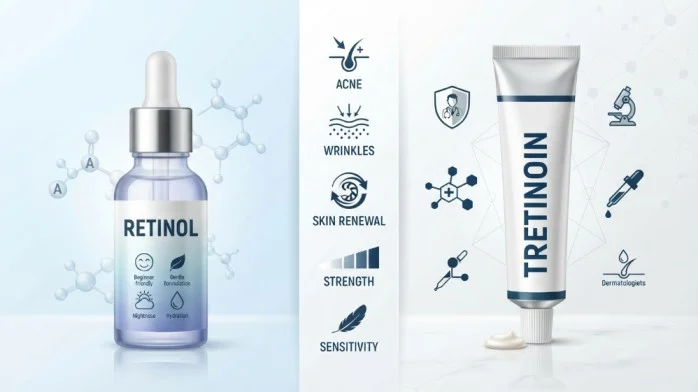
Standing in the skincare aisle or scrolling through beauty recommendations online can feel overwhelming when you see retinol or tretinoin mentioned everywhere. Many people assume these two ingredients are the same because both promise smoother skin, fewer wrinkles, and clearer acne. In reality, they work differently and are designed for different needs.
This confusion is one reason thousands of people search for retinol or tretinoin every month. Some want to know which is stronger, while others simply want the safest option for their skin. Choosing the wrong product can lead to irritation, wasted money, or disappointing results.
This guide explains the differences in simple language, compares both ingredients side by side, shows when each one is the better choice, and helps you confidently pick the right option for your skincare routine.
Quick Answer
Retinol and tretinoin are not the same ingredient. Retinol is an over-the-counter form of vitamin A that works gradually and is suitable for beginners. Tretinoin is a prescription-strength retinoid that acts faster and is commonly used to treat acne, sun damage, and deeper wrinkles. If you have sensitive skin, retinol is usually the better starting point. If you need stronger results under medical guidance, tretinoin is often the preferred choice.
The Origin of Retinol and Tretinoin
Although both ingredients belong to the retinoid family, they were created for different purposes and entered skincare at different times.
Retinol
The word retinol comes from retina, referring to vitamin A’s important role in eye health. Scientists later discovered that vitamin A also improves skin cell turnover, making retinol a popular ingredient in cosmetic skincare products.
Because retinol must be converted into retinoic acid inside the skin, it works more slowly and gently.
Tretinoin
Tretinoin is the scientific name for all-trans retinoic acid, the active form of vitamin A.
Unlike retinol, tretinoin does not need to be converted after application. It begins working immediately, making it much stronger and more effective for medical skin conditions.
Why People Get Confused
The confusion usually happens because:
- Both come from vitamin A.
- Both reduce wrinkles and acne.
- Many skincare articles discuss them together.
- Social media often uses the names interchangeably.
- Beginners assume stronger always means better.
Despite these similarities, they are different products with different strengths.
British English vs American English Spelling
Unlike many English spelling differences, retinol and tretinoin are medical ingredient names, not regional spellings.
Whether you’re in the United States, the United Kingdom, Canada, Australia, or anywhere else, the spelling remains exactly the same.
| Feature | Retinol | Tretinoin |
|---|---|---|
| British English | Retinol | Tretinoin |
| American English | Retinol | Tretinoin |
| Medical spelling | Same worldwide | Same worldwide |
| Dictionary spelling | Correct | Correct |
| Alternate spelling | None | None |
Examples
Correct
- My dermatologist recommended tretinoin.
- I started using retinol twice a week.
Incorrect
- Retinal (when referring to retinol)
- Tretnoin
- Tretinion
- Retinoll
Why Is There Confusion Between Retinol and Tretinoin?
The confusion is not about spelling—it is about understanding.
Similar Names
Both names begin with retin-, making them look nearly identical.
Similar Benefits
Each ingredient can help improve:
- Acne
- Fine lines
- Wrinkles
- Uneven skin tone
- Sun damage
People naturally assume they perform the same way.
Social Media Advice
Many influencers compare them without explaining their strength differences, leading viewers to believe they are interchangeable.
Online Shopping
Some product descriptions highlight similar benefits while hiding important details about concentration and prescription requirements.
Search Intent
Users commonly search:
- Retinol vs tretinoin
- Is retinol the same as tretinoin?
- Which is stronger?
- Can I replace tretinoin with retinol?
- Do I need a prescription?
Which One Should You Use?
The answer depends on your skin goals, experience, and sensitivity.
Choose Retinol If You:
- Are new to retinoids
- Have sensitive skin
- Want gradual improvement
- Prefer over-the-counter products
- Want fewer side effects
Choose Tretinoin If You:
- Have persistent acne
- Need treatment for significant sun damage
- Want faster anti-aging results
- Have been advised by a healthcare professional
- Can tolerate stronger formulas
Practical Advice
For beginners, starting with retinol often allows the skin to build tolerance. If stronger treatment becomes necessary, a dermatologist may recommend switching to tretinoin.
Common Mistakes with Retinol or Tretinoin
Using Too Much
❌ Applying a thick layer every night.
✔ Use only a pea-sized amount.
Expecting Overnight Results
Neither ingredient works instantly.
Visible improvements often require consistent use over several weeks or months.
Skipping Moisturizer
Retinoids may cause dryness.
A moisturizer helps reduce irritation.
Forgetting Sunscreen
Both ingredients increase sun sensitivity.
Daily sunscreen is essential.
Using Both Together Immediately
Many beginners layer retinol and tretinoin, believing faster results will follow.
Instead, this often causes irritation without improving effectiveness.
Applying to Wet Skin
Damp skin increases absorption, which can increase irritation.
Allow your skin to dry completely before applying.
Retinol or Tretinoin in Everyday Examples
“My dermatologist suggested switching from retinol to tretinoin because my acne wasn’t improving.”
News Article
“Researchers continue studying how retinoids, including retinol and tretinoin, improve skin aging.”
Social Media
“I’ve been using retinol for three months, and my skin feels smoother already.”
Medical Consultation
“Tretinoin may provide stronger results, but patients should expect an adjustment period.”
Beauty Blog
“If you’re just beginning skincare, retinol usually offers a gentler introduction.”
Product Review
“I started with retinol before moving to tretinoin under professional guidance.”
Google Search Behavior and User Intent
People searching retinol or tretinoin usually have one of several goals.
Some want to know which ingredient is stronger.
Others are deciding which product to buy before spending money.
Many users have recently received a prescription and want to understand how it differs from products available without one.
Another large group searches after seeing both names in skincare videos or online discussions and assumes they are different spellings of the same ingredient.
Interest also increases during skincare trends, seasonal sales, and when anti-aging routines become popular. Educational comparisons often satisfy this search intent better than simple product recommendations because users want to understand both effectiveness and safety.
Comparison Table
| Feature | Retinol | Tretinoin |
|---|---|---|
| Meaning | Vitamin A derivative | Active retinoic acid |
| Available | Over the counter | Prescription in many countries |
| Strength | Mild | Strong |
| Speed | Gradual | Faster |
| Irritation | Lower | Higher |
| Best for | Beginners | Moderate to severe acne, deeper wrinkles |
| Daily use | Easier | Requires careful adjustment |
| Suitable for sensitive skin | Usually yes | Often needs supervision |
| Correct usage | ✔ | ✔ |
Frequently Asked Questions
What is the difference between retinol and tretinoin?
Retinol is a gentler vitamin A ingredient that must convert into retinoic acid inside the skin before becoming active. Tretinoin is already in its active form, making it stronger, faster, and commonly prescribed for acne, wrinkles, and sun damage.
Is retinol the same as tretinoin?
No. They belong to the same family of vitamin A derivatives but differ in strength, availability, and speed. Retinol is sold without a prescription in many places, while tretinoin is usually prescribed by healthcare professionals.
Which is stronger: retinol or tretinoin?
Tretinoin is considerably stronger because it works immediately without conversion inside the skin. Retinol delivers similar benefits more gradually, making it a better option for beginners or people with sensitive skin.
Can I switch from retinol to tretinoin?
Yes. Many people begin with retinol to build skin tolerance before moving to tretinoin if stronger treatment becomes necessary. A gradual transition and professional advice help reduce irritation.
Which ingredient is better for acne?
Tretinoin is generally more effective for persistent acne because it increases skin cell turnover more rapidly. Mild acne may still improve with retinol, especially when used consistently.
Which ingredient works better for wrinkles?
Both improve fine lines over time. Tretinoin usually produces visible improvements sooner because of its higher potency, while retinol offers slower but gentler anti-aging benefits.
Can beginners use tretinoin?
Some beginners can, but irritation is more common. Starting with retinol often provides a smoother introduction before considering prescription-strength treatment.
Can I use retinol every day?
Many people eventually can, but it is best to begin two or three nights each week and gradually increase use as the skin adapts. Moisturizer and sunscreen help minimize irritation.
Conclusion
Choosing between retinol or tretinoin becomes much easier once you understand that they are related but not identical. Retinol is a gentle option for people beginning their skincare journey or those with sensitive skin. Tretinoin delivers stronger and faster results but usually requires medical guidance because it can cause more irritation. Neither ingredient is universally better the right choice depends on your skin concerns, experience, and goals. By understanding how each works, using them correctly, and being patient with results, you can build a skincare routine that is both safe and effective while avoiding the confusion that surrounds these two popular vitamin A ingredients.
Read More Related Articles:
Fazed or Phased | The Correct Word, Meaning, Examples, and …
Mykonos or Santorini| Which Greek Island Is Better for Your …
Over or Under| Which Word Should You Use? Meaning, …