Have you ever noticed a rough, hard spot on your skin and wondered whether it is a wart or callus? These two skin problems can look alike, especially on the hands, fingers, and feet. That is why people often search for the difference before trying to treat the spot themselves. A callus usually forms because of repeated pressure or rubbing, while a wart is caused by a viral infection.
Knowing which one you have matters because the right care can be very different. In this guide, you will learn how to tell a wart from a callus, understand their common causes, spot key differences, and choose safer next steps. The goal is simple: help you identify what you are looking at without unnecessary confusion.
Quick Answer:
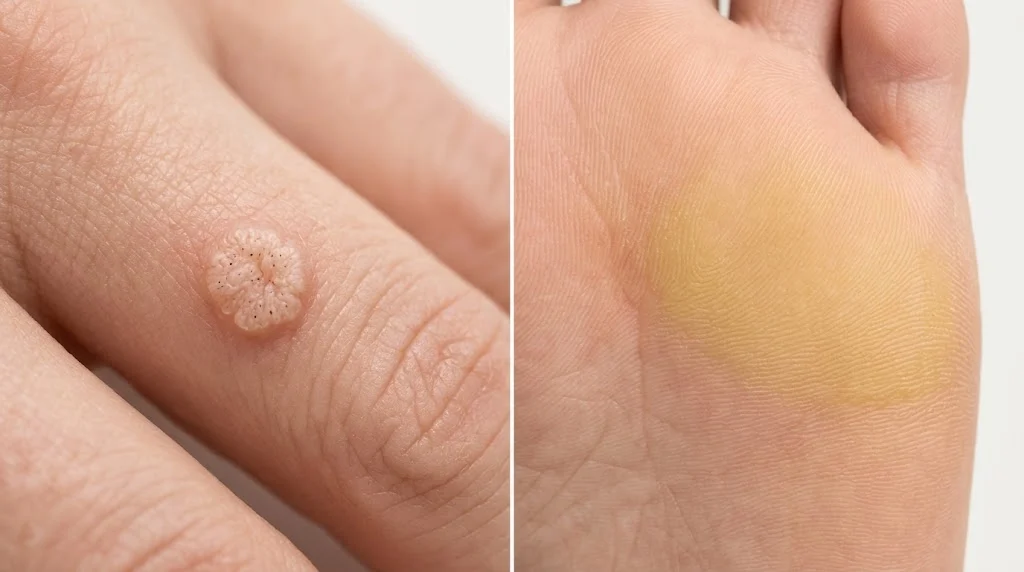
A wart is a small skin growth caused by certain types of human papillomavirus, while a callus is thick, hardened skin caused by repeated pressure or friction. Warts may have tiny black dots and interrupt normal skin lines. Calluses usually have a broad, smooth area of thickened skin.
The Origin of Wart and Callus
The words wart and callus have different histories because they describe different things.
The word wart comes from Old English wearte, with roots linked to older Germanic words for a small growth on the skin. Over time, the spelling changed into the modern English word wart.
Callus comes from Latin callum, meaning hard skin or a hard substance. The word entered English through medical and scholarly language and became associated with thickened, hardened skin.
Their different origins also reflect an important medical difference. A wart is a skin growth linked to a virus. A callus is the body’s response to repeated mechanical stress. In simple terms, one is usually caused by an infection, while the other develops because the skin is protecting itself.
British English vs American English Spelling
Unlike many confusing English word pairs, wart and callus do not have different standard spellings in British and American English.
The spelling wart is standard in both varieties. Likewise, callus is the standard noun used in both British and American English.
| Word | British English | American English | Correct Usage |
|---|---|---|---|
| Wart | wart | wart | Correct in both |
| Callus | callus | callus | Correct in both |
| Warts | warts | warts | Correct in both |
| Calluses | calluses | calluses | Correct in both |
There is one detail worth knowing. In British English, callosity may also appear in medical writing to describe an area of thickened skin. However, callus remains a normal and widely understood word.
So, if you are writing an email, school assignment, health article, or social media post, you do not need to change the spelling based on whether your readers use British or American English.
Why Is There Confusion Between Wart or Callus?
The confusion is usually not about spelling. It is about appearance and meaning.
Both warts and calluses can create a rough or thick area of skin. Both can appear on parts of the body that experience frequent contact or pressure. This makes it easy to assume they are the same thing.
Search behavior adds another layer of confusion. Someone who finds a hard spot under a foot may not know what to call it. They might search phrases such as wart or callus, wart vs callus, hard spot on foot, painful bump on foot, or difference between wart and callus.
Typing mistakes can also affect searches. People may enter incomplete phrases, use singular words when they mean plural ones, or describe what they see instead of using the medical term.
The key point is this: a wart and a callus can look similar, but their causes are not the same.
Which One Should You Use?
If you are describing a skin condition, choose the word based on what you mean.
Use wart when you are talking about a rough skin growth associated with a viral infection.
Use callus when you mean thick, hardened skin that develops after repeated pressure or friction.
For formal writing, be specific. Instead of writing, “I have a hard spot,” you might write, “I have a thickened area of skin that may be a callus.”
For everyday conversation, both words are easy to understand.
If you are unsure whether a skin growth is a wart or callus, avoid treating it based only on appearance. A healthcare professional can help identify unusual, painful, bleeding, or persistent skin changes.
Common Mistakes with Wart or Callus
One common mistake is treating every rough spot on the foot as a callus. Not every thick patch is caused by friction.
Another mistake is assuming that every small bump is a wart. Skin conditions can have similar appearances, so appearance alone does not always provide a definite answer.
Here are some common usage mistakes:
Incorrect: I have a callous on my finger.
Better: I have a callus on my finger.
The word callus is the usual spelling for hardened skin. Callous is a different English word that usually describes someone who is emotionally insensitive or uncaring.
Incorrect: This wart came from wearing tight shoes.
Better: A callus may develop from repeated pressure caused by tight or poorly fitting shoes.
Incorrect: Every hard bump is a wart.
Better: A hard bump may have several possible causes, including a wart or callus.
This distinction is especially useful because callus and callous sound alike but have different meanings.
Wart or Callus in Everyday Examples
Knowing how the words work in real sentences makes the difference easier to remember.
Email:
“I noticed a rough spot on my heel that may be a callus from my new shoes.”
Health article:
“A wart may have a rough surface and can appear on different parts of the body.”
Social media:
“Does anyone else get a callus after wearing new walking shoes?”
Formal writing:
“Repeated friction may contribute to the development of a callus.”
Everyday conversation:
“I think that bump on my finger might be a wart.”
School writing:
“A callus forms when skin becomes thicker after repeated pressure or friction.”
The words also have different plural forms. The plural of wart is warts, while the plural of callus is commonly calluses.
How Can You Tell a Wart From a Callus?
There are several clues that may help you understand the difference.
A callus is often broad and develops where the skin receives repeated pressure or rubbing. It may feel hard, thick, and dry. The skin lines often continue across a callus.
A wart can have a more defined shape and may feel rough or grainy. Tiny dark dots may sometimes appear inside it. These dots are not necessarily dirt; they can be small blood vessels.
Another useful clue is the direction of discomfort. A callus may hurt when direct pressure is placed on it. A wart on the foot can sometimes feel more painful when squeezed from the sides.
However, these clues are not a guaranteed diagnosis. Different skin conditions can resemble one another.
What Causes a Wart?
Warts are linked to certain types of human papillomavirus, commonly shortened to HPV. The virus can enter through tiny breaks or weak areas in the skin.
Warts may spread through direct contact or through contact with contaminated surfaces. They can appear on the hands, fingers, feet, and other areas.
Some people are more likely to develop warts than others. A wart can also disappear without treatment, although this may take time.
Avoid picking or cutting a suspected wart because doing so can irritate the skin and may help spread the virus to another area.
What Causes a Callus?
A callus forms when skin repeatedly experiences pressure or friction. It is the body’s natural protective response.
Common causes include poorly fitting shoes, repeated walking, sports equipment, manual work, musical instruments, and frequent pressure on a particular area of the hand or foot.
For example, a person who regularly lifts weights may develop thicker skin on the palms. Someone who walks long distances in uncomfortable shoes may develop thick areas on the feet.
A callus is therefore not usually an infection. It is a protective change in the skin.
Reducing the source of friction or pressure can help prevent the problem from returning.
Comparison Table – Wart vs Callus
| Feature | Wart | Callus |
|---|---|---|
| Main cause | Viral infection | Repeated pressure or friction |
| Appearance | Often rough or grainy | Usually thick and hardened |
| Skin lines | May be interrupted | Often continue across the area |
| Tiny dark dots | May be present | Usually not typical |
| Common locations | Hands, fingers, feet | Feet, hands, pressure points |
| Can spread? | Yes, warts can spread | No, calluses do not spread like infections |
| Main issue | Skin growth | Thickened protective skin |
| Typical trigger | Certain HPV types | Friction and pressure |
This table provides a useful starting point, but it should not be used as a substitute for professional medical assessment.
Search Behavior and Usage Patterns
People rarely search for wart or callus because they are interested in the words alone. Most searches come from a practical problem: they have found a strange spot on their skin and want to know what it might be.
Searches often include descriptive phrases such as wart or callus on foot, wart vs callus, how to tell a wart from a callus, and painful hard spot on foot.
This shows strong information intent. The searcher usually wants a quick distinction first and more details afterward.
Regional spelling does not create a major issue here because wart and callus are spelled the same in standard British and American English. The bigger challenge is understanding which condition the searcher is actually describing.
Clear explanations, simple examples, and comparison tables are therefore useful for readers who want an answer quickly.
When Should You Get Professional Advice?
Many minor skin changes are not serious, but some should be checked by a healthcare professional.
Consider getting medical advice if a growth is bleeding, changing quickly, very painful, repeatedly returning, spreading widely, or difficult to identify.
Extra care is also important for people with certain health conditions that affect the feet, skin healing, or circulation. In those situations, self-treatment may not be appropriate.
Do not cut, burn, or aggressively scrape an unknown skin growth. A professional can examine it and recommend suitable treatment if needed.
FAQs
What is the difference between a wart and a callus?
A wart is a skin growth associated with certain types of human papillomavirus. A callus is thickened skin caused mainly by repeated pressure or friction. They can look similar, but their causes are different. Warts may spread, while ordinary calluses are not contagious.
Is a callus a wart?
No. A callus and a wart are different skin conditions. A callus develops when skin becomes thicker because of repeated pressure or rubbing. A wart is linked to a viral infection. Because both can feel rough or hard, they are sometimes confused.
Can a wart look like a callus?
Yes. Some warts, especially those on the feet, can become thick and rough and may resemble a callus. However, warts may interrupt normal skin lines and sometimes contain tiny dark dots. A professional examination can help when the appearance is unclear.
How can you tell if a foot spot is a wart or callus?
A callus often appears where repeated pressure or rubbing occurs and usually forms a broader patch of thick skin. A wart may have a rough surface and interrupt normal skin lines. These signs can help, but they cannot always confirm the cause.
Can a callus turn into a wart?
No. A callus does not transform into a wart. They develop for different reasons. A callus results from repeated friction or pressure, while a wart is associated with certain viral infections. A spot that changes appearance should be checked rather than assumed to be a callus.
Are warts contagious but calluses are not?
Generally, yes. Warts can spread because they are associated with a virus and may pass through direct or indirect contact. Ordinary calluses are caused by friction or pressure and are not contagious. Good hygiene and avoiding picking at warts can reduce spread.
Why do people confuse wart and callus?
People confuse them because both can create rough, thick, or raised areas of skin. Foot warts can especially resemble calluses. Online searches also encourage people to compare the two terms when they find an unfamiliar spot and do not know its cause.
Is callus the correct spelling?
Yes. Callus is the correct spelling for a thickened area of skin caused by repeated pressure or friction. Do not confuse it with callous, which has a different meaning and commonly describes someone who shows little concern for other people’s feelings.
Conclusion
Understanding wart or callus becomes much easier when you focus on the cause rather than appearance alone. A wart is linked to certain viral infections, while a callus usually develops as the skin responds to repeated pressure or friction. Both can feel rough and may appear on the feet or hands, which explains why people often mistake one for the other. Remember that callus is the correct spelling for hardened skin, while callous is a different word. If a skin growth is painful, bleeding, changing, spreading, or difficult to identify, professional advice is the safest choice. The right name is the first step toward the right care.
Read More Related Articles:
Indexes or Indices | Which Plural Is Correct? Meaning, …
Calendar or Calender| Which Spelling Is Correct …