Have you noticed a small, painful bump on your foot and wondered if it’s a corn or wart? You’re not alone. Thousands of people search this question every month because these two skin problems can look very similar, making it hard to know which one they have and how to treat it correctly.
The confusion around corn or wart isn’t about spelling or pronunciation it’s about meaning and appearance. Since both can cause discomfort and often develop on the feet, many people mistake one for the other, leading to the wrong treatment and unnecessary pain.
In this guide, you’ll learn the key differences, why they’re often confused, and how to identify each one with simple explanations and real-life examples. By the end, you’ll know how to avoid common mistakes and feel more confident the next time you face this problem. Keep reading to discover the answer.
Quick Answer
A corn is a thick layer of hard skin caused by repeated pressure or friction. A wart is a small skin growth caused by the human papillomavirus (HPV). Corns usually develop on pressure points, while warts are caused by a virus and may spread to other areas.
Quick Examples
- A tight shoe causes a painful hard spot on your toe. It is likely a corn.
- A rough bump with tiny black dots appears on the bottom of your foot. It is likely a wart.
The Origin of the Terms “Corn” and “Wart”
The word corn has been used in English for hundreds of years to describe a small area of thick, hardened skin. It comes from an old word meaning a hard or grain-like object. Because a corn often looks like a small, hard kernel, the name became common in medicine.
The word wart also has a long history. It comes from ancient Germanic languages and has always referred to small raised growths on the skin. Today, doctors know that most warts are caused by the human papillomavirus (HPV).
Although these words have different origins, many people confuse them because they often appear on the feet and can cause discomfort while walking.
Why Do People Mix Them Up?
Several reasons make people think a corn and a wart are the same.
- Both can appear on the feet.
- Both may hurt when walking.
- Both can feel rough.
- Both can be round and small.
- Many people have never learned the difference.
However, their causes are completely different.
Main Cause of a Corn
A corn develops because of repeated pressure or rubbing.
Common causes include:
- Tight shoes
- High heels
- Walking long distances
- Foot deformities
- Standing for many hours
Main Cause of a Wart
A wart develops after the skin becomes infected with HPV.
The virus enters through tiny cuts in the skin and causes extra skin cells to grow.
Common places where people catch the virus include:
- Public swimming pools
- Locker rooms
- Gym showers
- Shared changing rooms
British English vs American English Usage
Unlike many English words, the medical terms corn and wart are spelled the same in both British English and American English.
There is no spelling difference between the two versions of English.
Doctors, nurses, hospitals, and health websites all use the same words.
British vs American Usage
| British English | American English | Correct? |
|---|---|---|
| Corn | Corn | ✅ Yes |
| Wart | Wart | ✅ Yes |
Example Sentences
British English
- The doctor removed the corn from my foot.
- The child has a wart on his finger.
American English
- I think this painful spot is a corn.
- My daughter has a wart on her hand.
The spelling remains the same everywhere.
Why Is There Confusion Between Corn and Wart?
Many people cannot tell whether they have a corn or a wart because both can look similar at first glance. They are often found on the feet and may feel painful while standing or walking.
Here are the most common reasons for the confusion.
They Look Similar
Both conditions can appear as small, round bumps.
From a distance, they may look almost identical.
Both Can Hurt
Pain is one of the biggest reasons people confuse them.
A corn hurts because pressure pushes into thick skin.
A wart hurts because the virus affects the skin underneath.
They Often Appear on the Feet
Foot corns and plantar warts are both very common.
Without looking closely, many people cannot tell them apart.
They Have Rough Skin
Both can have a rough outer surface.
This makes them appear almost the same to someone without medical knowledge.
Internet Searches Increase Confusion
Many people type questions like:
- Is this a corn or wart?
- Why does my foot hurt?
- What is this bump on my toe?
- Hard skin or wart?
- Plantar wart vs corn?
These searches show that people often notice the symptoms before they know the correct name.
Home Treatments Can Be Misleading
Some home remedies claim to treat both problems in the same way.
However, treating a wart like a corn—or a corn like a wart—may not solve the problem.
Easy Ways to Tell Them Apart
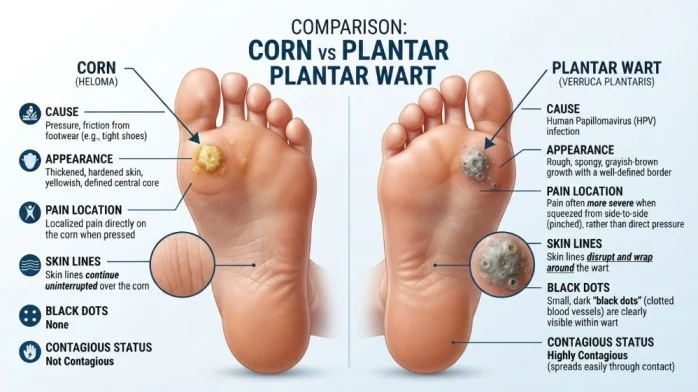
| Feature | Corn | Wart |
|---|---|---|
| Cause | Pressure and friction | HPV infection |
| Skin Lines | Continue across the corn | Often interrupted |
| Black Dots | No | Often yes |
| Contagious | No | Yes |
| Usually Found | Pressure points | Hands and feet |
Which Term Should You Use?
Using the correct term helps you explain your problem clearly and choose the right treatment.
If You Think It Is Thick, Hard Skin
Use corn if the bump developed after wearing tight shoes or spending long hours on your feet.
Example:
- I have a painful corn on my little toe.
If You Think It Is Caused by a Virus
Use wart if the bump has tiny black dots, feels rough, or has spread over time.
Example:
- My plantar wart hurts when I walk.
For Medical Writing
Always use the correct medical term.
Avoid guessing if you are unsure.
Instead, describe the symptoms.
Example:
- I have a painful growth on the bottom of my foot that has been there for three weeks.
A healthcare professional can confirm whether it is a corn or a wart.
For Everyday Conversation
Simple language is enough.
Examples:
- I think I have a corn from my new shoes.
- I may have a wart on my foot.
For Readers in the United States
The words corn and wart are the standard medical terms.
For Readers in the United Kingdom
Healthcare providers also use corn and wart.
For Global Readers
These terms are understood worldwide and are used in medical books, hospitals, and health information websites.
Practical Writing Tips
Use corn when talking about hard skin caused by pressure.
Use wart when talking about a viral skin growth.
If you are not sure, avoid self-diagnosing and ask a healthcare professional for advice, especially if the bump becomes very painful, bleeds, changes in size, or does not improve after treatment.
Common Mistakes with Corn or Wart
Many people mistake a corn for a wart or a wart for a corn. This can lead to using the wrong treatment and delaying healing. Understanding these common mistakes can help you choose the right care.
Mistake 1: Thinking Every Hard Bump Is a Wart
❌ Incorrect: Every hard bump on the foot is a wart.
✅ Correct: A hard bump caused by pressure is often a corn, not a wart.
Mistake 2: Believing Corns Are Contagious
❌ Incorrect: I caught a corn from someone else.
✅ Correct: Corns are not contagious. They develop because of repeated pressure or friction.
Mistake 3: Assuming All Warts Have Black Dots
❌ Incorrect: If there are no black dots, it cannot be a wart.
✅ Correct: Many warts have tiny black dots, but not every wart shows them clearly.
Mistake 4: Treating a Wart Like a Corn
❌ Incorrect: I only filed down the skin, so the wart should disappear.
✅ Correct: Filing may remove surface skin, but a wart is caused by a virus and often needs different treatment.
Mistake 5: Ignoring Ongoing Pain
❌ Incorrect: It will go away on its own.
✅ Correct: If the bump is very painful, keeps growing, bleeds, or does not improve, it is best to see a healthcare professional.
Corn or Wart in Everyday Examples
Knowing how to use these terms correctly makes communication easier.
In Emails
- I have developed a painful corn on my toe after wearing new shoes.
- My doctor believes the bump is a wart and suggested treatment.
In News Articles
- Doctors remind people to wear sandals in public showers to reduce the risk of catching warts.
- Proper footwear can help prevent painful corns.
On Social Media
- My new hiking boots gave me a painful corn.
- Finally got my plantar wart treated today!
In Formal Writing
- The patient presented with a painful corn caused by repeated friction.
- Examination confirmed that the lesion was a plantar wart.
In Everyday Conversation
- I think this is just a corn from my shoes.
- My child has a wart on his finger.
Search Trends and User Behavior
Many people search for corn or wart because they notice a painful bump but cannot identify it.
Common searches include:
- Corn or wart on foot
- How to tell a corn from a wart
- Plantar wart vs corn
- Hard skin or wart
- Painful bump on toe
People often search after:
- Wearing new shoes
- Feeling pain while walking
- Seeing a rough spot on the foot
- Trying home treatments without success
Interest in this topic is common in many English-speaking countries because both conditions affect people of all ages.
Most users are looking for quick answers, pictures, treatment advice, and simple ways to tell the difference.
Comparison Table
| Feature | Corn | Wart |
|---|---|---|
| Cause | Pressure and friction | Human papillomavirus (HPV) |
| Appearance | Hard, thick skin | Rough, raised skin growth |
| Pain | Hurts when pressed directly | Often hurts when squeezed from the sides |
| Skin Lines | Continue across the corn | Usually interrupted |
| Black Dots | No | Often present |
| Contagious | No | Yes |
| Common Location | Toes, soles, pressure points | Hands, fingers, soles of feet |
| Treatment | Reduce pressure, remove thick skin | Antiviral treatment, freezing, or medical care |
Frequently Asked Questions
1. What is the difference between a corn and a wart?
A corn is thick, hardened skin caused by pressure or rubbing. A wart is a skin growth caused by HPV. Corns usually appear where shoes rub the skin, while warts result from a viral infection and may spread to nearby skin.
2. How can I tell if I have a corn or a wart?
Look closely at the bump. A corn usually has smooth, hard skin with normal skin lines. A wart often has a rough surface, may contain tiny black dots, and interrupts the natural skin lines. If you are unsure, a healthcare professional can examine it.
3. Can a corn become a wart?
No. A corn cannot turn into a wart. They have different causes. A corn develops from repeated pressure, while a wart develops after infection with HPV.
4. Are warts contagious?
Yes. Warts can spread through direct skin contact or by walking barefoot on contaminated surfaces such as public showers or swimming pool areas. Corns do not spread because they are not caused by an infection.
5. Can I remove a corn at home?
Many small corns improve by wearing comfortable shoes, using protective pads, and gently softening thick skin. However, people with diabetes or poor circulation should avoid treating foot problems without medical advice.
6. Which hurts more, a corn or a wart?
Either condition can be painful. A corn usually hurts when direct pressure is applied. A plantar wart may hurt when standing or when pressure is applied from the sides. Pain levels vary from person to person.
7. When should I see a doctor?
You should seek medical advice if the bump is very painful, bleeds, changes in appearance, keeps growing, becomes infected, or does not improve after home care. Professional treatment can help prevent further problems.
8. Can children get corns or warts?
Yes. Children can develop both conditions. Warts are especially common because children are more likely to catch HPV through shared surfaces. Corns are less common but can occur if shoes fit poorly or create repeated pressure.
Conclusion
Understanding the difference between a corn or wart is important because the right diagnosis leads to the right treatment. A corn develops from repeated pressure and friction, while a wart is caused by HPV. Although they can look alike, features such as skin lines, black dots, and the cause help tell them apart. Avoid guessing if you are unsure, especially if the bump is painful or does not improve. Wearing properly fitting shoes, practicing good foot hygiene, and seeking medical advice when needed can help keep your feet healthy. Knowing these simple differences will help you identify the problem with greater confidence.
Read More Related Articles:
Tortoise or Turtle | What’s the Difference and Which Word …
Which Word Is Correct and When Should You Use Each One