Have you ever typed offerred and wondered if it was correct? You are not alone. Thousands of English learners, students, professionals, and writers search for offerred or offered because the two spellings look similar. When adding -ed to a verb, many people become unsure whether another letter should also be added. This simple spelling mistake appears in emails, homework, business writing, blog posts, and social media every day.
The good news is that the answer is easy. Offered is the correct spelling in standard English. Offerred is a spelling mistake and should not be used in normal writing. In this guide, you will learn why the confusion happens, where the word comes from, how British and American English treat it, and how to avoid this common error forever.
Quick Answer
Offered is the correct spelling.
The word offered is the past tense and past participle of the verb offer, which means to present, give, or provide something to another person.
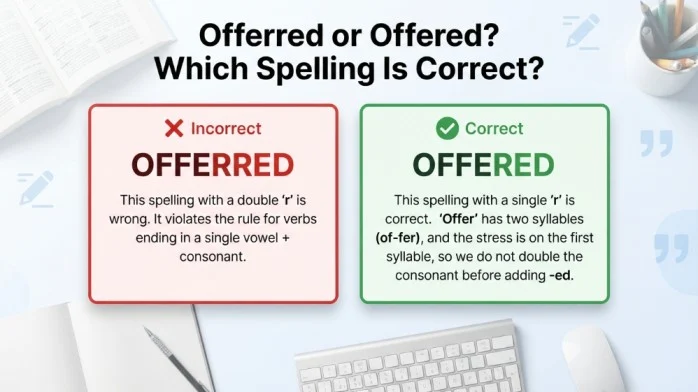
The spelling offerred is incorrect because the verb offer does not require an extra r before adding -ed.
Examples
✅ She offered me a cup of tea.
✅ The company offered a better price.
❌ She offerred me a cup of tea.
❌ They offerred free shipping.
Quick Rule: Always write offered, never offerred.
What Does “Offered” Mean?
The word offered means someone gave, presented, suggested, or made something available.
It can describe:
- Giving help
- Presenting a gift
- Making a job proposal
- Providing services
- Suggesting an idea
- Giving support
Simple Examples
- Sarah offered her seat to an woman.
- My teacher offered extra lessons before the exam.
- The hotel offered free breakfast.
- They offered a discount to new customers.
- He offered his opinion during the meeting.
In every example above, offered is the correct spelling.
The Origin of Offerred or Offered
Understanding where a word comes from often makes spelling much easier.
The word offer comes from the Latin word offerre, which means to bring before, to present, or to give.
The Latin word later became the Old French word ofrir, before entering Middle English as offeren. Over time, English speakers shortened the spelling to offer.
When English grammar forms the past tense, the ending -ed is added.
So:
Offer
↓
Offered
The spelling never changes by adding another r.
Why Doesn’t It Become “Offerred”?
English spelling follows certain patterns.
Some verbs double their final consonant before adding -ed.
Examples include:
- Stop → Stopped
- Plan → Planned
- Prefer → Preferred
However, offer follows a different rule because the stress falls on the first syllable.
Offer
OF-fer
Since the stress is not on the final syllable, English does not double the last r.
That is why:
✅ Offer → Offered
❌ Offer → Offerred
Learning this simple rule helps you avoid many similar spelling mistakes.
Why Do Some Words Double the Final Letter?
Many English learners notice words like:
- Admit → Admitted
- Refer → Referred
- Prefer → Preferred
These verbs double the last consonant because the final syllable is stressed.
For example:
ad-MIT
re-FER
pre-FER
Now compare them with:
OF-fer
VIS-it
HAP-pen
Because the stress comes earlier, these verbs simply add -ed.
Examples:
Offer → Offered
Visit → Visited
Open → Opened
Happen → Happened
No extra consonant is added.
British English vs American English Spelling
One reason people search for offerred or offered is that they wonder whether one spelling belongs to British English and the other to American English.
The answer is simple.
Both British English and American English use exactly the same spelling:
Offered
There is no spelling difference between the two varieties of English.
Comparison Table
| English Version | Correct Spelling | Incorrect Spelling | Example |
|---|---|---|---|
| American English | Offered | Offerred | The company offered a refund. |
| British English | Offered | Offerred | She offered to help. |
| Canadian English | Offered | Offerred | They offered free delivery. |
| Australian English | Offered | Offerred | He offered useful advice. |
The spelling offerred is not accepted in any major English-speaking country.
Why Is There Confusion Between “Offerred” and “Offered”?
Many people accidentally write offerred even though it is incorrect.
Here are the most common reasons.
1. The Double-Letter Rule
English has many verbs that double the last consonant.
For example:
- Refer → Referred
- Prefer → Preferred
- Transfer → Transferred
After seeing these words, many writers believe offer should follow the same pattern.
It does not.
2. Pronunciation
When spoken, offered sounds very similar to what some people imagine offerred would sound like.
Since English pronunciation does not always show spelling clearly, people often guess incorrectly.
3. Typing Quickly
Fast typing causes thousands of spelling mistakes every day.
Someone may accidentally press the R key twice without noticing.
Spell-check tools usually correct this mistake, but not every writing platform does.
4. Learning English Grammar
People learning English often memorize spelling rules without understanding when those rules apply.
Because words like preferred and referred contain double r, learners sometimes assume offered should also contain two r letters.
Knowing where the stress falls solves this confusion.
5. Autocorrect and Search Behavior
People often search exactly what they typed.
If someone writes offerred, they search using that spelling to check whether it is correct.
This is why search engines receive many searches for offerred or offered.
Most users simply want confirmation of the correct spelling.
Quick Spelling Rule to Remember
A simple memory trick can help.
Think about the base word first.
Offer
Now add -ed.
Offer + ed = Offered
Nothing changes.
No extra r is needed.
Whenever you are unsure, remove -ed.
If the original word already ends correctly as offer, simply add ed.
This small habit prevents the mistake every time.
Common Words That Follow the Same Rule
Many English verbs behave exactly like offer.
Examples include:
| Base Word | Past Tense |
|---|---|
| Offer | Offered |
| Visit | Visited |
| Open | Opened |
| Answer | Answered |
| Listen | Listened |
| Enter | Entered |
| Order | Ordered |
| Remember | Remembered |
Which Spelling Should You Use?
If you are writing in English, the answer is simple: always use offered. It is the only correct spelling in standard English. Whether you are writing an email, school assignment, business report, website article, or social media post, offered is the right choice.
The spelling offerred is a mistake and should be avoided. Using the correct spelling helps your writing look clear, professional, and trustworthy.
If Your Audience Is in the United States
Use offered.
American English follows the same spelling rule.
Examples
- The company offered free shipping.
- She offered to answer my questions.
- They offered a full refund.
If Your Audience Is in the United Kingdom
Use offered.
British English also uses the same spelling.
Examples
- The charity offered food to local families.
- He offered practical advice during the meeting.
- Our teacher offered extra lessons before the exam.
If Your Audience Is in Canada
Canadian English follows the same rule.
Examples
- The store offered a holiday discount.
- They offered excellent customer service.
If Your Audience Is in Australia or New Zealand
The correct spelling is still offered.
Examples
- The bank offered lower interest rates.
- The guide offered useful travel tips.
For Global Readers
If your content is written for an international audience, always choose offered. It is understood and accepted by English speakers around the world.
Easy Rule to Remember
Start with the base word:
Offer
Simply add -ed.
Offer + ed = Offered
Never add another r.
Common Mistakes with Offerred or Offered
Many writers make the same spelling mistakes. Learning them now will help you avoid them later.
Mistake 1: Adding an Extra “R”
❌ The manager offerred me a new position.
✅ The manager offered me a new position.
Why?
The verb offer does not double the final r before adding -ed.
Mistake 2: Copying the Rule from Other Words
Some people think this is correct because they know words like:
- Preferred
- Referred
- Transferred
These words double the final consonant because they follow a different stress pattern.
Offer does not.
Correct:
✅ Offered
Incorrect:
❌ Offerred
Mistake 3: Trusting Fast Typing
Many spelling mistakes happen simply because people type too quickly.
For example:
❌ We offerred our support.
Always proofread your work before sending it.
Correct:
✅ We offered our support.
Mistake 4: Ignoring Spell Check
Modern writing tools usually highlight offerred as incorrect.
Ignoring these warnings can leave mistakes in your writing.
Take a few seconds to review suggested corrections.
Mistake 5: Confusing Past Tense Forms
Some learners think every verb ending with -er needs another r in the past tense.
That is not true.
Correct examples include:
- Ordered
- Entered
- Answered
- Offered
- Remembered
Everyday Examples of Offered
Seeing a word in real situations makes it easier to remember.
In Emails
Professional emails often use offered.
Examples:
- Thank you for the help you offered yesterday.
- Our team offered several solutions.
- The supplier offered a better price.
In Business Writing
Companies use offered when describing products and services.
Examples:
- The company offered free installation.
- Our business offered flexible payment plans.
- The hotel offered complimentary breakfast.
In News Articles
Journalists use offered every day.
Examples:
- The government offered emergency assistance.
- Local volunteers offered food and water.
- The charity offered support to affected families.
On Social Media
People often use the word while sharing experiences.
Examples:
- My friend offered to drive me home.
- The restaurant offered amazing customer service.
- They offered free tickets for the event.
In School Assignments
Students frequently use the word in essays and reports.
Examples:
- The scientist offered a new explanation.
- The teacher offered helpful feedback.
- The author offered several interesting ideas.
In Everyday Conversation
Examples include:
- She offered me some coffee.
- He offered to fix my computer.
- Dad offered to pick me up.
- My neighbor offered extra vegetables from the garden.
- The doctor offered useful advice.
Google Trends & Search Behavior
Many people search for offerred or offered because they want to check whether they have spelled the word correctly.
Most searches happen after someone writes an email, school assignment, office report, or online post.
The search usually comes from uncertainty rather than a lack of vocabulary. People know the word offer, but they become unsure when forming the past tense.
Why Do People Search for This Keyword?
Common reasons include:
- Checking the correct spelling
- Learning English grammar
- Preparing school homework
- Writing professional emails
- Creating blog articles
- Editing business documents
- Avoiding spelling mistakes
Common User Intent
Most users want quick answers such as:
- Which spelling is correct?
- Is offerred a real word?
- Why isn’t there a double r?
- Does British English spell it differently?
- Is offerred ever correct?
Regional Interest
English learners from many countries search this keyword because spelling rules can be confusing.
Native speakers also search for it while proofreading important documents.
The interest comes from spelling uncertainty rather than differences between countries.
Related Search Terms
People often search for similar phrases, including:
- offered meaning
- offered definition
- offer past tense
- how to spell offered
- offered examples
- offered in a sentence
- offer verb forms
- offered grammar
- offer spelling
- offered or offerred
These related searches show that users want both the correct spelling and practical examples.
Comparison Table
| Word | Meaning | Correct or Incorrect | Context of Use |
|---|---|---|---|
| Offered | Past tense of offer | ✅ Correct | All standard English writing |
| Offerred | Misspelling of offered | ❌ Incorrect | Typing or spelling mistake |
| Offer | Base verb | ✅ Correct | Present tense |
| Offering | Present participle or noun | ✅ Correct | Ongoing action or noun |
| Offers | Third-person singular form | ✅ Correct | Present tense |
Quick Summary Table
| Question | Answer |
|---|---|
| Correct spelling | Offered |
| Incorrect spelling | Offerred |
| British English | Offered |
| American English | Offered |
| Formal writing | Offered |
| Informal writing | Offered |
| Business communication | Offered |
| Academic writing | Offered |
Final Reminder Before You Write
Whenever you are unsure, remember this simple pattern:
Offer → Offered
There is no extra r.
Using the correct spelling will make your writing clearer, more professional, and easier for every reader to understand.
Frequently Asked Questions
1. Which is correct: offerred or offered?
Offered is the correct spelling. It is the past tense and past participle of the verb offer. The spelling offerred is incorrect and should not be used in standard English. Whether you are writing an email, report, essay, or social media post, always choose offered for clear and accurate communication.
2. Is offerred a real English word?
No. Offerred is not a standard English word. It is a common spelling mistake that happens when people incorrectly add an extra r before -ed. English dictionaries recognize offered, while offerred is treated as an error in normal writing.
3. Why do people confuse offerred and offered?
Many people become confused because some English verbs double the final consonant before adding -ed, such as preferred, referred, and transferred. They assume offer follows the same pattern. However, offer does not double the final r, so the correct form is offered.
4. Is offered correct in both British and American English?
Yes. Offered is the correct spelling in both British English and American English. There is no regional spelling difference for this word. English speakers in Canada, Australia, New Zealand, and other countries also use offered.
5. How can I remember the correct spelling?
A simple trick is to start with the base word offer and add -ed.
Offer + ed = Offered
Do not add another r. If you remember the base verb, you can quickly form the correct past tense without making a spelling mistake.
6. Why doesn’t offer double the letter “r”?
English only doubles the final consonant in certain situations, usually when the last syllable is stressed. In the word offer, the stress is on the first syllable (OF-fer), so the final r is not doubled. That is why offered is correct and offerred is incorrect.
7. Can spell-check detect the word offerred?
Most modern spelling tools identify offerred as a mistake and suggest offered as the correct spelling. However, it is still a good habit to proofread your writing because no spell-check tool catches every error perfectly.
8. Can I ever use the spelling offerred?
In normal English writing, no. The spelling offerred should not be used in business documents, school assignments, books, websites, emails, or social media posts. Unless you are quoting someone else’s spelling mistake, always write offered.
Final Summary
The difference between offerred and offered is simple once you understand the spelling rule. Offered is the only correct past tense and past participle of the verb offer. The spelling offerred is a common mistake caused by confusion with words like preferred and referred, which follow a different spelling pattern. Fortunately, remembering the base word makes the rule easy: offer + ed = offered. This spelling is correct in American English, British English, Canadian English, Australian English, and every other standard variety of English. Whenever you write an email, report, article, or message, choose offered with confidence to keep your writing accurate, professional, and easy to understand.
Read More Related Articles:
What’s the Difference and Which Term Is Correct in 2026
Medical or Abbreviation | Meaning, Usage, Examples, and …