Choosing the right word can completely change the meaning of your sentence, and stayed or staid is one of those word pairs that often causes confusion. Many writers, students, and English learners come across these similar-looking words while writing emails, essays, or social media posts and are unsure which one actually fits. Since they look alike and are easy to mix up, thousands of people search for stayed or staid to avoid embarrassing grammar and vocabulary mistakes.
This guide will help you understand the difference in a simple and practical way. You’ll learn which word is correct in different situations, why the confusion happens, see clear real-life examples, and discover easy tips to remember the right choice every time. Keep reading to master these commonly confused words with confidence.
Quick Answer
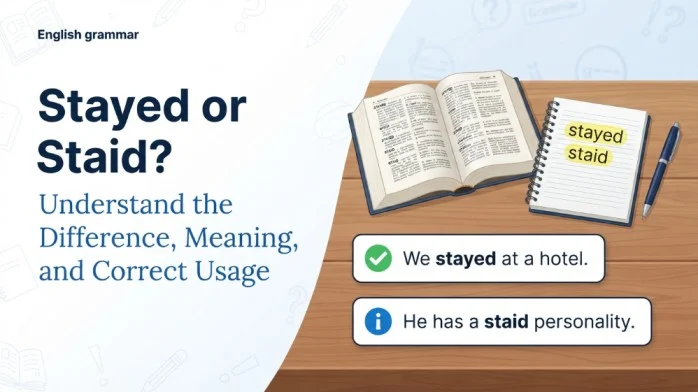
If you’re choosing between stayed and staid, they are both correct, but they do not mean the same thing.
- Stayed is the past tense of stay, meaning to remain in one place.
- We stayed at a hotel.
- Staid is an adjective meaning serious, calm, traditional, or not flashy.
- The lawyer had a staid appearance.
Use stayed for actions and staid to describe a person’s style, behavior, or atmosphere.
The Origin of Stayed or Staid
Although these words look and sound similar, they come from different paths in the English language.
The Origin of Stayed
The word stay entered English through Old French and later developed into the verb we use today.
It means:
- remain
- continue
- stop in one place
- delay leaving
Adding -ed creates the past tense:
- stay → stayed
Examples:
- They stayed until midnight.
- I stayed home because of the rain.
- She stayed calm during the meeting.
The Origin of Staid
The history of staid is more interesting.
Centuries ago, staid actually came from an older form of the verb stay, describing someone who was settled or steady.
Over time, English speakers stopped using it as a verb and began using it as an adjective.
Today, staid describes someone or something that is:
- respectable
- conservative
- traditional
- serious
- quiet
- not fashionable or exciting
Examples:
- He wore a staid gray suit.
- The museum has a staid atmosphere.
- Her personality is calm and staid.
Because the pronunciation stayed almost the same while the meanings separated, many people now confuse the two words.
British English vs American English
Unlike many spelling questions, stayed or staid is not a British versus American spelling difference.
Both countries use both words with exactly the same meanings.
| Feature | British English | American English |
|---|---|---|
| Stayed | ✔ Correct | ✔ Correct |
| Staid | ✔ Correct | ✔ Correct |
| Meaning of stayed | Past tense of stay | Past tense of stay |
| Meaning of staid | Serious or traditional | Serious or traditional |
| Interchangeable | ❌ No | ❌ No |
Examples
British English
- We stayed in London for three days.
- The ceremony was rather staid.
American English
- They stayed at a cabin.
- His speech sounded staid.
There is no regional spelling difference.
Why Is There Confusion Between Stayed or Staid?
Several factors cause writers to confuse these words.
1. Nearly Identical Pronunciation
When spoken naturally, many accents pronounce them almost the same.
For example:
- stayed
- staid
Without seeing the spelling, listeners often cannot tell which word is intended.
2. Similar Appearance
Only two letters are different.
- stayed
- staid
A quick glance makes them easy to mix up.
3. Spell Check Doesn’t Help
Since both are real English words, grammar checkers usually won’t flag the mistake.
Example:
❌ She staid home yesterday.
The sentence contains a real word, but it’s the wrong one.
4. Reading Without Context
Readers sometimes encounter staid in novels or newspapers without knowing its meaning.
They assume it is simply another spelling of stayed.
5. Search Behavior
People often search:
- stayed or staid
- staid meaning
- stayed meaning
- is staid correct
- stayed vs staid
Most are trying to discover whether the words are interchangeable.
The answer is no.
Which Spelling Should You Use?
The correct word depends entirely on what you want to say.
Use Stayed When Talking About Actions
Choose stayed if someone remained somewhere.
Examples
- We stayed at my grandparents’ house.
- She stayed late after work.
- The guests stayed overnight.
- I stayed focused during the exam.
Use Staid When Describing Someone or Something
Use staid when describing personality, appearance, clothing, style, or atmosphere.
Examples
- He has a staid personality.
- The office looked staid.
- Their design feels traditional and staid.
- Her speech had a staid tone.
For Global Readers
Whether you’re writing in:
- the United States
- Canada
- Australia
- New Zealand
- the United Kingdom
the rule is identical.
Choose the word based on meaning, not location.
Easy Memory Trick
Stayed = Action
Someone remained somewhere.
Staid = Description
Someone looked calm, serious, or traditional.
This simple rule solves almost every mistake.
Common Mistakes with Stayed or Staid
Mistake 1
❌ She staid home all day.
✔ She stayed home all day.
Reason:
The sentence describes an action.
Mistake 2
❌ He stayed in a very serious suit.
✔ He wore a staid suit.
Reason:
The sentence describes appearance.
Mistake 3
❌ The building stayed and formal.
✔ The building looked staid and formal.
Reason:
Buildings cannot “stay” in this context.
Mistake 4
❌ Their conversation stayed.
✔ Their conversation remained calm.
or
✔ Their conversation had a staid tone.
Mistake 5
❌ The professor stayed in his personality.
✔ The professor had a staid personality.
Reason:
Use staid as an adjective.
Stayed or Staid in Everyday Examples
We stayed at the conference hotel for two nights.
News
Thousands of visitors stayed in the city during the festival.
Business Writing
The company maintained a staid corporate image for decades.
Social Media
We stayed up until sunrise watching the meteor shower.
Book Review
The novel begins with a staid family before unexpected events change everything.
Office Conversation
Everyone stayed after the meeting to finish the presentation.
Fashion Magazine
The designer moved away from the brand’s once staid style.
Classroom
The students stayed quiet during the test.
Google Trends & Usage Behavior
People usually search stayed or staid because the two words sound almost the same but serve different purposes in English. Most searches come from writers, students, bloggers, and professionals who want to make sure they are using the correct word in emails, reports, or everyday writing.
Search behavior shows several common intentions:
- People want to know if staid is a real English word.
- Many believe staid is simply another spelling of stayed.
- Some users think the difference is between British and American English.
- Others encounter staid in novels or newspapers and look up its meaning.
- Writers often search before publishing articles to avoid grammar mistakes.
Although stayed appears much more frequently in everyday writing because it is the past tense of stay, staid still appears in literature, journalism, fashion writing, business articles, and formal descriptions. Understanding the difference helps readers interpret texts correctly and makes your own writing clearer and more professional.
Comparison Table
| Word | Meaning | Correct or Incorrect? | Context of Use |
|---|---|---|---|
| Stayed | Past tense of stay; remained in a place | ✔ Correct | Daily conversation, stories, emails, news, business writing |
| Staid | Serious, calm, conservative, or traditional | ✔ Correct | Describing people, clothing, offices, organizations, writing style |
| Stayed | Misspelling of stayed | ❌ Incorrect | Never use |
| Staied | Obsolete spelling found only in very old texts | ❌ Incorrect in modern English | Avoid in modern writing |
Frequently Asked Questions
Is stayed or staid the correct word?
Both words are correct, but they have different meanings. Stayed is the past tense of stay and means to remain somewhere. Staid is an adjective that describes someone or something as serious, traditional, or calm. Choose the word that matches your intended meaning.
Is staid a real English word?
Yes. Staid is a genuine English adjective that has been used for centuries. It describes people, clothing, behavior, places, or organizations that appear formal, respectable, quiet, or conservative. It is less common than stayed, but it is still correct.
Why do people confuse stayed and staid?
The confusion happens because the words have very similar pronunciation and nearly identical spelling. Many readers hear them spoken without seeing the written form, making it easy to assume they are the same word or alternative spellings when they are not.
Is staid the British spelling of stayed?
No. This is a common misunderstanding. British English and American English both use stayed as the past tense of stay and staid as an adjective meaning serious or traditional. The meanings remain the same in both varieties of English.
Can I replace stayed with staid?
No. These words are not interchangeable. Stayed expresses an action, while staid describes a quality or characteristic. Replacing one with the other changes the meaning of the sentence and creates a grammatical error.
When should I use stayed?
Use stayed whenever you describe someone remaining in a place or continuing an action. Examples include staying at a hotel, staying home, staying late at work, or staying focused during an activity.
When should I use staid?
Use staid when describing people, places, clothing, behavior, or organizations that appear serious, respectable, traditional, or not especially colorful or exciting. It is commonly found in formal writing, reviews, biographies, and news articles.
How can I remember the difference between stayed and staid?
A simple trick is to remember that stayed describes an action, while staid describes a person, place, or thing. If someone remained somewhere, choose stayed. If you’re describing a serious or traditional appearance, choose staid.
Conclusion
Although stayed and staid sound similar, they serve completely different purposes in English. Stayed is the past tense of stay and refers to remaining in a place or continuing an action. Staid, on the other hand, is an adjective that describes someone or something as calm, serious, traditional, or conservative. Remember that this is not a British-versus-American spelling difference both forms are correct when used in the right context. Understanding the distinction will improve your writing, prevent common mistakes, and help readers understand your message without confusion. Whenever you’re unsure, think about whether you’re describing an action or a characteristic, and you’ll choose the correct word with confidence.
Read More Related Articles:
DC or Marvel | Which Universe Is Better The Ultimate …
Imput or Input | Which Spelling Is Correct? Meaning …
Sulphur or Sulfur | Why Both Spellings Exist and Which Is Right …