You finish writing an email, read it one last time, and suddenly pause. Should the sentence say rational or rationale? The two words look almost identical, but they have completely different meanings. This small difference causes thousands of writers, students, professionals, and English learners to stop and double-check before hitting send.
The confusion is common because both words come from the same language family and are often used in formal writing. However, choosing the wrong one can change the meaning of an entire sentence.
This guide explains rational or rationale in the simplest way possible. You’ll learn the correct meaning of each word, why people confuse them, when to use each one, and how to avoid making the mistake in everyday writing.
Quick Answer
If you’re wondering whether to use rational or rationale, here’s the simple answer:
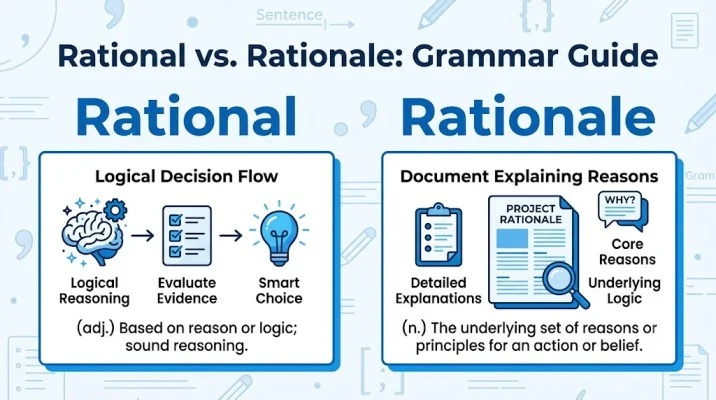
- Rational is an adjective. It describes someone or something that is logical, reasonable, or based on clear thinking.
- Rationale is a noun. It means the reason or explanation behind a decision, action, or plan.
Examples
- She made a rational decision after reviewing the facts.
- The manager explained the rationale behind the new company policy.
Remember:
- Rational = logical
- Rationale = explanation or reason
The Origin of Rational or Rationale
Although these words look alike, they developed into different parts of speech over time.
Rational comes from the Latin word rationalis, meaning reasonable or able to think logically. It entered English centuries ago to describe people, decisions, and ideas guided by reason instead of emotion.
Rationale entered English later through French. It originally referred to the underlying explanation or reasoning behind an argument or decision. Today, it mainly appears in education, business, science, law, and government writing.
Since both words share the same Latin root connected to reason, many people assume they can replace one another. In reality, they cannot.
British English vs American English Spelling
Unlike many English words, rational and rationale are spelled exactly the same in British and American English.
The only difference is how often they appear in certain writing styles. British and American writers both use these words correctly with the same meanings.
| Feature | British English | American English |
|---|---|---|
| Rational | ✔ Correct | ✔ Correct |
| Rationale | ✔ Correct | ✔ Correct |
| Meaning of Rational | Logical or reasonable | Logical or reasonable |
| Meaning of Rationale | Reason behind something | Reason behind something |
| Everyday Usage | Common | Common |
| Academic Writing | Very common | Very common |
| Business Writing | Common | Common |
There is no spelling difference between the two varieties of English.
Why Is There Confusion Between Rational or Rationale?
Several factors cause people to confuse these words.
They Look Almost Identical
Only the ending changes.
- Rational
- Rationale
Many readers overlook the final letters while typing.
They Share the Same Root
Both come from the idea of reason.
That makes people think they carry the same meaning.
Pronunciation Similarity
When spoken quickly, the endings can sound alike, especially for non-native speakers.
Autocorrect Doesn’t Help
Since both words are correct English words, spell check rarely flags the mistake.
Similar Writing Contexts
You’ll often see both words in:
- Academic papers
- Research reports
- Office documents
- Business presentations
- Government reports
Because they appear together so often, writers sometimes choose the wrong one.
Which Spelling Should You Use?
The correct choice depends on what you’re trying to say.
Use Rational when describing someone or something.
Examples:
- The judge made a rational decision.
- We need a rational solution.
- She remained rational during the emergency.
Use Rationale when explaining a reason.
Examples:
- Please explain your rationale.
- The report includes the project’s rationale.
- Teachers discussed the rationale for changing the curriculum.
For American Writers
Use whichever word matches your meaning.
For British Writers
Exactly the same rule applies.
For International English
These meanings remain consistent worldwide.
An easy memory trick:
- Rational describes.
- Rationale explains.
Common Mistakes with Rational or Rationale
Here are mistakes people often make.
Incorrect
The manager shared the rational for the new policy.
Correct
The manager shared the rationale for the new policy.
Incorrect
She gave a rational of her research.
Correct
She gave the rationale for her research.
Incorrect
He stayed rationale during the debate.
Correct
He stayed rational during the debate.
Incorrect
The company’s rational explains the budget changes.
Correct
The company’s rationale explains the budget changes.
Incorrect
The doctor remained rationale.
Correct
The doctor remained rational.
Rational or Rationale in Everyday Examples
The proposal includes the rationale for increasing the budget.
Business Meeting
The CEO presented the rationale behind the company’s expansion.
News Article
Officials explained the rationale for introducing the new law.
School Assignment
Your essay should include the rationale for your research topic.
Social Media
Let’s make a rational choice instead of reacting emotionally.
Scientific Report
Researchers explained the rationale behind the experiment.
Healthcare
Doctors use rational treatment plans based on medical evidence.
Family Conversation
Try to stay rational before making a big decision.
Job Interview
Can you explain the rationale for choosing this strategy?
Government Document
The report outlines the rationale behind the proposed legislation.
Google Trends and Usage Behavior
People searching rational or rationale usually want immediate clarification before submitting school assignments, professional documents, emails, or reports.
Most searches happen because:
- Writers forget which word is the adjective.
- Students need help with grammar.
- Professionals want accurate business writing.
- English learners confuse similar-looking words.
- Spell check fails because both words are valid.
Related searches often include:
- rational meaning
- rationale meaning
- rational vs rationale
- rationale definition
- rational definition
- when to use rationale
- rational sentence examples
- rationale examples
- difference between rational and rationale
- rationale in a sentence
People generally want a quick answer first, followed by examples that confirm they’re using the correct word.
Comparison Table
| Word | Meaning | Correct Usage | Context |
|---|---|---|---|
| Rational | Logical, reasonable | ✔ Correct | Describing decisions, people, ideas |
| Rationale | Explanation or reason | ✔ Correct | Business, education, research, reports |
| Rationale | Misspelling of rational in context | ✘ Incorrect | Typing mistake |
| Rational used instead of rationale | Wrong part of speech | ✘ Incorrect | Grammar mistake |
| Rationale used instead of rational | Wrong part of speech | ✘ Incorrect | Grammar mistake |
FAQs
What is the difference between rational and rationale?
Rational describes logical thinking or reasonable actions. Rationale refers to the explanation or reason behind a decision. One is an adjective, while the other is a noun, so they cannot replace each other in a sentence.
Is rationale a real English word?
Yes. Rationale is a standard English noun. It refers to the reasoning, justification, or explanation for a decision, policy, plan, or action. It is commonly used in education, research, healthcare, business, and government writing.
Is rational a real English word?
Absolutely. Rational is an adjective meaning logical, sensible, or based on reason. It describes people, choices, arguments, and decisions that rely on facts instead of emotions.
Why do people confuse rational and rationale?
The words share the same Latin root, have similar spelling, and often appear in formal writing. Since both are correct English words, spell check usually cannot identify when the wrong one has been chosen.
Which word should I use in business writing?
Use rationale when explaining why a decision was made. Use rational when describing a reasonable decision, logical process, or sensible approach. Business documents often contain both words, but they serve different purposes.
Is there a British or American spelling difference?
No. Both rational and rationale have identical spellings in British English and American English. Only their meanings determine which word belongs in a sentence.
Can rational and rationale be used interchangeably?
No. Rational describes something logical, while rationale names the explanation behind something. Swapping them changes the grammar and often makes the sentence incorrect.
How can I remember the difference?
Think of rational as describing a person or decision that makes sense. Think of rationale as the reason you give afterward. If you’re explaining “why,” you almost always need rationale.
Conclusion
The confusion between rational and rationale is understandable because the words look similar and come from the same linguistic root. However, their jobs in a sentence are completely different. Rational describes logical thinking or sensible actions, while rationale explains the reason behind a decision or plan. Learning this distinction makes your writing clearer, more professional, and easier to understand. Whenever you’re unsure, remember the simple rule: if you’re describing something logical, choose rational. If you’re giving an explanation or justification, choose rationale. Keeping this difference in mind will help you write with greater confidence in school, business, and everyday communication.
Read More Related Articles:
DC or Marvel | Which Universe Is Better The Ultimate …
Imput or Input | Which Spelling Is Correct? Meaning …
Sulphur or Sulfur | Why Both Spellings Exist and Which Is Right …