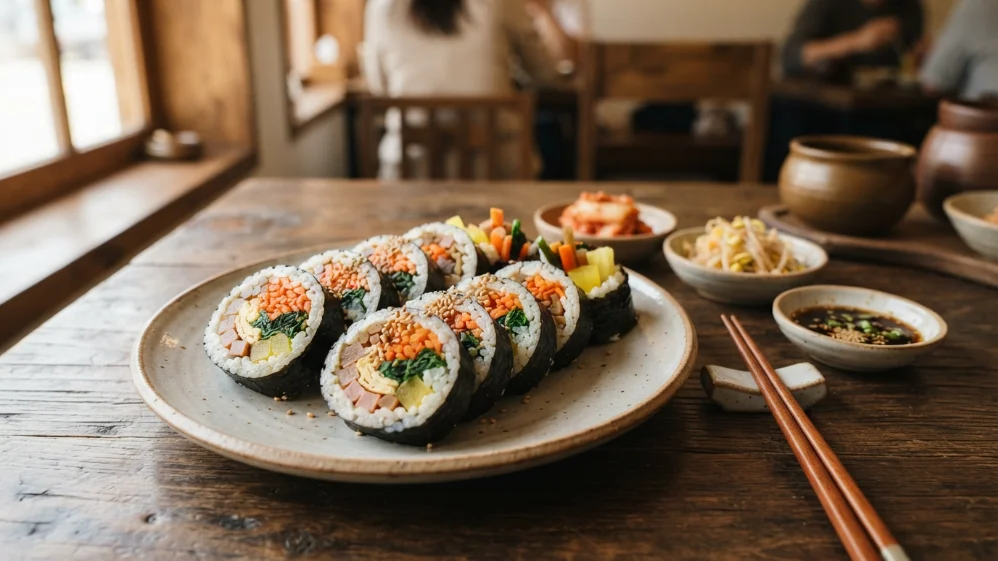
Imagine searching for a Korean rice roll recipe and seeing two names everywhere: kimbap and gimbap. One menu says kimbap, a recipe says gimbap, and a Korean restaurant may use either spelling. It can make you wonder whether they describe the same food or two completely different dishes.
The confusion is common because both spellings come from the same Korean word. The difference mainly comes from how Korean sounds are written in the Roman alphabet. This guide explains kimbap or gimbap in simple terms, including their origin, correct usage, common mistakes, real-life examples, and the spelling you should choose for your audience.
Quick Answer
Both kimbap and gimbap are used for the same Korean dish: rice and other ingredients rolled in dried seaweed. Gimbap is the more direct modern Romanization of the Korean word 김밥, while kimbap is a widely used alternative spelling in English. Both can be understood, but gimbap is generally closer to the official Korean Romanization.
Example: I ordered gimbap for lunch.
Also common: I made kimbap at home.
The Origin of Kimbap or Gimbap
The word comes from the Korean word 김밥, made of two parts:
Gim means dried edible seaweed.
Bap means cooked rice.
Together, gimbap literally means seaweed rice. However, the dish usually contains more than just seaweed and rice. Common fillings include vegetables, egg, meat, fish, cheese, tofu, or pickled radish.
The spelling difference comes from Romanization, which means writing Korean words with the English alphabet. Korean sounds do not always match English sounds perfectly. The first sound in 김 can fall between what English speakers hear as a g and a k.
Under the official Revised Romanization system used in South Korea, 김밥 is written as gimbap. However, older spelling habits, international menus, cookbooks, and English-language food culture helped kimbap become very common.
That is why both forms appear online. The food did not change. Only the Roman spelling changed.
British English vs American English Spelling
Unlike words such as colour and color, kimbap and gimbap are not mainly a British versus American English issue.
Both British and American writers may use either spelling. The difference is more closely connected to Korean Romanization and international usage.
| Usage | British English | American English | Correctness |
|---|---|---|---|
| Modern Korean Romanization | Gimbap | Gimbap | Correct |
| Common English food spelling | Kimbap | Kimbap | Widely accepted |
| Restaurant and menu usage | Either may appear | Either may appear | Depends on house style |
| Formal Korean language context | Gimbap | Gimbap | Preferred |
| General English writing | Kimbap or gimbap | Kimbap or gimbap | Both understandable |
The safest choice is to stay consistent. If you write gimbap at the beginning of an article, avoid switching to kimbap later without a reason.
Why Is There Confusion Between Kimbap or Gimbap?
Several factors create confusion between these spellings.
Pronunciation differences are one major reason. The Korean consonant ㄱ can sound different depending on its position and context. To English speakers, it may seem closer to either a soft g or a k.
Different Romanization systems also play a role. Korean words have been written in Roman letters using more than one system over time. Older systems and informal spellings may produce forms that differ from modern official spellings.
Restaurant menus add another layer of confusion. A Korean restaurant may use kimbap because international customers already recognize it. Another restaurant may use gimbap because it follows modern Korean Romanization.
Search habits also matter. People often type the spelling they first learned from a recipe, video, menu, or social media post. Someone who searches kimbap may continue using that form for years.
Autocorrect and spelling tools can make the issue worse. Some English writing tools may not recognize either word, while others may suggest a different spelling.
The key point is simple: the two spellings usually refer to the same Korean food.
Which Spelling Should You Use?
The best spelling depends on your audience and purpose.
For Korean language, culture, education, or formal reference, use gimbap. It follows the current official Romanization more closely.
For general food writing, either spelling can work. If your readers already know the dish as kimbap, using kimbap may feel more natural and familiar.
For a global audience, it can help to introduce both forms once:
Gimbap, also commonly spelled kimbap, is a Korean rice roll wrapped in seaweed.
After that, choose one spelling and use it consistently.
For restaurant menus, follow the spelling used by the business or brand. Changing a dish name without a reason can confuse customers.
For informal writing and social media, kimbap is often familiar to English-speaking readers, while gimbap may be preferred when accuracy and Korean language standards are the main focus.
Neither spelling should automatically be treated as a mistake in ordinary English food writing. Context matters.
Common Mistakes with Kimbap or Gimbap
Here are some common errors and how to fix them.
Mistake: Treating them as two different dishes
Incorrect: Kimbap is different from gimbap.
Better: Kimbap and gimbap are different Roman spellings of the same Korean dish.
Mistake: Assuming one spelling is always wrong
Incorrect: Kimbap is completely incorrect.
Better: Gimbap follows modern official Romanization, but kimbap remains widely used in English.
Mistake: Changing spelling randomly
Incorrect: I bought kimbap, then made gimbap, and later served kimbap.
Better: Choose one spelling for the main text unless you are explaining the difference.
Mistake: Confusing gimbap with sushi
Incorrect: Gimbap is simply Korean sushi.
Better: Gimbap and sushi may look similar, but they have different traditions, ingredients, and preparation methods.
Mistake: Misspelling the word
Common incorrect forms may include:
Gim bap
Kim bap
Gimbop
Kimbop
Gimmap
When writing in standard English text, gimbap or kimbap is usually clearer.
Kimbap or Gimbap in Everyday Examples
Both spellings appear in everyday communication. Here is how they may be used.
In an email
Please order two boxes of kimbap for the office lunch tomorrow.
In a food review
The gimbap was fresh, colorful, and filled with vegetables and seasoned rice.
In a news article
The Korean food festival introduced visitors to popular dishes such as gimbap, tteokbokki, and bibimbap.
On social media
Homemade kimbap for dinner today, and every slice disappeared in minutes.
In a restaurant description
Our vegetable gimbap is prepared with seasoned rice, fresh vegetables, egg, and roasted seaweed.
In formal writing
Gimbap is a popular Korean dish consisting of cooked rice and various fillings wrapped in dried seaweed.
In a recipe
Slice the kimbap into bite-sized pieces before serving.
These examples show that both spellings can work naturally. The most important thing is to match the spelling to your chosen style.
Search Trends and Usage Behavior
People searching for kimbap or gimbap usually have one of several clear intentions.
Some want to know which spelling is correct. Others have seen both names and wonder whether they describe different foods. Many are looking for recipes, restaurants, pronunciation help, or information about Korean cuisine.
The spelling kimbap is common in English-language recipes, food blogs, menus, and social posts. It is familiar to many people who discovered the dish outside Korea.
The spelling gimbap often appears in Korean cultural content, educational material, and writing that follows modern Korean Romanization.
Search behavior also shows a common pattern: people may first type one version and then search the other after seeing different results. This means both forms are useful for understanding what readers want.
For writers, the best approach is to mention both spellings naturally, explain the difference clearly, and then use one preferred form consistently.
Comparison Table – Kimbap and Gimbap Variations
| Variation | Meaning | Correct or Incorrect | Context of Use |
|---|---|---|---|
| Gimbap | Korean seaweed rice roll | Correct | Formal and modern Romanization |
| Kimbap | Same Korean seaweed rice roll | Widely accepted | English-language recipes and menus |
| Gim-bap | Same meaning with a hyphen | Understandable but less common | Linguistic or explanatory writing |
| Gimbop | Misspelling of gimbap | Incorrect | Typing or pronunciation error |
| Kimbop | Misspelling of kimbap | Incorrect | Typing error |
| Gim rice roll | General description, not a standard name | Context-dependent | Informal explanation |
The most useful distinction is not about meaning. Kimbap and gimbap usually mean the same thing.
Is Gimbap the Official Spelling?
Yes, gimbap is the spelling that matches South Korea’s modern Revised Romanization system more closely. The Korean word 김밥 begins with 김, which is represented as gim in this system.
However, language use does not always follow official systems exactly. Once a food name enters international English, familiar alternative spellings can continue to spread.
That is why kimbap remains common and recognizable, especially in English-speaking food communities.
Is Kimbap Still a Correct Spelling?
Yes. In ordinary English food writing, kimbap is widely understood and commonly used. It may not be the preferred spelling under modern official Korean Romanization, but it is not simply a random error.
If you are writing for readers who are already familiar with the term kimbap, using it can be practical.
The stronger rule is consistency. Do not treat one form as correct in one sentence and the other as incorrect in the next without explaining the difference.
Does the Pronunciation Change?
No major meaning change happens when you say kimbap or gimbap. The spelling difference reflects how English speakers and Romanization systems represent the Korean sound.
English does not have a perfect one-to-one match for every Korean consonant. As a result, a sound may be heard or written differently by different speakers.
If you want a simple pronunciation guide, gimbap is often pronounced roughly like:
gim-bap
The first sound may seem softer than the English g in go and can sometimes sound close to k for English speakers.
Kimbap or Gimbap: Which Form Is Best for Food Blogs?
For a general food blog, either form can work, but gimbap is useful when you want to follow modern Korean Romanization.
You can also write the first mention like this:
Gimbap, also known as kimbap, is a popular Korean rice and seaweed roll.
This immediately helps readers who know either spelling. After the first mention, continue with one version throughout the article.
If your website already uses kimbap in recipes, keep using kimbap for consistency unless you are updating the entire naming style.
Kimbap or Gimbap in Korean Culture
Gimbap is more than a simple snack. It is often enjoyed as a convenient meal for school lunches, picnics, travel, and busy days.
Different versions can contain many fillings, such as:
Carrot
Spinach
Egg
Pickled radish
Cucumber
Beef
Tuna
Crab stick
Cheese
Tofu
The ingredients can change, but the basic idea remains the same: seasoned rice and fillings rolled inside seaweed.
This cultural connection is another reason why accurate naming matters. Understanding the spelling difference helps readers recognize that gimbap and kimbap point to the same Korean dish, rather than treating them as separate foods.
FAQs
What is the correct spelling of kimbap or gimbap?
Both spellings are used for the same Korean seaweed rice roll. Gimbap follows modern Korean Romanization more closely, while kimbap is widely used in English. For formal Korean language contexts, gimbap is usually preferred. For general food writing, either spelling can work.
Is kimbap a real word?
Yes, kimbap is a widely recognized English spelling for the Korean dish 김밥. It is especially common in recipes, menus, and food writing. Although gimbap is closer to modern official Romanization, kimbap remains understandable and accepted in many English-language contexts.
Is gimbap a real word?
Yes. Gimbap is the modern Romanized spelling of the Korean word 김밥. The word refers to rice and other ingredients rolled in dried seaweed. It is the preferred form in many Korean language, cultural, and formal contexts.
Why do people confuse kimbap and gimbap?
The confusion comes from Romanization and pronunciation. Korean sounds do not always match English sounds exactly. Older spelling habits and international food culture also helped both versions spread. As a result, readers often see two spellings for the same dish.
Which spelling is correct in English?
Both can be correct in English, depending on context. Gimbap is closer to official modern Korean Romanization. Kimbap is widely used and familiar to many English-speaking readers. The best choice is to consider your audience and use one spelling consistently.
Is kimbap a typo?
No, kimbap is not usually considered a simple typo. It is a common alternative Roman spelling of the Korean dish. However, if a formal style guide requires modern Korean Romanization, gimbap may be the preferred form.
Is gimbap the same as sushi?
No. Gimbap and sushi can look similar because both may contain rice and seaweed. However, they come from different culinary traditions and often use different rice seasoning, fillings, flavors, and preparation methods. Gimbap should not simply be described as Korean sushi.
Should restaurants use kimbap or gimbap?
Either can work, depending on the restaurant’s audience and style. Gimbap may emphasize modern Korean Romanization, while kimbap may feel more familiar to English-speaking customers. The most important thing is clear labeling and consistent menu usage.
Conclusion
The difference between kimbap and gimbap is mainly a matter of Romanization, not food. Both spellings refer to the popular Korean dish made with rice, fillings, and dried seaweed. Gimbap follows modern Korean Romanization more closely, while kimbap remains widely used in English recipes, menus, and everyday food writing.
If you are writing in a formal Korean language context, gimbap is the stronger choice. For general readers, either spelling can work when used consistently. The easiest way to avoid confusion is to mention both forms once, explain that they mean the same dish, and then continue with your preferred spelling confidently.
Read More Related Articles:
Intel or Ryzen| Which CPU Is Better in 2026? Complete …
Peeking or Peaking| What’s the Difference? Meaning, …
Naxos or Paros| Which Greek Island Is Better for Your …