You are filling out an insurance form or reading a legal contract when you notice two different spellings: payer and payor. At first glance, both words seem correct because they have the same meaning. This leaves many people wondering which spelling they should use in everyday writing.
The confusion exists because both payer or payor appear in professional documents, especially in healthcare, insurance, finance, and legal writing. However, one spelling is far more common in standard English. This guide explains the difference, where each word comes from, when to use each spelling, and how to avoid common mistakes. By the end, you will know exactly which spelling fits your audience and writing purpose.
Quick Answer
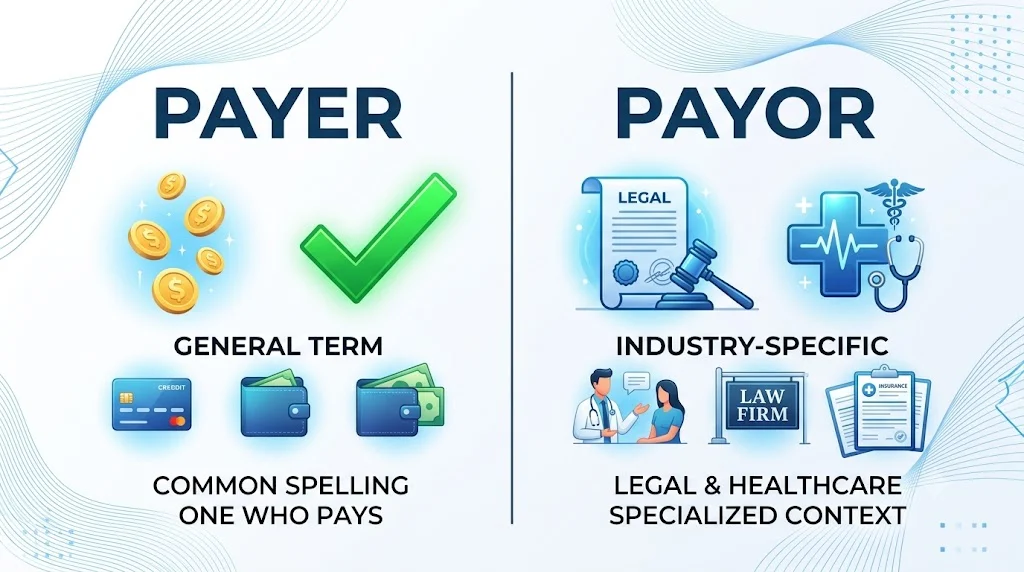
Payer is the standard and most widely accepted spelling in English. It refers to a person or organization that pays money for goods, services, or expenses.
Payor has the same meaning but is mainly used in legal, insurance, and healthcare documents in some regions.
Examples
- The payer approved the invoice.
- The insurance payor covered the patient’s treatment costs.
For general writing, payer is usually the better choice.
The Origin of Payer or Payor
The word payer comes from the English verb pay, which traces back to the Old French word paier. Over time, English added the suffix -er, creating payer, meaning “a person or organization that pays.”
The spelling payer has been used in English for centuries and became the standard form in dictionaries, books, newspapers, and everyday communication.
The spelling payor appeared much later. It developed mainly in legal and financial writing, where professionals wanted a spelling that matched other legal terms ending in -or, such as:
- Grantor
- Mortgagor
- Obligor
- Assignor
Although payor is recognized in many legal dictionaries, it never replaced payer in standard English.
Today, both words can describe the same person or organization. The main difference is the context in which they are used.
Why Do Both Spellings Exist?
Several factors explain why both spellings are still used.
Traditional English spelling
Standard English naturally forms agent nouns by adding -er to verbs.
Examples:
- Teach → Teacher
- Drive → Driver
- Pay → Payer
Legal writing traditions
Many legal documents prefer words ending in -or because they match older legal terminology.
Industry habits
Insurance companies, healthcare providers, and financial institutions sometimes continue using payor because older contracts and databases already use that spelling.
This explains why both words remain visible today.
British English vs American English Spelling
Unlike words such as colour/color or centre/center, the difference between payer and payor is not a British versus American spelling rule.
Both the United Kingdom and the United States generally prefer payer in everyday English.
However, some American legal and healthcare organizations continue using payor in official documents.
Comparison Table
| Feature | British English | American English |
|---|---|---|
| Standard spelling | Payer | Payer |
| Legal documents | Mostly payer | Payer and sometimes payor |
| Insurance industry | Payer | Payer or payor |
| Newspapers | Payer | Payer |
| Academic writing | Payer | Payer |
| Everyday writing | Payer | Payer |
Examples
British English
- The payer must complete the application form.
- The payer is responsible for the payment.
American English
- The insurance payer approved the claim.
- The healthcare payor processed the reimbursement.
Although both spellings may appear in the United States, payer remains the more common choice.
Why Is There Confusion Between Payer and Payor?
Many people become confused because they see both spellings used by trusted organizations. Since each word refers to someone who pays, it is easy to assume they are different words when they actually share the same meaning.
Here are the most common reasons for the confusion.
Similar Meaning
Both words describe the same role.
Examples:
- The insurance company is the payer.
- The insurance company is the payor.
The meaning does not change.
Industry-Specific Usage
Healthcare systems, insurance providers, and legal firms sometimes choose payor because it has been used in contracts for many years.
Outside these industries, payer is much more common.
Spell Check and Autocorrect
Many spelling tools recognize payer first because it is the standard English spelling.
Some legal software and healthcare systems still accept payor, adding to the confusion.
Reading Professional Documents
Someone may read a hospital bill that says payor and later see a bank statement using payer.
Seeing both spellings in official documents makes people wonder whether one is incorrect.
Search Intent
Many online searches ask:
- payer or payor
- is payor correct
- payer vs payor
- what is the difference between payer and payor
- payer meaning
- payor meaning
People usually want to know whether one spelling is more correct than the other.
Which Spelling Should You Use?
The best spelling depends on your audience and the type of document you are writing.
For General English
Choose payer.
It is the spelling found in most dictionaries and style guides.
Example:
- Every payer must submit payment before the deadline.
For Business Writing
Use payer unless your organization has a different style guide.
Example:
- The payer is responsible for all transaction fees.
For Legal Documents
Follow the wording already used in the contract.
If the document uses payor, remain consistent throughout.
For Healthcare and Insurance
Many organizations still use payor in forms, policies, billing systems, and reimbursement documents.
Always follow your employer’s preferred terminology.
For Global Readers
Use payer because it is easier to recognize and understood by readers around the world.
Quick Recommendation
| Audience | Best Choice |
|---|---|
| Students | Payer |
| Teachers | Payer |
| General public | Payer |
| Businesses | Payer |
| Legal professionals | Follow document style |
| Healthcare organizations | Follow organization style |
| International audience | Payer |
Common Mistakes with Payer or Payor
Understanding the common mistakes can help you choose the correct spelling with confidence.
Mistake 1: Thinking Payor Is Incorrect
Incorrect belief
Payor is always wrong.
Correct explanation
Payor is accepted in many legal and healthcare settings, even though payer is the standard spelling.
Mistake 2: Mixing Both Spellings
Incorrect
The payer submitted the claim, and the payor approved the payment.
If both words refer to the same organization, use one spelling consistently.
Better
The payer submitted the claim and approved the payment.
Mistake 3: Assuming They Have Different Meanings
Many people think a payer and a payor perform different jobs.
They do not.
Both refer to the person or organization responsible for making payment.
Mistake 4: Ignoring Company Style
Some organizations officially use payor in every document.
Changing it to payer may create inconsistency.
Always follow your company’s writing guidelines.
Payer or Payor in Everyday Examples
Emails
- The payer has completed the bank transfer.
- Please contact the insurance payor for claim approval.
News Articles
- The largest healthcare payer announced new coverage rules.
- The hospital worked closely with every insurance payor involved in the case.
Social Media
- Always confirm who the payer is before sending an invoice.
- The insurance payor finally approved my claim today.
Formal Writing
- The payer agrees to pay all charges listed in this agreement.
- The payor shall provide reimbursement according to the contract terms.
Business Communication
- The payer must receive a copy of every invoice.
- Payment cannot be processed until the payer confirms the billing details.
By understanding the context, you can confidently choose the spelling that best fits your audience and document.
Google Trends & Usage Behavior
People search for payer or payor because they often see both spellings in official documents. Many want to know whether one spelling is correct or whether each has a different meaning.
In general, payer is searched more often because it is the standard English spelling used in dictionaries, schools, business writing, and news articles. Students, writers, and professionals usually search for it when checking grammar or spelling.
The spelling payor is searched by people working in healthcare, insurance, law, and finance. They often see the word in contracts, billing systems, insurance claims, and policy documents.
Why People Search for “Payer or Payor”
Common reasons include:
- They found different spellings in official documents.
- They want the correct spelling for an email or report.
- They are completing insurance or healthcare forms.
- They are writing legal or financial documents.
- They want to know if both words have the same meaning.
Regional Usage
Although payer is the preferred spelling in most English-speaking countries, payor appears more often in industries such as:
- Healthcare
- Insurance
- Legal services
- Financial contracts
For everyday writing, payer remains the safest and most widely understood choice.
Comparison Table
| Feature | Payer | Payor |
|---|---|---|
| Meaning | A person or organization that pays | Same meaning |
| Standard English | ✔ Yes | Accepted mainly in legal and healthcare contexts |
| Everyday Writing | ✔ Recommended | Rare |
| Business Writing | ✔ Common | Sometimes used |
| Legal Documents | Common | Common in some contracts |
| Healthcare & Insurance | Very common | Common in many systems |
| Dictionaries | Listed as the standard spelling | Listed as a variant in some dictionaries |
| Best Choice for Most Readers | ✔ Payer | Only when required by industry style |
Frequently Asked Questions
1. Which is correct: payer or payor?
Both spellings are correct, but they are used in different situations. Payer is the standard spelling found in general English, dictionaries, and everyday writing. Payor is mainly used in legal, insurance, and healthcare documents. For most people, payer is the better choice.
2. Is payor a real word?
Yes. Payor is a real word. It appears in legal agreements, insurance policies, healthcare billing systems, and financial documents. While it is less common than payer, many organizations continue using it because of long-standing industry practices.
3. What is the difference between payer and payor?
There is almost no difference in meaning. Both words describe a person or organization responsible for making a payment. The difference is mainly spelling and preferred usage. Payer is standard English, while payor is more common in specialized industries.
4. Which spelling should I use in everyday writing?
Use payer for emails, school assignments, business communication, articles, and general writing. It is the spelling most readers expect and understand. Choose payor only if your workplace, legal document, or organization specifically requires it.
5. Is payor used in healthcare?
Yes. Many hospitals, insurance companies, and healthcare providers use payor in billing systems, reimbursement documents, and claim forms. This spelling has become common in the healthcare industry, even though payer remains the standard English form.
6. Is payer used in British and American English?
Yes. Payer is the standard spelling in both British English and American English. Unlike words such as colour and color, there is no national spelling difference. However, some American legal and healthcare organizations also use payor.
7. Why do people confuse payer and payor?
People become confused because both spellings appear in official documents. They have the same meaning, sound alike, and are used by trusted organizations. This makes many readers think they are different words when they are simply spelling variants.
8. Can I use payer and payor in the same document?
It is best not to mix them unless you are quoting another source. Choose one spelling and use it consistently throughout your document. Consistent spelling makes your writing look professional and prevents readers from wondering if the words have different meanings.
Conclusion
The choice between payer or payor depends mainly on your audience and writing purpose. Payer is the standard spelling used in dictionaries, schools, business communication, and everyday English. It is the best option for most writers because it is familiar to readers around the world. Payor is also correct but is mainly found in legal, healthcare, insurance, and financial documents where it has become part of industry terminology. If you are writing for the general public, choose payer. If your workplace or contract uses payor, follow that style consistently. Understanding this small spelling difference will help you write with greater accuracy and confidence.
Read More Related Articles:
Quartz or Granite | Which Countertop Is Better for Your Home
Which Word Is Correct and When Should You Use Each One