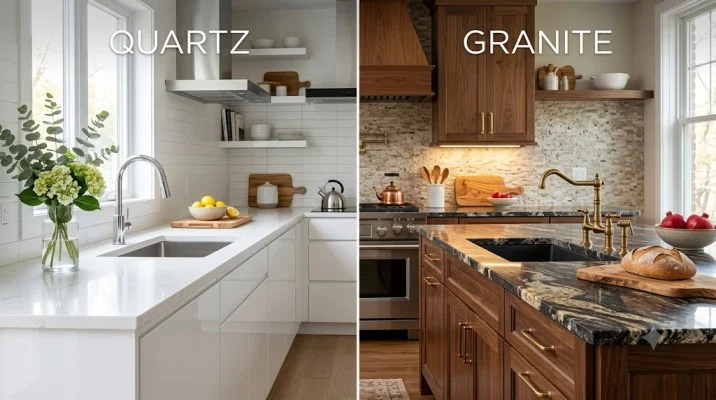
Choosing between quartz or granite is one of the biggest decisions when planning a new kitchen or bathroom. Both materials are beautiful, strong, and long-lasting, but they are not the same. Many homeowners search for quartz or granite because they want the best value, the easiest care, and a surface that fits their style.
Some people also wonder if one lasts longer or costs less than the other. This guide answers those questions in simple words. You will learn the differences, the benefits, the drawbacks, and which material is the better choice for your home and budget.
Quick Answer
If you want a countertop that is easy to clean and needs very little care, quartz is usually the better choice. If you love the natural beauty of real stone and do not mind regular sealing, granite is an excellent option. Both are durable, attractive, and can last for many years.
| Feature | Quartz | Granite |
|---|---|---|
| Type | Engineered stone | Natural stone |
| Maintenance | Very low | Needs sealing |
| Appearance | Consistent patterns | Unique natural patterns |
| Durability | Excellent | Excellent |
What Is Quartz?
Quartz is an engineered stone made from natural quartz crystals mixed with resins and pigments. This process creates a strong and smooth surface that is available in many colors and designs.
Benefits of Quartz
- Non-porous surface
- Does not need sealing
- Easy to clean
- Resists stains
- Many modern colors and patterns
- Great for busy kitchens
Drawbacks of Quartz
- Usually costs more than some granite options
- Can be damaged by very high heat
- Less natural-looking than real stone
Best Places to Use Quartz
- Kitchen countertops
- Bathroom vanities
- Laundry rooms
- Office worktops
- Kitchen islands
What Is Granite?
Granite is a natural stone formed deep inside the earth over millions of years. Large blocks are cut from quarries and polished into beautiful countertops.
Each granite slab is different, making every countertop unique.
Benefits of Granite
- Natural beauty
- Strong and durable
- Heat resistant
- Scratch resistant
- Adds value to a home
- Every slab has unique colors and patterns
Drawbacks of Granite
- Needs sealing every few years
- Can stain if not sealed
- Some slabs have natural cracks or color changes
- Requires a little more maintenance than quartz
Best Places to Use Granite
- Kitchens
- Outdoor kitchens
- Bathroom countertops
- Fireplace surrounds
- Bar tops
The Origin of Quartz or Granite
Although quartz and granite are both popular countertop materials, they have different origins.
Origin of Quartz
The word quartz comes from the German word Quarz. Quartz is one of the most common minerals found on Earth. Natural quartz crystals are mined and then combined with resins to create modern quartz countertops.
Because manufacturers control the production process, quartz countertops have consistent colors and patterns.
Origin of Granite
The word granite comes from the Latin word granum, meaning grain. The name describes the stone’s grain-like appearance.
Granite forms naturally when molten rock cools slowly beneath the Earth’s surface. This slow process creates beautiful crystals that make every slab different.
Since granite is a natural material, no two pieces look exactly alike.
British English vs American English Usage
Unlike some English words, quartz and granite are spelled the same in both British English and American English.
| British English | American English | Correct? | Example |
|---|---|---|---|
| Quartz | Quartz | ✔ Yes | Quartz countertops are popular. |
| Granite | Granite | ✔ Yes | Granite is a natural stone. |
There is no spelling difference between the two varieties of English. The only differences you may notice are regional preferences in design, pricing, or countertop styles rather than spelling.
Why Do People Compare Quartz or Granite?
Many people believe quartz and granite are almost the same because both are used for countertops. However, they are made differently.
People compare them because they want answers to questions like:
- Which one lasts longer?
- Which one is easier to clean?
- Which one costs less?
- Which one looks better?
- Which one increases home value?
- Which one is best for families?
These questions make quartz or granite one of the most searched countertop comparisons online.
Side-by-Side Comparison
Both quartz and granite are premium countertop materials. They are strong, attractive, and can last for decades. However, they perform differently in daily use. The table below gives a quick overview before we explore each feature in detail.
| Feature | Quartz | Granite | Winner |
|---|---|---|---|
| Material | Engineered stone | Natural stone | Depends on preference |
| Appearance | Uniform colors and patterns | One-of-a-kind natural patterns | Tie |
| Maintenance | Very low | Moderate | Quartz |
| Heat Resistance | Good | Excellent | Granite |
| Scratch Resistance | Excellent | Excellent | Tie |
| Stain Resistance | Excellent | Good with sealing | Quartz |
| Sealing Required | No | Yes | Quartz |
| Outdoor Use | Not recommended in direct sunlight | Excellent | Granite |
| Lifespan | 20–30+ years | 30–100+ years | Granite |
| Value | High | High | Tie |
Durability: Which Lasts Longer?
Both materials are built to last, but they have different strengths.
Quartz
Quartz is made by combining natural quartz with strong resins. This creates a hard and durable surface that stands up well to everyday use.
It can handle:
- Daily cooking
- Heavy dishes
- Busy family kitchens
- Normal wear and tear
Because quartz is non-porous, it does not absorb water or food spills.
Granite
Granite is one of the hardest natural stones on Earth. It can last for many decades when cared for properly.
Granite easily handles:
- Heavy cookware
- Daily meal preparation
- Busy kitchens
- High traffic homes
With proper sealing, granite often lasts a lifetime.
Winner
If you want the longest possible lifespan, granite has a slight advantage. For everyday family use, both materials are excellent choices.
Appearance: Which Looks Better?
Beauty is one of the biggest reasons people compare quartz or granite.
Quartz Appearance
Quartz offers a clean and modern style.
Manufacturers create many designs, including:
- Pure white
- Bright black
- Soft gray
- Marble-look patterns
- Solid colors
- Modern textures
Since quartz is manufactured, every slab looks very similar.
This makes it easy to match large kitchens or multiple countertops.
Granite Appearance
Granite comes directly from nature.
Every slab has:
- Different colors
- Natural crystals
- Unique veins
- Natural movement
- One-of-a-kind patterns
No two granite countertops are exactly the same.
If you love natural beauty, granite is hard to beat.
Winner
- Choose quartz if you like a clean, modern, and consistent look.
- Choose granite if you want a unique natural design.
Maintenance: Which Is Easier?
One of the biggest differences between quartz and granite is maintenance.
Quartz Maintenance
Quartz is very easy to care for.
Simply:
- Wipe with warm water
- Use mild soap
- Clean spills quickly
- Avoid harsh chemicals
No sealing is needed.
Granite Maintenance
Granite also cleans easily, but it needs more care.
You should:
- Wipe spills quickly
- Use stone-safe cleaner
- Reseal every few years
- Avoid strong acidic cleaners
Sealing helps prevent stains and keeps the surface looking beautiful.
Winner
Quartz wins because it requires less maintenance.
Heat Resistance
Hot cookware can damage some countertop materials.
Quartz
Quartz handles warm pots and pans well.
However, extreme heat can damage the resin inside the countertop.
It is best to use:
- Trivets
- Hot pads
- Heat-resistant mats
Granite
Granite forms under intense heat inside the Earth.
Because of this, it has outstanding heat resistance.
Hot pots usually do not damage properly installed granite.
Even so, using trivets is still a smart habit.
Winner
Granite offers better heat resistance.
Scratch Resistance
Kitchen countertops face knives, dishes, and heavy cookware every day.
Quartz
Quartz is extremely hard.
Normal kitchen use rarely scratches the surface.
However, cutting directly on the countertop is not recommended because it can damage your knives.
Granite
Granite is also highly scratch resistant.
It easily handles everyday cooking.
Many people are surprised by how hard granite really is.
Winner
This category is a tie. Both materials resist scratches very well.
Stain Resistance
Food and drinks can stain some countertop materials.
Quartz
Quartz is non-porous.
That means liquids stay on the surface instead of soaking in.
Common spills include:
- Coffee
- Tea
- Juice
- Wine
- Oil
These are usually easy to clean.
Granite
Granite is naturally porous.
Without sealing, liquids may soak into the stone.
Proper sealing greatly reduces this risk.
Winner
Quartz provides better stain protection because it does not require sealing.
Cost Comparison
The price of quartz and granite depends on:
- Color
- Thickness
- Brand
- Quality
- Edge design
- Installation
In many areas, both materials cost a similar amount.
Some premium granite slabs are more expensive than quartz.
Some designer quartz brands cost more than natural granite.
Instead of choosing only by price, compare:
- Maintenance costs
- Long-term value
- Installation quality
- Warranty
- Appearance
A slightly higher price may be worth it if the countertop better fits your lifestyle.
Pros and Cons of Quartz
Pros
- Very easy to maintain
- No sealing required
- Excellent stain resistance
- Many colors available
- Consistent appearance
- Great for modern homes
Cons
- Sensitive to very high heat
- Less natural than granite
- Premium designs may cost more
Pros and Cons of Granite
Pros
- Natural stone beauty
- Every slab is unique
- Excellent heat resistance
- Very durable
- Long lifespan
- Adds timeless style
Cons
- Needs sealing
- Requires more maintenance
- Can stain if not sealed
- Natural patterns vary from slab to slab
Which Material Offers Better Value?
The answer depends on your needs.
Choose quartz if you want:
- Easy cleaning
- Low maintenance
- Modern style
- Consistent colors
- Excellent stain resistance
Choose granite if you want:
- Real natural stone
- Unique patterns
- Better heat resistance
- Outdoor use
- A classic, timeless appearance
There is no single winner for every home. The best choice is the one that matches your cooking habits, design style, budget, and maintenance preferences.
Best Places to Use Quartz
Quartz is a great choice for many indoor spaces. It looks modern and is easy to keep clean, making it perfect for busy homes.
Kitchen Countertops
Quartz is one of the best materials for kitchen counters because it resists stains and does not need sealing.
It works well for:
- Family kitchens
- Open kitchens
- Small apartments
- Modern homes
Bathroom Vanities
Quartz handles water very well because it is non-porous.
It is a smart choice for:
- Main bathrooms
- Guest bathrooms
- Powder rooms
Laundry Rooms
Laundry rooms often have water, soap, and cleaning products. Quartz is easy to wipe clean and stays looking new.
Home Offices
Many people now use quartz for desks and workspaces because it has a clean, modern appearance.
Best Places to Use Granite
Granite is ideal for homeowners who love natural stone and timeless beauty.
Family Kitchens
Granite is strong enough for daily cooking and food preparation.
Its natural patterns make every kitchen look unique.
Outdoor Kitchens
Granite performs better outdoors than quartz because it handles direct sunlight and changing weather more effectively.
Bar Tops
A polished granite bar top creates a rich and elegant look.
Fireplace Surrounds
Because granite handles high temperatures well, it is often used around fireplaces.
Quartz or Granite for Different Home Styles
Different homes have different design needs.
| Home Style | Better Choice | Why |
|---|---|---|
| Modern | Quartz | Smooth colors and clean lines |
| Traditional | Granite | Natural beauty and classic look |
| Luxury | Either | Both create a premium finish |
| Farmhouse | Granite | Warm and natural appearance |
| Minimalist | Quartz | Simple and consistent design |
| Outdoor Kitchen | Granite | Better resistance to sunlight |
How to Choose Between Quartz or Granite
Before buying a countertop, think about how you use your kitchen or bathroom.
Ask yourself these questions:
- Do I cook every day?
- Do I want very little maintenance?
- Do I love natural stone?
- Will the countertop be outside?
- What is my budget?
- Which style matches my home?
If you prefer convenience, quartz is often the better option.
If you want the beauty of real stone, granite may be the perfect choice.
Common Buying Mistakes
Many homeowners rush their decision. Avoid these common mistakes.
Choosing Only by Price
A cheaper countertop may cost more over time if it needs extra care or repairs.
Always compare:
- Quality
- Warranty
- Installation
- Maintenance
Ignoring Maintenance
Granite needs sealing.
Quartz does not.
Choose the material that matches the amount of care you are willing to provide.
Forgetting About Heat
People often place hot pans directly on countertops.
Granite handles heat better than quartz.
Using trivets is a good habit for both materials.
Not Viewing Full Slabs
Small samples can look different from a full countertop.
Whenever possible, see the complete slab before making your final decision.
Everyday Examples
Here are simple examples showing how people talk about quartz and granite in daily life.
In Emails
We decided to install quartz countertops because they are easy to maintain.
The granite slab arrived today and looks beautiful.
In News Articles
More homeowners are choosing quartz for modern kitchen renovations.
Granite remains one of the most popular natural stones for luxury homes.
On Social Media
Our new quartz kitchen is finally finished!
I love the natural pattern in our granite countertop.
In Formal Writing
Quartz provides excellent stain resistance for residential kitchens.
Granite offers long-lasting durability and timeless natural beauty.
Search Behavior and User Intent
People search for quartz or granite because they want a clear answer before spending money on a countertop.
Common questions include:
- Which lasts longer?
- Which is easier to clean?
- Which costs less?
- Which is better for kitchens?
- Which adds more home value?
- Which is best for families?
Many users also compare maintenance, durability, appearance, and long-term value before making a decision.
The goal is not simply to find the cheapest option. Most people want a countertop that looks beautiful, lasts for years, and fits their daily lifestyle.
Comparison Table – Quartz or Granite
| Feature | Quartz | Granite |
|---|---|---|
| Material | Engineered stone | Natural stone |
| Look | Uniform and consistent | Unique natural patterns |
| Maintenance | Very low | Moderate |
| Sealing | Not required | Required periodically |
| Heat Resistance | Good | Excellent |
| Scratch Resistance | Excellent | Excellent |
| Stain Resistance | Excellent | Good with sealing |
| Outdoor Use | Limited | Excellent |
| Lifespan | 20–30+ years | 30–100+ years |
| Best For | Easy maintenance | Natural beauty |
Which One Is Better for You?
There is no one-size-fits-all answer.
Choose Quartz if you want:
- Easy cleaning
- No sealing
- Modern designs
- Consistent colors
- Low maintenance
Choose Granite if you want:
- Real natural stone
- One-of-a-kind patterns
- Better heat resistance
- Outdoor use
- A timeless appearance
The best countertop is the one that fits your lifestyle, cooking habits, design preferences, and long-term plans for your home.
Frequently Asked Questions
1. Which is better, quartz or granite?
The better choice depends on your needs. Quartz is best if you want a countertop that is easy to clean and does not need sealing. Granite is a better choice if you love the beauty of natural stone and want excellent heat resistance. Both materials are durable and can last for many years.
2. Is quartz more expensive than granite?
It depends on the color, quality, brand, and installation. Some quartz countertops cost more than granite, while some granite slabs are more expensive than quartz. Instead of looking only at the price, compare maintenance, durability, appearance, and long-term value before making your decision.
3. Which countertop lasts longer?
Both quartz and granite have a long lifespan. Quartz can easily last 20 to 30 years or more with normal care. Granite can last several decades and often remains in excellent condition for the life of the home when properly sealed and maintained.
4. Does granite need sealing?
Yes. Granite is a natural stone with tiny pores that can absorb liquids. Applying a quality sealer helps protect the surface from stains and moisture. Most granite countertops only need sealing every few years, depending on how often they are used.
5. Can I place hot pans on quartz?
It is better not to place very hot pots or pans directly on quartz. High temperatures can damage the resin used to make the countertop. Always use a trivet or heat pad to protect the surface and help it last longer.
6. Which countertop is easier to clean?
Quartz is generally easier to clean because it has a non-porous surface. Most spills can be wiped away with warm water and mild soap. Granite is also easy to clean, but it needs regular sealing to help prevent stains.
7. Is granite better for outdoor kitchens?
Yes. Granite is usually the better choice for outdoor kitchens because it handles sunlight, changing weather, and high temperatures better than quartz. Many quartz surfaces are designed mainly for indoor use and may fade if exposed to strong sunlight for long periods.
8. Which countertop adds more value to a home?
Both quartz and granite are considered premium countertop materials and can increase the appeal of a home. Buyers often appreciate quartz for its low maintenance and granite for its natural beauty. The best option depends on the home’s style and the preferences of future buyers.
Conclusion
Choosing between quartz or granite comes down to your lifestyle, budget, and design preferences. Quartz is an excellent option for homeowners who want a beautiful countertop that is easy to clean and requires very little maintenance. Granite is perfect for those who appreciate the natural beauty of real stone and want outstanding heat resistance with a unique look. Both materials are durable attractive, and capable of lasting for many years. Before making your final choice, compare appearance, maintenance, durability, and cost to find the countertop that best suits your home. No matter which material you select, a quality installation and proper care will help you enjoy your investment for decades.
Read More Related Articles:
Medical or Abbreviation | Meaning, Usage, Examples, and …
Manual or Automatic | Which Is Better Complete Guide to …