Have you ever typed elfs and watched your spell checker instantly change it to elves? You are not the only one. Thousands of English learners, students, writers, and fantasy fans search for elfs or elves because the plural form does not follow the usual rule of simply adding -s.
This confusion becomes even more common when reading fantasy novels, playing video games, or writing holiday content about Santa’s helpers. Knowing the correct spelling helps you write with confidence and avoid embarrassing mistakes. In this guide, you will learn the correct plural form, why the confusion exists, where the word comes from, and when you should use each spelling in modern English.
Quick Answer
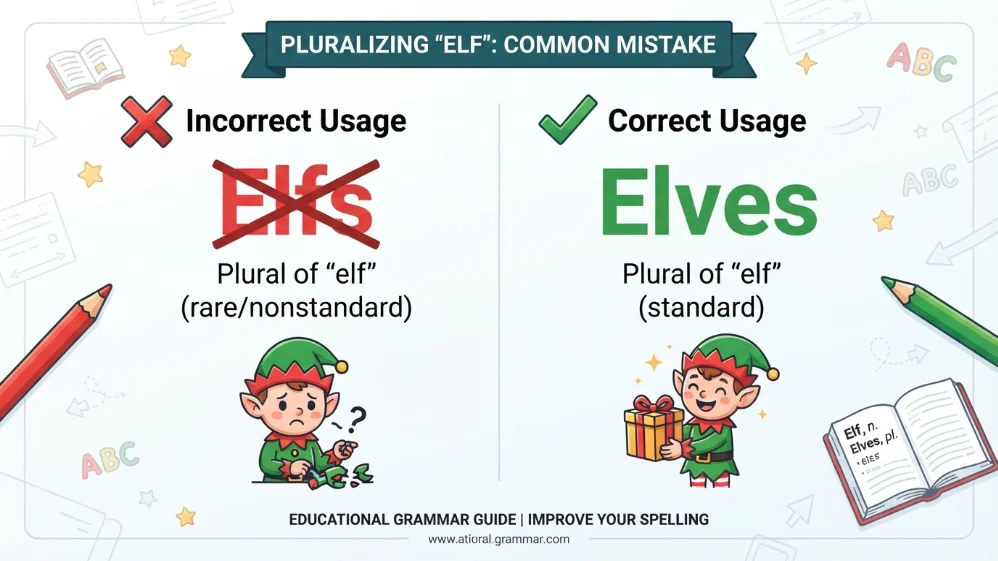
The correct plural of elf is elves.
Elfs is considered incorrect in standard English and should generally be avoided. The word elf follows a common English spelling pattern where nouns ending in -f often change f to v before adding -es.
Correct Examples
- One elf decorated the tree.
- Many elves worked in Santa’s workshop.
- The story featured magical elves living in the forest.
The Origin of Elfs or Elves
The word elf has a long history that dates back more than a thousand years. It comes from the Old English word ælf, which referred to a supernatural being believed to possess magical powers. Similar words also appeared in Old Norse, German, and other early Germanic languages.
As English developed, many nouns ending in -f changed their plural by replacing f with v before adding -es. This language pattern gave us words such as:
- leaf → leaves
- wolf → wolves
- shelf → shelves
- elf → elves
The spelling elfs occasionally appeared in very old texts or as a stylistic choice, but modern dictionaries and grammar guides recognize elves as the standard plural.
Because fantasy books, movies, and games made elves famous worldwide, the correct plural became even more firmly established in modern English.
British English vs American English Spelling
Unlike many English spelling differences, there is no difference between British and American English for this word.
Both varieties use elves as the correct plural.
| Feature | British English | American English |
|---|---|---|
| Singular | elf | elf |
| Plural | elves | elves |
| Standard spelling | Correct | Correct |
| Elfs | Incorrect | Incorrect |
| Used in books | Yes | Yes |
| Used in schools | Yes | Yes |
Examples
British English
- The children loved the Christmas elves.
American English
- The movie showed magical elves protecting the kingdom.
Both sentences use exactly the same spelling.
Why Is There Confusion Between “Elfs or Elves”?
Many people accidentally write elfs because English usually forms plurals by simply adding -s. Since this rule works for many words, it feels natural to apply it here too.
Several reasons explain the confusion.
The Regular Plural Habit
People learn early that:
- cat → cats
- book → books
- tree → trees
They naturally expect:
- elf → elfs
However, elf belongs to an irregular group.
Pronunciation
The final sound in elves can sound similar to elfs during fast speech. This makes many writers unsure which spelling is correct.
Typing Mistakes
When typing quickly, adding -s feels faster than changing f to v.
Fantasy Games and Fiction
Some old games, fan communities, or unofficial websites have used elfs, leading readers to believe both spellings are acceptable.
Search Behavior
Many users search elfs or elves because they want immediate confirmation before submitting homework, writing stories, or publishing articles.
Which Spelling Should You Use?
The answer is simple.
Choose elves in nearly every situation.
If You Write for American Readers
Always use elves.
If You Write for British Readers
Use elves.
If You Write for an International Audience
Use elves because it is accepted worldwide.
Formal Writing
Examples include:
- school assignments
- business writing
- articles
- newspapers
- books
Always choose elves.
Informal Writing
Even in text messages, blogs, or social media, elves remains the preferred spelling.
Unless you intentionally quote historical text or create a fictional language, there is no practical reason to write elfs.
Common Mistakes with Elfs or Elves
Many learners make the same mistakes repeatedly.
Mistake 1
❌ There were many elfs in the forest.
✅ There were many elves in the forest.
Mistake 2
❌ Santa’s elfs made toys all night.
✅ Santa’s elves made toys all night.
Mistake 3
❌ Fantasy stories often include magical elfs.
✅ Fantasy stories often include magical elves.
Mistake 4
❌ The little elfs helped decorate the house.
✅ The little elves helped decorate the house.
Mistake 5
❌ I drew two Christmas elfs.
✅ I drew two Christmas elves.
Helpful Memory Trick
Think about these familiar words:
- leaf → leaves
- wolf → wolves
- shelf → shelves
- elf → elves
They all follow the same spelling pattern.
Elfs or Elves in Everyday Examples
Here are examples from different types of writing.
The children dressed as elves for the holiday party.
News
Local volunteers dressed as Santa’s elves to deliver gifts.
Social Media
Our Christmas elves have finished decorating the office.
School Writing
Many old stories describe magical elves living deep inside forests.
Fantasy Novel
The ancient elves protected the kingdom for centuries.
Holiday Advertisement
Meet Santa’s cheerful elves this weekend.
Children’s Story
The friendly elves baked cookies before sunrise.
Travel Blog
The village looked like a place where elves might live.
Google Trends & Usage Behavior
People search elfs or elves because they want a quick confirmation before using the word in writing. Most searches come from students, English learners, fantasy readers, gamers, and people creating Christmas content. The confusion is not about meaning it is almost always about the correct plural spelling.
Here are the main reasons behind these searches:
- Many people assume every noun forms its plural by adding -s, so they write elfs first.
- Search engines receive typo-based queries because users want an instant spelling check.
- Fantasy books, movies, and role-playing games increase interest in the word elves throughout the year.
- During the holiday season, searches rise as people write about Santa’s elves.
- Both British and American users search this term, but the correct answer remains the same in both varieties of English.
- Users often search related questions like:
- Is elfs correct?
- What is the plural of elf?
- Why is it elves instead of elfs?
- Is elves an irregular plural?
Understanding this search intent helps writers answer the question quickly while also explaining the grammar behind it.
Comparison Table – Elfs vs Elves
| Feature | Elfs | Elves |
|---|---|---|
| Meaning | Intended plural of elf | Correct plural of elf |
| Dictionary Status | Generally considered incorrect | Standard English spelling |
| Grammar | Incorrect in modern English | Correct |
| Used in Schools | No | Yes |
| Used in Books | Rare and usually nonstandard | Yes |
| Used in News Articles | No | Yes |
| Used in Professional Writing | No | Yes |
| Recommended Choice | ❌ Avoid | ✅ Always use |
Quick Summary
- Elf = One magical creature.
- Elves = More than one magical creature.
- Elfs = Nonstandard spelling that should usually be avoided.
Frequently Asked Questions
What is the correct spelling: elfs or elves?
The correct plural is elves. English changes the f in elf to v before adding -es. Modern dictionaries, schools, and professional writers all use elves as the standard form.
Is elfs a real word?
Elfs has appeared in some older texts and fictional works, but it is not accepted as the standard plural in modern English. Today, elves is the correct choice for almost every type of writing.
Why do people confuse elfs and elves?
Most people expect the plural of elf to follow the regular rule of adding -s. Fast typing, pronunciation, and unfamiliarity with irregular plurals also contribute to the confusion.
Which spelling is correct in English?
The correct spelling is elves. This is true in British English, American English, Canadian English, Australian English, and other major varieties of English.
Is elfs a typo?
In most situations, yes. When someone writes elfs, they usually mean elves. Spell checkers often correct it automatically because elves is the accepted plural.
Why does elf become elves?
English has several nouns ending in -f that form their plurals by changing f to v and adding -es. Elf follows the same pattern as wolf → wolves and leaf → leaves.
Can I ever use elfs?
Only in very rare situations, such as quoting an old historical text or preserving the original spelling used by an author. For normal writing, always use elves.
How can I remember the correct spelling?
Think of similar words:
- leaf → leaves
- wolf → wolves
- shelf → shelves
- elf → elves
If those words change f to v, elf does too.
Conclusion
The confusion between elfs or elves is easy to understand because many English nouns simply add -s to form the plural. However, elf is an irregular noun that follows a different pattern. The correct plural is elves, and it is the form used in dictionaries, schools, books, newspapers, and everyday writing around the world. While you may occasionally come across elfs in older or fictional sources, it is not considered standard English. Remember the simple pattern shared by leaf → leaves and wolf → wolves, and you’ll never have to guess again. Choosing elves will make your writing accurate, natural, and easy for every reader to understand.
Read More Related Articles:
Fazed or Phased | The Correct Word, Meaning, Examples, and …
Mykonos or Santorini| Which Greek Island Is Better for Your …
Over or Under| Which Word Should You Use? Meaning, …