Choosing between dove or dived can feel confusing, especially when you’re writing an email, school assignment, article, or social media post. Many English learners and even native speakers pause before using these words because both appear in books, websites, and everyday conversations. This common mix-up often comes from grammar differences, regional usage, and the way people learn English.
If you’ve searched for dove or dived, you’re far from alone. Thousands of people look up this word pair to make sure they’re using the correct past tense of dive. In this guide, you’ll learn which form is right, why both versions exist, where each one is commonly used, and see clear examples that help you avoid the same mistake in the future. Keep reading to choose the right word with confidence.
Quick Answer
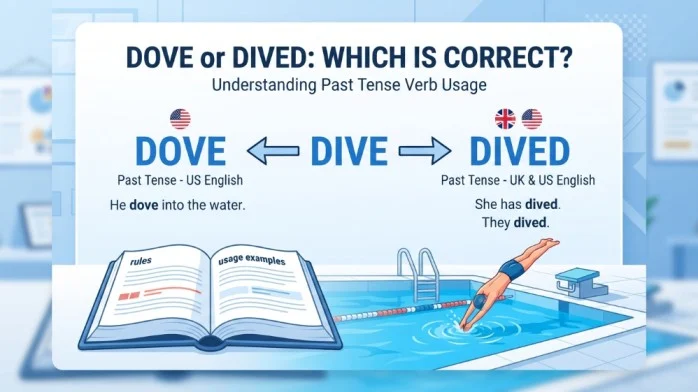
Both dove and dived are correct past tense forms of the verb dive.
- Dove is more common in American English.
- Dived is the preferred form in British English and many other English-speaking countries.
Examples
- She dove into the swimming pool without hesitation. (American English)
- She dived into the swimming pool without hesitation. (British English)
If you’re writing for an international audience, dived is usually the safest choice because it is widely accepted worldwide.
The Origin of Dove or Dived
The verb dive has an unusual history because English developed two accepted past tense forms instead of one.
Originally, the regular past tense was dived. Like many English verbs ending in -e, speakers simply added -d to create the past tense.
During the nineteenth century, many Americans began using dove by analogy with verbs like:
- Drive → Drove
- Ride → Rode
- Write → Wrote
Although dive did not historically belong to this pattern, the new form sounded natural to many speakers. Over time, dove became common throughout the United States.
Meanwhile, Britain, Australia, New Zealand, and most Commonwealth countries continued using dived as the preferred standard.
Today, dictionaries recognize both forms, making this one of the few verbs with two accepted past tense variations.
British English vs American English Spelling
Although this is a grammar difference rather than a spelling difference, regional preference plays a major role.
| Feature | British English | American English |
|---|---|---|
| Preferred past tense | Dived | Dove |
| Also accepted | Dove (less common) | Dived |
| Used in schools | Mostly Dived | Mostly Dove |
| Newspapers | Usually Dived | Usually Dove |
| Formal writing | Dived | Dove or Dived |
Examples
British English
- The swimmer dived into the cold water.
- Rescue workers dived beneath the waves.
American English
- The swimmer dove into the lake.
- He dove for the football.
Both versions are grammatically correct, but matching your audience makes your writing feel more natural.
Why Is There Confusion Between “Dove or Dived”?
The confusion exists because both words are correct. Unlike many grammar questions where one form is wrong, dove and dived are both accepted as the past tense of dive. Their usage mainly depends on regional English.
Here are the biggest reasons people get confused.
Different English Varieties
American English commonly uses dove, while British English prefers dived. Since people read content from around the world, they often see both forms.
Example
- US: The child dove into the pool.
- UK: The child dived into the pool.
School Grammar Rules
Students often learn only one version in school.
- American textbooks usually teach dove.
- British textbooks usually teach dived.
When learners later encounter the other form, they think it must be incorrect.
Internet Content
Search engines display articles from many countries. One website may use dove, while another uses dived, making both appear equally common.
Pronunciation
Both words are easy to pronounce and sound natural in conversation. Since neither sounds unusual, many speakers never realize that regional preference exists.
Autocorrect and Grammar Checkers
Writing tools sometimes recommend one form based on the language setting.
For example:
- English (US) often suggests dove.
- English (UK) often suggests dived.
This can make writers think the other version is wrong when it is actually acceptable.
Search Intent
People searching dove or dived usually want to know:
- Which form is correct?
- Which one sounds more natural?
- Which should I use in school writing?
- Which form appears in exams?
- Is one American and the other British?
Understanding these questions helps explain why this grammar topic remains popular.
Which Form Should You Use?
The best choice depends on your audience rather than strict grammar rules.
If You Write for American Readers
Choose dove because it is the form most Americans naturally expect.
Example
- He dove into the ocean to save the child.
If You Write for British Readers
Choose dived because it follows standard British usage.
Example
- The athlete dived into the river.
For International Writing
If your audience comes from different countries, dived is often the safest option because it is widely accepted across British and Commonwealth English.
Academic Writing
Check your institution’s preferred style guide.
- American universities usually accept dove.
- British universities generally recommend dived.
Consistency matters more than choosing one particular form.
Business Writing
Use whichever form matches your company’s language style.
If your documents use American English, stay with dove.
If they follow British English, use dived throughout.
Common Mistakes with Dove or Dived
Even though both forms are correct, writers sometimes make mistakes by mixing grammar or using the wrong verb form.
Mistake 1: Mixing Regional Styles
❌ The swimmer dove into the pool. (British document using UK spelling elsewhere.)
✅ The swimmer dived into the pool.
Remain consistent throughout your writing.
Mistake 2: Using the Wrong Past Participle
Many people confuse the simple past with the past participle.
❌ He has dove into the water.
✅ He has dived into the water.
Most style guides recommend dived as the past participle, even in American English.
Mistake 3: Changing Forms Mid-Article
❌ Yesterday she dove into the lake. Later she dived again.
While not technically incorrect, switching forms in one piece of writing feels inconsistent.
Choose one style and keep it throughout.
Mistake 4: Thinking One Is Always Wrong
Many learners believe only one answer exists.
The truth:
- Dove ✔ Correct
- Dived ✔ Correct
The better choice depends on your audience.
Mistake 5: Confusing Dove With the Bird
Remember that dove can also be a noun.
Examples
- A white dove landed on the fence. (Bird)
- She dove into the lake. (Past tense of dive)
The sentence tells you which meaning is intended.
Dove or Dived in Everyday Examples
Seeing both forms in real situations makes the difference much easier to understand.
In an Email
American English
Yesterday I dove into the project and completed the first draft.
British English
Yesterday I dived into the project and completed the first draft.
In News Writing
- Firefighters dived into the flooded river to rescue two children.
- The goalkeeper dove to stop the penalty kick.
On Social Media
- I finally dove into my summer reading list.
- We dived straight into the adventure.
In Formal Writing
The researcher dived into historical records before publishing the report.
In Everyday Conversation
- He dove into the pool.
- She dived from the boat.
Both sound natural, depending on the speaker’s English variety.
Google Trends and Usage Behavior
Search interest in dove or dived stays steady because learners regularly encounter both forms in books, classrooms, websites, and media.
Common reasons people search this topic include:
- Checking the correct past tense of dive
- Understanding American and British English differences
- Preparing for exams
- Improving grammar for school assignments
- Writing professional documents
- Editing books, blogs, or articles
- Confirming dictionary usage
- Learning natural English expressions
People also search related phrases such as:
- past tense of dive
- dive past participle
- is dove correct
- is dived correct
- dive grammar rules
- dove vs dived
- dive verb forms
- American vs British grammar
Because both forms are accepted, readers often look for practical guidance rather than a simple right-or-wrong answer. This explains why the topic remains popular year after year.
Comparison Table
| Feature | Dove | Dived |
|---|---|---|
| Meaning | Past tense of dive | Past tense of dive |
| Correct? | Yes | Yes |
| Main Usage | American English | British English and Commonwealth English |
| Formal Writing | Accepted in US | Widely accepted internationally |
| School Usage | Common in US | Common in UK |
| Past Participle | Less common | Preferred |
| Example | She dove into the water. | She dived into the water. |
| Best For | American audiences | British and global audiences |
FAQs About Dove or Dived
1. What is the correct past tense of dive?
Both dove and dived are correct past tense forms of dive. Dove is more common in American English, while dived is preferred in British English. The best choice depends on your audience and the variety of English you are using.
2. Is dove grammatically correct?
Yes. Dove is grammatically correct and widely accepted in American English. It has been used for more than a century in books, newspapers, and everyday speech. Although it is less common in British English, it is still recognized by major dictionaries.
3. Is dived grammatically correct?
Yes. Dived is the original and regular past tense of dive. It remains the standard choice in British English, Australia, New Zealand, Canada in many contexts, and other Commonwealth countries. It is also accepted in American English.
4. Should I use dove or dived in formal writing?
Use the form that matches your audience. If you are writing for an American audience, dove is a natural choice. For British or international readers, dived is usually preferred. The most important rule is to stay consistent throughout your writing.
5. Why do people confuse dove and dived?
People become confused because both forms are correct and appear in dictionaries, books, and online articles. Regional English differences, school lessons, grammar tools, and international websites all contribute to the confusion, making it difficult to know which form to choose.
6. Is dove the same as the bird dove?
Not always. Dove has two meanings. It can be the past tense of dive, or it can refer to the white bird that often symbolizes peace. The meaning becomes clear from the sentence.
Examples
- She dove into the lake. (Verb)
- A white dove flew across the sky. (Bird)
7. What is the past participle of dive?
The past participle is generally dived.
Examples
- She has dived in many oceans.
- They had dived before sunrise.
Although some informal American usage may occasionally use dove, most grammar guides recommend dived as the standard past participle.
8. Which form should English learners use?
If you are learning English for international communication, dived is often the safest choice because it is accepted in most English-speaking regions. If your goal is American English, using dove in the simple past will sound more natural to native speakers.
Conclusion
Choosing between dove or dived is easier once you understand that both forms are correct. The real difference lies in regional preference rather than grammar. Dove is the standard past tense in American English, while dived remains the preferred form in British English and many other parts of the world. For international writing, dived is often the safest option, but either form is acceptable when used consistently. By matching your choice to your audience and maintaining the same style throughout your writing, you can communicate clearly and confidently without worrying about making a grammar mistake.
Read More Related Articles:
Schooner or Later| Meaning, Correct Phrase, and Why …
AC or DC | What’s the Difference? Meaning, Uses, and …
Fazed or Phased | The Correct Word, Meaning, Examples, and …