Using the wrong verb in an email, school assignment, or social media post can make even a simple sentence look incorrect. Many English learners and native speakers hesitate when choosing are or is, especially when the subject seems confusing or the sentence includes extra words. If you’ve ever paused before hitting “send,” you’re definitely not the only one.
Thousands of people search for are or is because English grammar rules are not always as straightforward as they seem. Small differences in sentence structure, singular and plural subjects, and everyday usage often lead to mistakes that create unnecessary confusion.
This guide will help you understand which form is correct in different situations, explain the grammar rule behind it, provide clear examples, and show you how to avoid making the same mistake again. Keep reading to master this common grammar confusion with confidence.
Quick Answer
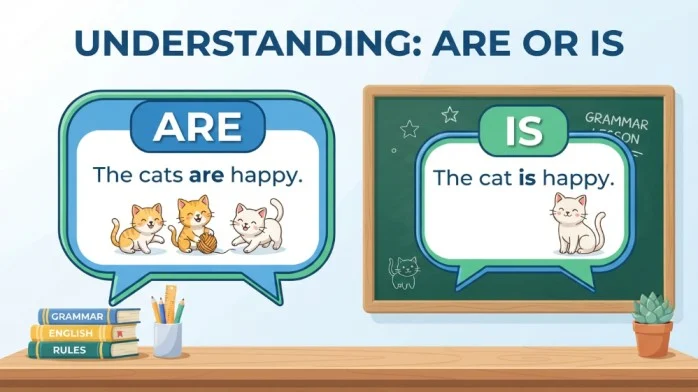
“Is” is used with singular subjects, while “are” is used with plural subjects and with the pronouns you and we.
Examples:
- She is happy.
- The dog is sleeping.
- They are ready.
- The books are on the table.
- You are my best friend.
The easiest rule is to match the verb with the subject. If the subject is one person or one thing, use is. If the subject is more than one person or thing, use are.
The Origin of “Are or Is”
Both are and is come from the ancient English verb to be, one of the oldest and most important verbs in the language. The verb to be has changed over hundreds of years, influenced by Old English, Germanic languages, and Latin.
In Old English, different forms of to be were already used depending on the subject. Over time, these forms became the modern words we use today:
| Subject | Correct Verb |
|---|---|
| I | am |
| You | are |
| He | is |
| She | is |
| It | is |
| We | are |
| They | are |
Unlike many English verbs, to be changes its form based on the subject. That is why learners often find it harder than regular verbs like play, walk, or read.
The confusion is not about spelling. Instead, it comes from choosing the correct verb form for the subject of a sentence.
British English vs American English
Unlike words that have different spellings in British and American English, are and is are exactly the same in both varieties of English.
Whether you are writing in the United States, the United Kingdom, Canada, Australia, New Zealand, or any other English-speaking country, the grammar rules do not change.
British vs American Usage
| Feature | British English | American English |
|---|---|---|
| Spelling | are / is | are / is |
| Grammar rule | Same | Same |
| Singular subject | is | is |
| Plural subject | are | are |
| Used in formal writing | Yes | Yes |
| Used in everyday speech | Yes | Yes |
Examples
| Sentence | Correct? |
|---|---|
| The car is new. | ✔ Correct |
| The cars are new. | ✔ Correct |
| My friend is here. | ✔ Correct |
| My friends are here. | ✔ Correct |
There is no regional spelling difference. The only thing you need to remember is matching the verb with the subject.
Why Is There Confusion Between “Are or Is”?
Although the grammar rule is simple, many people still hesitate before choosing are or is. Several reasons make this mistake common.
Similar Meaning
Both words come from the verb to be, so learners sometimes think they can be used in the same way.
Incorrect: The students is waiting.
Correct: The students are waiting.
Long Subjects
When a sentence has many words before the verb, it becomes harder to identify the real subject.
Incorrect:
The box of old books are heavy.
Many people look at books because it is closer to the verb.
Correct:
The box of old books is heavy.
The real subject is box, which is singular.
Collective Nouns
Words like team, family, group, and class often confuse writers.
In American English, collective nouns usually take is because the group is treated as one unit.
Example:
The team is practicing today.
In British English, people sometimes use are when they want to emphasize the members of the group.
Example:
The team are celebrating their victory.
Both styles are accepted depending on the writing style.
Pronunciation in Fast Speech
When people speak quickly, is and are often sound weak or shortened.
For example:
- He’s
- They’re
- You’re
- It’s
Because these contractions are so common, learners sometimes forget which full verb is correct.
Learning English as a Second Language
Many languages do not change the verb to be based on singular and plural subjects. As a result, English learners may use one form for every sentence until they become familiar with the grammar.
Typing Quickly
When writing emails, text messages, or social media posts, people often type without checking subject-verb agreement.
For example:
Incorrect: My shoes is dirty.
Correct: My shoes are dirty.
Reading the sentence one more time usually helps catch the mistake.
Which Should You Use?
The correct choice depends entirely on the subject of your sentence.
Use Is for Singular Subjects
Choose is when talking about one person, one animal, one place, or one thing.
Examples:
- The baby is asleep.
- My phone is charging.
- The weather is nice today.
- This book is interesting.
- Her idea is brilliant.
Use Are for Plural Subjects
Choose are when talking about two or more people, animals, places, or things.
Examples:
- The children are outside.
- My shoes are clean.
- These flowers are beautiful.
- The teachers are busy.
- The houses are expensive.
Use Are with These Pronouns
Always use are with:
- You
- We
- They
Examples:
- You are welcome.
- We are ready.
- They are my neighbors.
Even when talking to only one person, English always uses you are, never you is.
Use Is with These Pronouns
Always use is with:
- He
- She
- It
- This
- That
Examples:
- He is my brother.
- She is at work.
- It is raining.
- This is easy.
- That is correct.
Easy Memory Trick
Remember this simple rule:
- One = Is
- More than one = Are
If you first identify the subject, choosing the correct verb becomes much easier.
Common Mistakes with “Are or Is”
Here are some of the mistakes people make most often and how to correct them.
| Incorrect | Correct | Why? |
|---|---|---|
| The dogs is barking. | The dogs are barking. | Dogs is plural. |
| My parents is home. | My parents are home. | Parents is plural. |
| She are happy. | She is happy. | She is singular. |
| We is ready. | We are ready. | We always takes are. |
| The teacher are here. | The teacher is here. | Teacher is singular. |
| It are raining. | It is raining. | It always takes is. |
| You is late. | You are late. | You always takes are. |
| These book is old. | These books are old. | Books is plural. |
Tips to Avoid Mistakes
- Find the subject before choosing the verb.
- Ignore extra words between the subject and the verb.
- Remember he, she, it = is.
- Remember you, we, they = are.
- Read your sentence aloud before finishing your writing.
“Are or Is” in Everyday Examples
Knowing the rule is helpful, but seeing it in real situations makes it much easier to remember. Below are examples of how are and is are used in everyday writing.
Emails
Correct:
- The meeting is tomorrow at 10 a.m.
- Your documents are attached.
- My manager is available this afternoon.
- The reports are ready for review.
News Articles
Correct:
- The city is preparing for heavy rain.
- The players are celebrating their victory.
- A new school is opening next month.
- The roads are closed due to construction.
Social Media
Correct:
- Summer is finally here!
- My friends are amazing.
- This movie is so good.
- These photos are beautiful.
School Writing
Correct:
- The Earth is a planet.
- The students are learning grammar.
- My project is complete.
- The answers are correct.
Business Writing
Correct:
- The presentation is ready.
- The clients are waiting.
- Our office is closed today.
- The products are available online.
No matter where you write, the rule stays the same:
- One person or thing → is
- More than one person or thing → are
Google Trends & Usage Behavior
The phrase “are or is” is searched by people around the world because it is one of the first grammar rules every English learner studies. Native speakers also search for it when writing formal documents or checking difficult sentences.
People usually search this topic because they want to:
- Check whether a sentence is grammatically correct.
- Learn subject-verb agreement.
- Improve school or exam writing.
- Write better business emails.
- Avoid common grammar mistakes.
- Understand confusing sentences with long subjects.
Many searches also include questions like:
- Is it there are or there is?
- Family is or are?
- Everyone is or are?
- Data is or are?
- None is or are?
This shows that users are not confused about spelling. Instead, they want to know which verb matches the subject correctly.
Comparison Table
| Feature | Are | Is |
|---|---|---|
| Meaning | Present form of to be | Present form of to be |
| Used with | Plural subjects, you, we, they | Singular subjects, he, she, it |
| Correct Usage | ✔ Yes | ✔ Yes |
| Incorrect Usage | Using with singular subjects | Using with plural subjects |
| Example | The books are new. | The book is new. |
| Common Context | Groups, multiple people or things | One person, animal, place, or thing |
Frequently Asked Questions
1. Which is correct: are or is?
Both are correct, but they are used in different situations. Use is with singular subjects and are with plural subjects. Always match the verb with the subject of the sentence to keep your grammar correct.
2. When should I use is?
Use is when talking about one person, one place, one animal, or one thing. It is also used with the pronouns he, she, it, this, and that.
Example:
- The cat is sleeping.
- She is my sister.
3. When should I use are?
Use are with plural subjects and with the pronouns you, we, and they.
Example:
- The children are playing.
- We are ready.
4. Why do people confuse are and is?
The confusion usually happens because people focus on the wrong noun in a sentence or forget the subject-verb agreement rule. Long sentences, collective nouns, and fast typing also make mistakes more common.
5. Is you is ever correct?
No. Standard English always uses you are, whether you are speaking to one person or many people.
Correct:
- You are welcome.
Incorrect:
- You is welcome.
6. Is there is or there are correct?
Both are correct.
Use there is for one thing.
- There is a book on the desk.
Use there are for more than one thing.
- There are two books on the desk.
7. Can collective nouns use both is and are?
Yes. In American English, collective nouns usually take is because the group is treated as one unit.
Example:
- The team is winning.
In British English, are may be used when thinking about the individual members.
- The team are celebrating.
8. How can I remember the difference between are and is?
A simple trick is:
- One = Is
- More than one = Are
First identify the subject of your sentence. Once you know whether it is singular or plural, choosing the correct verb becomes easy.
Conclusion
Choosing between are and is becomes simple once you remember one basic rule: use “is” with singular subjects and “are” with plural subjects. Although both words come from the verb to be, they cannot be used interchangeably. Most mistakes happen because writers overlook the true subject or become confused by long sentences. By identifying the subject first and then matching the correct verb, you can avoid common grammar errors in schoolwork, professional writing, emails, and everyday conversations. With regular practice and the examples in this guide, you’ll feel more confident using are and is correctly every time you write.
Read More Related Articles:
Learn the Difference, Meaning, and Correct Usage in 2026
Cocoa or Cacao | What’s the Difference and Which Word …
Imput or Input | Which Spelling Is Correct? Meaning …