Many people type hamdullah or alhamdulillah while sending a message, posting on social media, or replying after receiving good news. A single missing part of the word can make you wonder if you have written it correctly. You are not the only one thousands of people search for this every month because of different spellings, pronunciations, and everyday usage.
This guide will clear up the confusion behind hamdullah or alhamdulillah, explain why both forms appear so often, and show which one is correct in different situations. You’ll also find simple examples, the reason behind the difference, and practical tips to help you avoid the same mistake in the future. Keep reading to discover the correct form with confidence.
Quick Answer
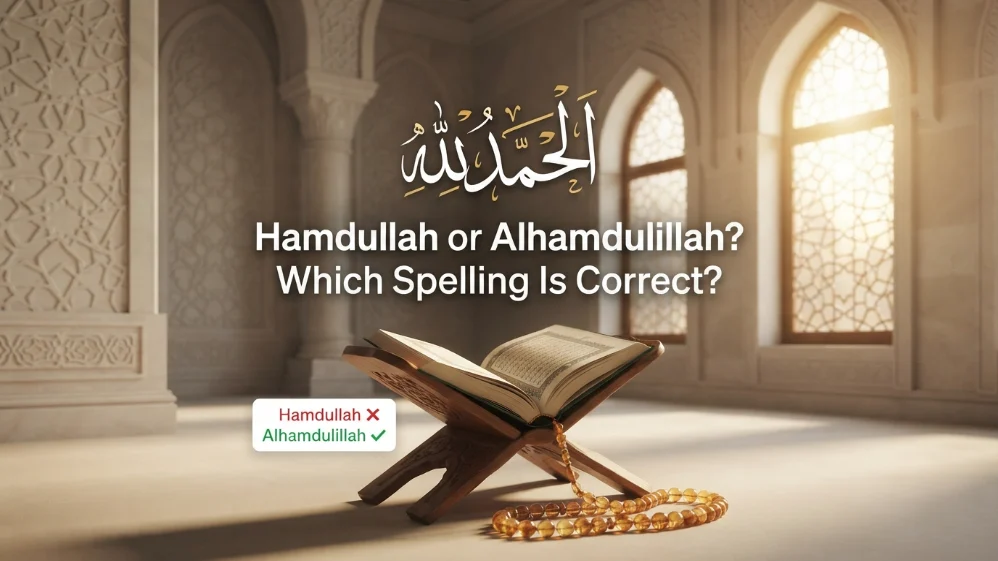
Alhamdulillah is the correct and complete transliteration of the Arabic phrase ٱلْحَمْدُ لِلَّٰهِ, which means “All praise is for Allah” or “Praise be to Allah.” The spelling hamdullah is a shortened or incorrect version often seen in casual typing. For formal writing, religious studies, and accurate communication, alhamdulillah is the recommended spelling.
Examples
- Correct: Alhamdulillah, my family arrived safely.
- Correct: We say Alhamdulillah after receiving good news.
- Less Accurate: Hamdullah, everything went well.
The Origin of Hamdullah or Alhamdulillah
The phrase Alhamdulillah comes from the Arabic language. It is one of the most well-known expressions used by Muslims around the world.
The Arabic text is:
ٱلْحَمْدُ لِلَّٰهِ
It is made of two parts:
| Arabic Part | Meaning |
|---|---|
| Al-Hamdu | The praise |
| Lillah | Belongs to Allah |
Together, the phrase means:
- All praise belongs to Allah.
- Praise be to Allah.
- Thanks be to Allah.
Muslims say Alhamdulillah in many situations, including:
- After receiving good news
- After completing a task
- When expressing gratitude
- During daily conversations
- In prayers and worship
Why Do Different Spellings Exist?
Arabic uses a completely different alphabet from English. Because of this, there is no single official English spelling for many Arabic words.
People write Arabic words based on how they hear them.
Examples include:
- Alhamdulillah
- Alhamdulilah
- Elhamdulillah
- Hamdulillah
- Hamdullah
Most of these spellings represent the same Arabic phrase, but Alhamdulillah is the most complete and widely accepted transliteration.
Why “Hamdullah” Appears Online
The spelling hamdullah usually appears because people:
- Type quickly on phones.
- Leave out the beginning “Al.”
- Spell the phrase based on pronunciation.
- Copy informal social media writing.
- Do not know the original Arabic spelling.
Although many readers understand what hamdullah means, it is not considered the preferred spelling in educational or religious writing.
British English vs American English Spelling
Unlike many English words, Alhamdulillah does not have separate British and American spellings.
The phrase comes directly from Arabic, so English-speaking countries generally use the same transliteration.
Whether you live in:
- United States
- United Kingdom
- Canada
- Australia
- New Zealand
the recommended spelling remains Alhamdulillah.
Comparison Table
| Feature | British English | American English |
|---|---|---|
| Preferred Spelling | Alhamdulillah | Alhamdulillah |
| Meaning | All praise belongs to Allah | All praise belongs to Allah |
| Religious Writing | Alhamdulillah | Alhamdulillah |
| Academic Writing | Alhamdulillah | Alhamdulillah |
| Casual Short Forms | Sometimes seen | Sometimes seen |
| Recommended Usage | Alhamdulillah | Alhamdulillah |
Example Sentences
British English:
- Alhamdulillah, everyone arrived safely.
American English:
- Alhamdulillah, we completed the project successfully.
The spelling stays the same in both versions of English.
Why Is There Confusion Between “Hamdullah” and “Alhamdulillah”?
Many people become confused because they usually hear the phrase before they ever see it written.
Several factors cause this spelling confusion.
1. Pronunciation Differences
In everyday speech, many speakers pronounce the phrase quickly.
Instead of hearing:
Al-ham-du-lil-lah
people may hear:
Hamdullah
As a result, they write what they hear.
2. Different Transliteration Styles
Arabic sounds cannot always be represented perfectly in English.
Because of this, several spellings are found online, including:
- Alhamdulillah
- Alhamdulilah
- Elhamdulillah
- Hamdulillah
- Hamdullah
These spellings refer to the same Arabic phrase, but Alhamdulillah is the most widely accepted form.
3. Typing Mistakes
Many users search quickly on mobile phones.
Small typing errors can change the spelling.
Examples include:
- Hamdulah
- Hamdulla
- Hamdullaah
- Alhamdulillah
- Alhamdulilah
Search engines usually understand these mistakes and show results for Alhamdulillah.
4. Autocorrect
Many phone keyboards do not recognize Arabic religious expressions.
Instead of correcting the spelling, they may:
- Leave the word unchanged.
- Suggest unrelated English words.
- Remove letters accidentally.
This creates even more spelling variations online.
5. Social Media Habits
Social media encourages short and fast writing.
Many users shorten words to save time.
For example:
- Hamdullah ❤️
- Hamdulilah
- Alhamdulillah 🤲
Although shortened forms are common on social media, Alhamdulillah remains the clearest and most accurate spelling for articles, books, educational content, and professional communication.
Which Spelling Should You Use?
If you want your writing to be accurate, respectful, and easy for readers to understand, choose Alhamdulillah.
It reflects the original Arabic phrase more completely and is the spelling most commonly used in Islamic books, translations, educational resources, and formal writing.
For Readers in the United States
Use Alhamdulillah in articles, emails, presentations, and educational content. It is the spelling most readers recognize and trust.
Example:
- Alhamdulillah, the event was a great success.
For Readers in the United Kingdom and Commonwealth Countries
The recommendation is the same. Use Alhamdulillah in both formal and informal writing to keep your message clear and consistent.
Example:
- Alhamdulillah, everyone reached home safely.
For Global Readers
If your audience includes people from different countries, Alhamdulillah is the safest choice because it is widely understood across the Muslim world and in English-language publications.
Formal Writing
Choose Alhamdulillah for:
- Articles
- Books
- Academic papers
- Religious studies
- School assignments
- Official publications
Informal Writing
Friends and family may understand shorter forms like hamdullah or hamdulillah, but using Alhamdulillah is still the better option because it avoids confusion and reflects the original phrase more accurately.
Common Mistakes with Hamdullah or Alhamdulillah
Many spelling mistakes happen because people write the phrase exactly as they hear it. Here are some common errors and the correct forms.
Mistake 1: Leaving Out “Al”
❌ Hamdullah, everything is fine.
✅ Alhamdulillah, everything is fine.
Explanation: The beginning “Al” is part of the original Arabic phrase and should not be omitted in formal writing.
Mistake 2: Missing Letters
❌ Alhamdulilah
✅ Alhamdulillah
Explanation: The standard transliteration includes the double l before Allah, making the spelling more accurate.
Mistake 3: Assuming Hamdullah Is the Official Spelling
❌ Hamdullah is the correct English spelling.
✅ Alhamdulillah is the most widely accepted and recommended spelling.
Explanation: While people may understand the shortened version, it is not the preferred form for educational or formal contexts.
Mistake 4: Mixing Spellings in the Same Document
❌ Alhamdulillah… later Hamdullah… then Hamdulilah.
✅ Use Alhamdulillah consistently throughout your writing.
Explanation: Consistency improves clarity and gives your writing a more professional appearance.
Hamdullah or Alhamdulillah in Everyday Examples
Knowing the correct spelling is helpful, but knowing how to use it is even more important. Below are simple examples from everyday life.
In Emails
Professional or personal emails sometimes include the phrase to express gratitude.
Examples:
- Alhamdulillah, the project was completed on time.
- Alhamdulillah, I have safely received your package.
- Alhamdulillah, everything went well during the meeting.
In News Articles
News stories may quote people using the phrase after a positive event.
Examples:
- After returning home safely, he said, “Alhamdulillah.”
- The family thanked everyone for their support and said, “Alhamdulillah.”
On Social Media
Many people share happy moments with this expression.
Examples:
- Alhamdulillah, I graduated today.
- Alhamdulillah for another beautiful morning.
- Alhamdulillah, our prayers were answered.
Although shortened forms sometimes appear online, Alhamdulillah is the clearest and most widely accepted spelling.
In Formal Writing
Books, educational articles, and religious publications almost always use the complete spelling.
Examples:
- Alhamdulillah is a common Arabic expression of gratitude.
- Muslims often say Alhamdulillah after receiving blessings.
In Everyday Conversations
People use the phrase in many situations.
Examples include:
- Alhamdulillah, I am feeling much better.
- Alhamdulillah, everyone arrived safely.
- Alhamdulillah, the exam went well.
- Alhamdulillah, business is improving.
- Alhamdulillah, the weather is pleasant today.
No matter where it is used, Alhamdulillah remains the preferred spelling.
Google Trends and Usage Behavior
People search for hamdullah or alhamdulillah for different reasons. Most are not asking about the meaning alone. They want to know the correct spelling, pronunciation, and proper way to write the phrase.
Common Search Intent
Users often search because they want to know:
- Which spelling is correct.
- Whether hamdullah is acceptable.
- How to spell the phrase in English.
- What the Arabic expression means.
- How to write it correctly in messages or posts.
Why “Hamdullah” Gets Searches
Many searches for hamdullah happen because:
- People type the word the way they hear it.
- Friends and family use shortened spellings.
- Mobile keyboards do not always suggest the correct transliteration.
- Users are unfamiliar with Arabic spelling conventions.
Regional Usage
The phrase is searched in many parts of the world, especially where English and Arabic are both commonly used or where Muslim communities are active.
Common regions include:
- Middle East
- South Asia
- United Kingdom
- United States
- Canada
- Australia
- Malaysia
- Indonesia
Even though spelling variations exist, educational and religious sources most often use Alhamdulillah.
Comparison Table
| Word | Meaning | Correct Usage | Best Context |
|---|---|---|---|
| Hamdullah | Shortened spelling of the Arabic phrase | Not recommended in formal writing | Casual chats and informal typing |
| Alhamdulillah | All praise belongs to Allah | Correct and widely accepted | Religious, educational, formal, and everyday writing |
Quick Comparison
| Feature | Hamdullah | Alhamdulillah |
|---|---|---|
| Complete Arabic transliteration | No | Yes |
| Common online spelling | Yes | Yes |
| Recommended for articles | No | Yes |
| Used in Islamic books | Rarely | Yes |
| Suitable for formal writing | No | Yes |
| Easy for global readers | Less | Yes |
Frequently Asked Questions
1. What is the correct spelling: hamdullah or alhamdulillah?
Alhamdulillah is the correct and complete spelling in English transliteration. It comes directly from the Arabic phrase meaning “All praise belongs to Allah.” While hamdullah appears online, it is generally treated as a shortened or informal spelling rather than the preferred form.
2. Is hamdullah a real word?
Hamdullah is commonly seen in text messages and social media, but it is not the standard transliteration of the Arabic expression. Most dictionaries, Islamic publications, and educational resources recommend Alhamdulillah instead.
3. Why do people confuse hamdullah and alhamdulillah?
The confusion happens because people often hear the phrase before they see it written. Fast pronunciation, different transliteration styles, typing habits, and mobile keyboards all contribute to the spelling differences.
4. Which spelling should I use in English?
For articles, emails, books, school work, presentations, and formal communication, use Alhamdulillah. It is widely recognized, accurate, and understood by readers around the world.
5. Is hamdullah just a typing mistake?
Sometimes it is simply a typing mistake. In other cases, people intentionally shorten the phrase while chatting online. Even so, Alhamdulillah is the better choice whenever accuracy matters.
6. Does British English spell it differently from American English?
No. Both British English and American English normally use Alhamdulillah. Since the phrase comes from Arabic, there is no separate British or American spelling.
7. What does Alhamdulillah mean?
Alhamdulillah means “All praise belongs to Allah” or “Praise be to Allah.” Muslims say it to express gratitude, thankfulness, relief, or appreciation for blessings in daily life.
8. Can I use Alhamdulillah in everyday conversation?
Yes. It is commonly used in conversations, emails, messages, speeches, and social media posts whenever someone wishes to express gratitude or thankfulness. It is appropriate in both informal and formal settings.
Conclusion
The difference between hamdullah and alhamdulillah is mainly a matter of spelling and accurate transliteration. While many people use hamdullah in casual messages or because they type the phrase as they hear it, Alhamdulillah is the complete and widely accepted form. It reflects the original Arabic phrase and is the best choice for formal writing, educational content, religious discussions, and everyday communication. Using the correct spelling helps readers understand your message clearly and shows respect for the original expression. Whenever you want to express gratitude in English, choose Alhamdulillah with confidence.
Read More Related Articles:
Skiis or Skis| Grammar Rules, Meaning, and Real …
Botox or Dysport| Everything You Need to Know Before …
Quizes or Quizzes | Which Spelling Is Correct in 2026